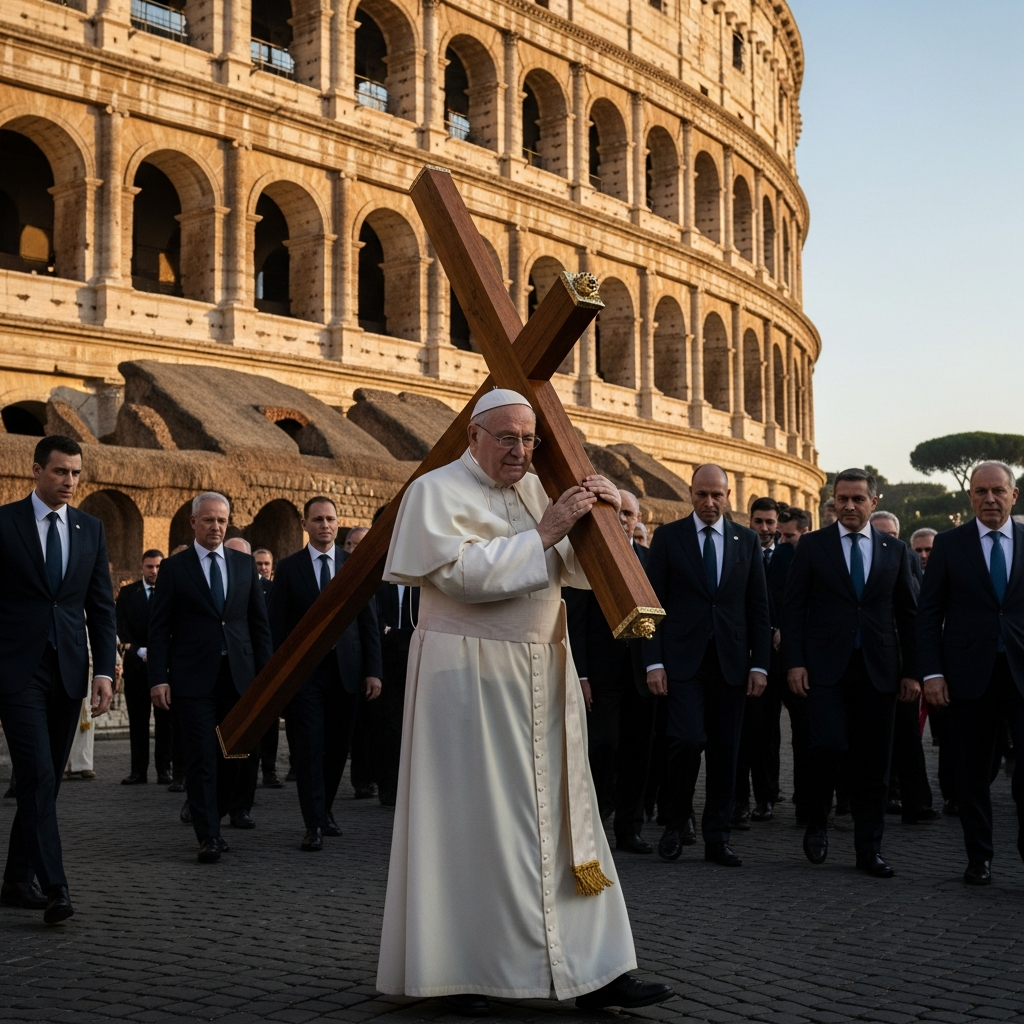
Pope Leo XIV dramatically reshaped a revered Good Friday tradition on April 3, 2026, by personally carrying the wooden cross for the entirety of the Way of the Cross (Via Crucis) procession at Rome’s ancient Colosseum. This profound act marked the first time in decades that a pontiff had undertaken the physically demanding journey through all 14 Stations. His full participation sent a powerful spiritual message, underscoring his vision for a church deeply connected to human suffering and resilience. The historic event drew an immense crowd of faithful, eager to witness this pivotal moment in papal history.
A Historic Display of Faith and Fortitude
In a truly unprecedented move for modern papacies, Pope Leo XIV shouldered a lightweight, 1.5-meter (5-foot) wooden cross, leading the torchlit Good Friday procession. This solemn ritual symbolically retraces Jesus Christ’s final steps to his crucifixion on Calvary. Speaking earlier that week from Castel Gandolfo, the Pope emphasized the profound spiritual significance of his decision. He declared it an “important sign” for the world, asserting that “Christ still suffers” and that he carries this universal suffering in his personal prayers.
A Return to Full Papal Participation
This year’s Via Crucis stood in stark contrast to practices of recent decades. Pope Leo XIV’s commitment to carry the cross for every station signaled a notable departure from his immediate predecessors. The previous pontiffs, due to advancing age and health challenges, had participated in varying, often limited, capacities. Leo XIV’s vigorous participation not only honored a deep-seated tradition but also projected an image of robust leadership. It underscored his dedication to physically embodying the spiritual burden he believes the Church must carry in the modern world.
The Torchlit Path: Retracing Christ’s Journey
The hour-long procession commenced within the historic confines of the Colosseum. Pope Leo XIV, flanked by two torchbearers, led the faithful through each symbolic station. The path wound from inside the majestic Roman amphitheater, through a crowd of some 30,000 attendees, and culminated with a solemn ascent up steep stairs to the Palatine Hill. It was there, amidst the ancient ruins, that the Pope delivered the final blessing, bringing the poignant ceremony to its emotional close. The Colosseum, illuminated by torchlight, provided a uniquely evocative backdrop for this powerful demonstration of faith.
Meditations on Power and Suffering
Central to this year’s Via Crucis were the meditations prepared by Reverend Francesco Patton. As the former Custos of the Holy Land from 2016-2025, Father Patton brought a unique perspective to the spiritual reflections. His writings, unveiled at the first station, which commemorates Jesus’ condemnation to death, offered a stark message on accountability. The meditations underlined that those in positions of authority face divine judgment for how they exercise their immense power. This included “the power to judge; the power to start or end a war; the power to instill violence or peace; the power to fuel the desire for revenge, or for reconciliation.” These words resonated deeply, especially given the ongoing global conflicts and instabilities.
A Pope of Remarkable Vigor
Pope Leo XIV’s ability to complete the entire Way of the Cross procession is a testament to his exceptional physical condition. At 70 years old, he is notably younger and more robust than his immediate predecessors were at the start of their pontificates. Described as an avid tennis player and swimmer, Leo XIV maintained an intensive workout regimen akin to a man in his early 50s before his election. This personal dedication to fitness has clearly enabled a more active, visible engagement in physically demanding papal duties.
Papal Health and the Via Crucis Tradition
The historical context of papal involvement in the Via Crucis highlights Pope Leo XIV’s unique position. Pope John Paul II, elected at a relatively young 58 and known for his outdoorsmanship, carried the cross for the entire procession from 1979 until a hip surgery in 1995. After that, he participated only partially. His successors faced greater health challenges. Pope Benedict XVI, who began his papacy in his late 70s, carried the cross for only the first station during his initial two years. Pope Francis, also in his late 70s when elected and missing part of a lung from a youthful infection, never physically carried the cross. He participated in the procession until his health declined, ultimately passing away on Easter Monday the previous year (2025) after a long illness. Pope Leo XIV’s robust health directly facilitates his full engagement in such a significant ritual.
More Than a Ceremony: A Living Faith
Father Patton’s introduction to the meditations provided further insight into the spiritual purpose of the Way of the Cross. He articulated that this sacred exercise is “not intended for those who lead a pristinely pious or abstractly recollected life.” Instead, it is designed for individuals who understand that “faith, hope and charity must be incarnated in the real world.” This perspective reinforces the idea that the procession is not merely a historical reenactment but a living, breathing expression of belief that connects suffering past with present realities. It encourages the faithful to confront global challenges through a lens of compassion and action.
Looking Ahead: Holy Week Continues
Pope Leo XIV’s Good Friday act set a powerful tone for the remainder of Holy Week. His schedule included presiding over a late-night Easter vigil on Holy Saturday, a profound service where he would baptize new Catholics. This ceremony initiates the most joyous celebration in Christianity: Christ’s resurrection. On Easter Sunday, the pontiff was set to celebrate an open-air Mass in St. Peter’s Square. Following the Mass, he would deliver his anticipated Easter message and impart the traditional “Urbi et Orbi” blessing, addressing both the city of Rome and the world beyond. These events continue to underscore the new Pope’s active and engaged papacy.
Frequently Asked Questions
What is the significance of Pope Leo XIV personally carrying the cross for the entire Via Crucis?
Pope Leo XIV’s decision to carry the cross for all 14 stations of the Way of the Cross on Good Friday, April 3, 2026, is highly significant. It marks the first time in decades that a pontiff has undertaken this physically demanding act for the entire procession. This act symbolizes his deep personal commitment to embodying the suffering of Christ and carrying the spiritual burdens of the world. It also contrasts sharply with his immediate predecessors, whose health prevented full participation, highlighting Pope Leo XIV’s physical vigor and renewed engagement with sacred traditions.
Where did Pope Leo XIV lead the Via Crucis procession in Rome?
Pope Leo XIV led the torchlit Via Crucis procession at the iconic Colosseum in Rome. The hour-long event began inside the ancient amphitheater, progressed through the thousands of faithful gathered outside, and concluded with an ascent up the steep stairs to the Palatine Hill. This historic route is a traditional setting for the Good Friday Stations of the Cross, providing a powerful and atmospheric backdrop for the solemn ritual.
How does Pope Leo XIV’s act compare to previous popes and what does it suggest about his papacy?
Pope Leo XIV’s full participation stands in stark contrast to Pope Benedict XVI and Pope Francis, who, due to age and health, participated in limited ways or not at all in carrying the cross. He more closely mirrors Pope John Paul II’s early papacy, who also carried the cross fully until health issues arose. This suggests Pope Leo XIV intends to lead a highly active and visible papacy, utilizing his physical fitness to engage more directly in traditional papal roles and send strong symbolic messages of faith, endurance, and hands-on spiritual leadership.
In conclusion, Pope Leo XIV’s historic act of carrying the cross for the entire Via Crucis procession at the Colosseum resonates as a powerful symbol of his papacy. His physical strength, coupled with his profound spiritual message, has reignited a deeply personal connection to one of Christianity’s most solemn rituals. This Good Friday demonstration not only honored centuries of tradition but also signaled a reinvigorated approach to papal leadership, emphasizing the tangible embodiment of faith in a world grappling with suffering. As Holy Week continues, the world watches as Pope Leo XIV further defines his legacy, leading with a blend of tradition, personal conviction, and remarkable vitality.