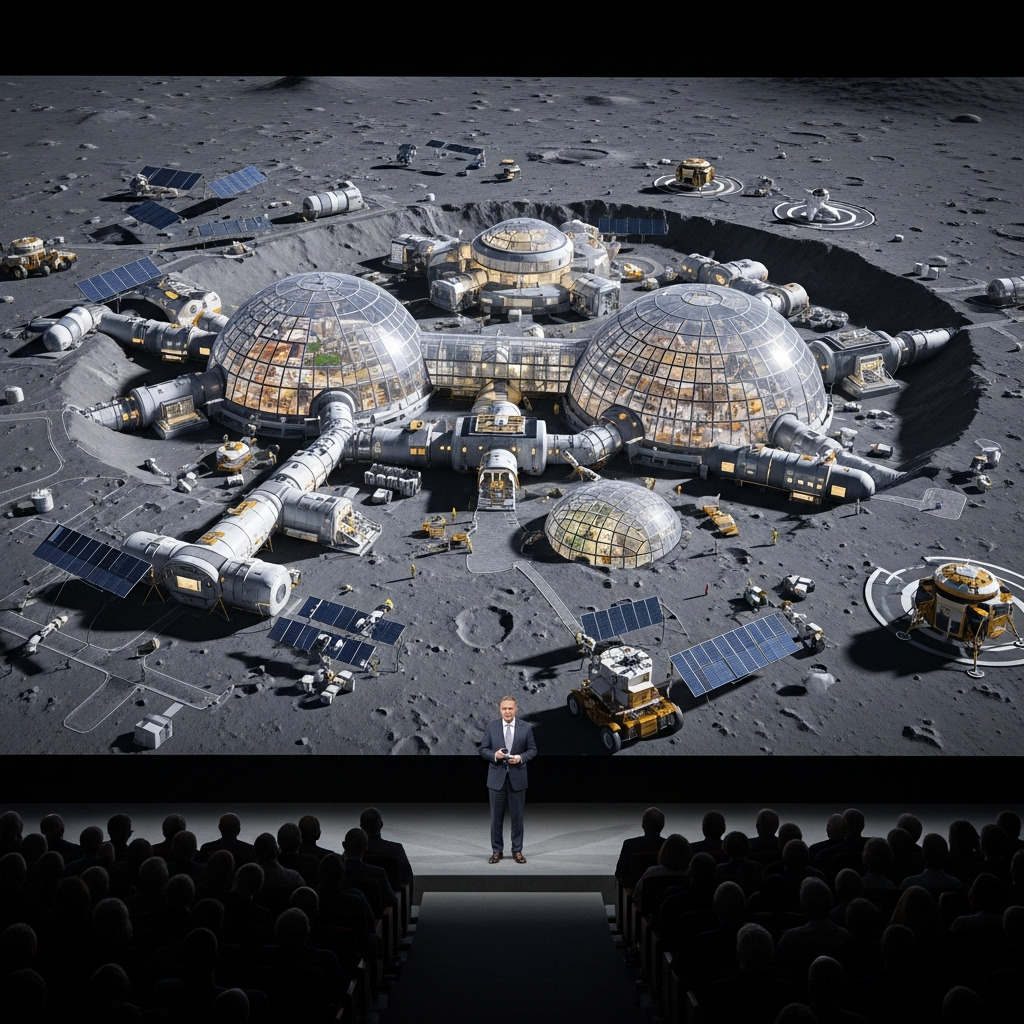
NASA has set its sights firmly on establishing a continuous human presence on the Moon, announcing a groundbreaking $20 billion strategy over seven years to construct a permanent lunar base near the Moon’s south pole. This bold new direction, unveiled at the “Ignition” event on March 24, 2026, marks a pivotal shift for the Artemis program, transforming it from a series of transient lunar visits into a long-term settlement endeavor. Driven by a renewed sense of global competition, NASA Administrator Jared Isaacman emphasized, “This time, the goal is to stay,” underscoring America’s commitment to securing its leadership in the cosmos.
America’s Ultimate Lunar Ambition: A Permanent Foothold
The vision for a permanent NASA moon base represents a dramatic departure from the Apollo era’s “flags and footprints” approach. This comprehensive plan aims for sustained human presence, facilitating extensive scientific research, resource utilization, and the development of technologies crucial for future deep-space missions to Mars. The strategic pivot focuses on creating enduring infrastructure, enabling astronauts to live and work on the lunar surface for extended periods.
Why the Lunar South Pole? A Strategic Choice
The decision to site the lunar base near the Moon’s south pole is highly strategic. This region is believed to contain significant reserves of water ice in permanently shadowed craters, a critical resource that could be harvested for drinking water, breathable air, and even rocket fuel. Such in-situ resource utilization (ISRU) is vital for minimizing dependency on Earth-supplied provisions, making long-duration human presence economically viable and sustainable. This prime location also offers unique scientific opportunities to study lunar geology and the history of the solar system.
A Phased Blueprint for Lunar Settlement
NASA’s plan for building the permanent moon base is structured in three carefully orchestrated phases, transitioning from robotic exploration to full human habitation:
Phase One: Build, Test, Learn. This initial stage focuses on a repeatable, modular approach, leveraging Commercial Lunar Payload Services (CLPS) and the Lunar Terrain Vehicle (LTV) program. It involves sending numerous robotic rovers, scientific instruments, and technology demonstrators to the lunar surface. The primary goal is to test critical capabilities like mobility, reliable power generation (including radioisotope heater units), robust communications networks, precise navigation systems, and various scientific investigations in the harsh lunar environment.
Phase Two: Establish Early Infrastructure. Drawing invaluable lessons from Phase One, NASA will progress towards establishing semi-habitable infrastructure. This phase includes regular logistics deliveries and the development of facilities capable of supporting recurring astronaut operations. Significant international partnerships will play a crucial role here, with contributions like the Japan Aerospace Exploration Agency’s (JAXA) pressurized rover becoming integral.
Phase Three: Enable Long-Duration Human Presence. With cargo-capable Human Landing Systems (HLS) fully operational, this final phase will deliver heavier, permanent infrastructure. This includes larger habitats, advanced power systems (both nuclear and solar), and a variety of crewed and uncrewed rovers for site preparation. International collaborators like the Italian Space Agency (ASI) contributing Multi-purpose Habitats and the Canadian Space Agency (CSA) providing Lunar Utility Vehicles will help establish a continuous human foothold, transforming periodic expeditions into a permanent lunar base.
Artemis Program: Accelerated Cadence & Strategic Shifts
The revamped Artemis program will see an unprecedented acceleration in lunar missions, with a clear focus on speed and efficiency to achieve its ambitious goals within the next seven years.
Goodbye Gateway, Hello Surface!
A major strategic change under this new plan is the decision to “pause” or “cancel” the development of the Gateway space station, which was originally intended to orbit the Moon. Instead, resources and components initially earmarked for Gateway will be directly repurposed for surface operations of the moon base. This shift emphasizes a direct human presence on the lunar surface rather than an orbital waystation. Under the revised plan, Orion crew ships will transfer astronauts directly to lunar landers without an intermediate stop at an orbital outpost. While Gateway’s current form is on hold, NASA is exploring alternative orbital strategies for the future, suggesting an orbital element might be revisited.
A New Mission Timeline for Lunar Exploration
The accelerated timeline for the Artemis program outlines several key missions:
Artemis II: Slated for its first crewed lunar flyby in 50 years, this mission had launch opportunities beginning April 1, 2026. It focuses on testing the environmental control and life support systems within the Orion capsule in high Earth orbit, vital for future human expeditions.
Artemis III: Targeted for launch in 2027, this mission will test the integrated operations of the Orion spacecraft and one or both commercial lunar landers (from companies like SpaceX and Blue Origin) in Earth orbit. It will also be the first to utilize a standardized Space Launch System (SLS) rocket configuration.
Artemis IV: Marking the first crewed landing on the Moon since 1972, this mission is now targeted for no earlier than 2028 and is already undergoing integration at Kennedy Space Center.
- Artemis V: Scheduled for a late 2028 launch, this mission represents a second crewed landing attempt designed to lay foundational infrastructure for the permanent lunar base.
- www.nasa.gov
- www.cbsnews.com
- www.usatoday.com
- abcnews.com
- www.livescience.com
Following Artemis V, NASA intends to undertake crewed surface missions at least every six months, with the potential to increase this frequency as capabilities mature and commercially procured reusable hardware becomes more prevalent.
Embracing Commercial & International Partnerships
NASA is increasingly leaning on the private sector and global allies to achieve its lunar objectives. The agency aims to transition from its government-owned Space Launch System (SLS) to a greater reliance on competitive commercial rockets. Collaborations with companies like SpaceX and Blue Origin are crucial for developing the Human Landing Systems (HLS) that will transport astronauts to the surface, with a safety requirement for uncrewed landings before any crewed missions. International contributions from agencies like JAXA, ASI, and CSA are also integral to the modular construction of the base, demonstrating a united front in space exploration.
Beyond the Moon: Mars, LEO, and Nuclear Power
While the Moon remains the primary focus, NASA’s ambitious plan extends beyond, with strategic investments in technology and infrastructure designed to propel future deep-space exploration.
Paving the Way to Mars: Nuclear Propulsion
A significant leap forward involves bringing nuclear power and propulsion from laboratories to space. NASA will launch Space Reactor-1 Freedom (SR-1 Freedom), the world’s first nuclear-powered interplanetary spacecraft, to Mars before the end of 2028. This groundbreaking mission will demonstrate advanced nuclear electric propulsion, enabling efficient mass transport in deep space and powering missions beyond Jupiter where solar arrays are ineffective. Upon reaching Mars, SR-1 Freedom will deploy the Skyfall payload of Ingenuity-class helicopters to scout future landing zones. This initiative, in partnership with the U.S. Department of Energy, aims to establish flight heritage for nuclear hardware and activate an industrial base for future fission power systems, critical for sustainable off-world settlements.
Securing Low Earth Orbit (LEO) for the Future
NASA is simultaneously reaffirming its commitment to maintaining a robust U.S. human presence in Low Earth Orbit (LEO). Recognizing the International Space Station (ISS)‘s two-decade legacy, the agency is developing a thoughtful transition strategy to commercial space stations to avoid any gap. This includes potentially procuring a government-owned Core Module to attach to the ISS, followed by commercial modules that can later detach into free flight. NASA aims to become one of many customers purchasing services from a thriving commercial LEO economy, with expanded opportunities for private astronaut missions and commander seat sales.
Pushing the Boundaries of Space Science
NASA continues to drive world-changing discovery, building on the successes of missions like the James Webb Space Telescope and the Parker Solar Probe. Future missions highlighted include the Nancy Grace Roman Space Telescope, launching as early as fall 2026 to study dark energy, and Dragonfly, a nuclear-powered octocopter launching in 2028 to explore Titan’s organic-rich environment by 2034. In 2028, NASA will also deliver ESA’s Rosalind Franklin Rover to Mars, equipped with NASA’s MOMA instrument for advanced organic matter detection. An increased CLPS cadence will accelerate lunar science, targeting up to 30 robotic landings starting in 2027, opening new opportunities for scientific payloads.
Fueling the Future: Workforce & Innovation
Underpinning these ambitious plans is a renewed focus on NASA’s human capital. The agency is rebuilding core competencies, converting thousands of contractor positions to civil service roles, and expanding opportunities for interns and early-career professionals. Creating pathways for experienced industry talent and embedding subject-matter experts across the supply chain are crucial reforms designed to strengthen NASA’s ability to execute its national space policy and ensure continued American superiority in space.
The Geopolitical Imperative: A New Space Race
A primary driver behind the urgency and scale of this plan is the escalating “space race,” particularly with China’s lunar ambitions. Administrator Isaacman explicitly linked the program’s accelerated timeline to this geopolitical competition, stating that “success or failure will be measured in months, not years.” China aims to land its own astronauts on the Moon before 2030, eyeing similar resource-rich sites at the lunar south pole. This competitive landscape fuels NASA’s commitment to returning to the Moon and establishing an enduring presence, ensuring America will “never again give up the moon.” Isaacman emphasized that “uncomfortable action” would be taken to prevent schedule slips or budget overruns, reflecting the public’s significant investment and high expectations.
Frequently Asked Questions
What is NASA’s new moon base plan and its primary goal?
NASA’s new plan, announced in March 2026, is an ambitious $20 billion initiative over seven years to build a permanent human settlement near the Moon’s south pole. The primary goal is to establish a sustained human presence on the lunar surface, moving beyond short-term visits to facilitate extensive scientific research, resource utilization, and develop technologies for future deep-space exploration to Mars. Administrator Jared Isaacman stressed, “This time, the goal is to stay.”
How will NASA build the permanent moon base, and what are the key phases?
NASA plans to build the moon base through a three-phased approach. Phase One, “Build, Test, Learn,” focuses on robotic missions using Commercial Lunar Payload Services (CLPS) to test mobility, power, communications, and scientific instruments. Phase Two, “Establish Early Infrastructure,” involves developing semi-habitable facilities and logistics for recurring astronaut operations with international partners. Phase Three, “Enable Long-Duration Human Presence,” will deliver heavier, permanent infrastructure like larger habitats and advanced power systems, transitioning to a continuous human presence.
What are the major strategic shifts in NASA’s approach to lunar exploration?
A significant shift is the decision to “pause” or “cancel” the Gateway lunar orbital station, repurposing its resources directly for surface operations of the moon base. This emphasizes direct human presence over an orbital outpost. Other shifts include a dramatic acceleration of mission cadence (up to 30 robotic landings by 2027, crewed missions every six months post-Artemis V), a greater reliance on commercial partners like SpaceX and Blue Origin for lunar landers, and a strong focus on developing nuclear power and propulsion for future deep-space missions, including Mars.
A New Era of Lunar Exploration
NASA’s commitment to a permanent lunar base marks an audacious new chapter in space exploration. This comprehensive strategy, fueled by innovation, international collaboration, and a competitive spirit, envisions the Moon not as a distant destination but as a strategic outpost for humanity’s expansion into the solar system. With billions invested and an accelerated timeline, the coming years promise transformative advancements, laying the groundwork for a future where humanity lives and works sustainably beyond Earth. This isn’t just about returning to the Moon; it’s about staying and learning to thrive in the cosmos.