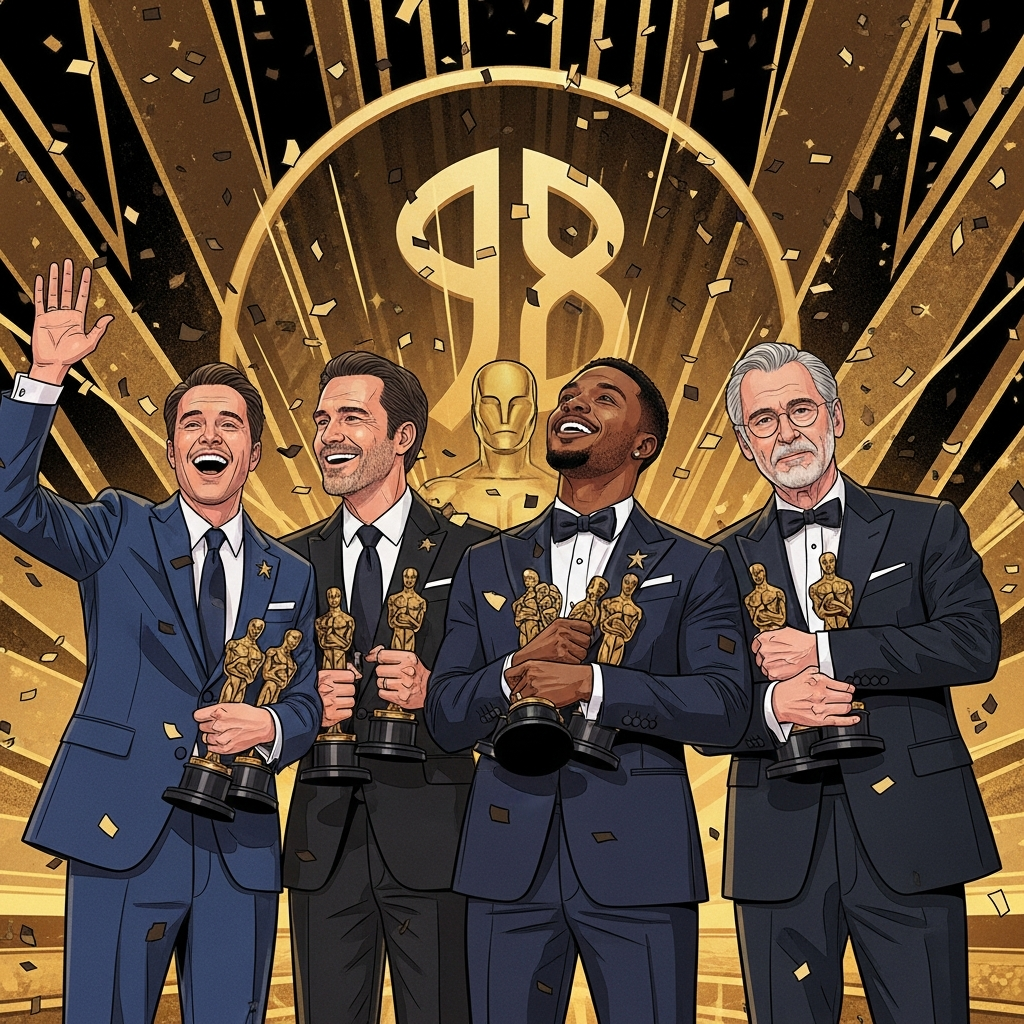
Warner Bros. made history at the 98th Annual Academy Awards, tying a long-standing record for the most Oscar wins by a studio in a single night. Securing an astounding 11 Academy Awards, the studio’s monumental success on March 15, 2026, was largely fueled by the dual powerhouses of Ryan Coogler’s Sinners and Paul Thomas Anderson’s One Battle After Another. This unprecedented achievement arrives at a pivotal moment, as the studio navigates a proposed $111 billion acquisition by Paramount, positioning its future firmly in the industry spotlight.
A Historic Night Unfolds for Warner Bros.
The Dolby Theatre in Hollywood buzzed with anticipation as the 98th Academy Awards ceremony crowned a new titan. Warner Bros.’ impressive haul of 11 golden statues placed it alongside an elite group of cinematic giants, including MGM’s Ben-Hur (1959), Paramount’s Titanic (1997), and New Line’s The Lord of the Rings: The Return of the King (2003) – all films that previously achieved this remarkable feat. This collective victory stands as a significant triumph for Pam Abdy and Michael De Luca, co-chairs and co-CEOs of Warner Bros. Motion Picture Group, whose names echoed frequently from the stage throughout the night.
The Epic Showdown: Sinners vs. One Battle After Another
Heading into the ceremony, the narrative was dominated by an intriguing internal studio rivalry. Ryan Coogler’s horror thriller Sinners, starring Michael B. Jordan, shattered nomination records with an incredible 16 nods. Hot on its heels was Paul Thomas Anderson’s sprawling ensemble piece, One Battle After Another, featuring Leonardo DiCaprio, which garnered 13 nominations. The stage was set for an all-Warner Bros. showdown, with both critically acclaimed films poised to make cinematic history.
Ultimately, both films delivered. One Battle After Another led the studio’s charge with six wins, including the coveted Best Picture, Best Director for Paul Thomas Anderson, and Best Adapted Screenplay (also for Anderson). Sean Penn secured Best Supporting Actor for his role, while Cassandra Kulukundis made history with the inaugural Best Casting award. Andy Jurgensen also took home the trophy for Best Film Editing.
Ryan Coogler’s Sinners illuminated the night with four major awards. Coogler himself won Best Original Screenplay, and Michael B. Jordan clinched the Best Actor award. The film’s captivating soundscape earned Ludwig Goransson Best Original Score, and Autumn Durald Arkapaw broke new ground as the first woman to win Best Cinematography for her stunning work on the film. Further bolstering Warner Bros.’ tally, Amy Madigan was honored with Best Supporting Actress for her powerful performance in Zach Cregger’s horror entry, Weapons.
Beyond the Trophies: Cultural Impact and Industry Trends
The 98th Academy Awards were more than just a celebration of cinematic excellence; they were a reflection of the industry’s evolving landscape and broader cultural conversations. The fierce online discourse surrounding Sinners and One Battle After Another highlighted deep-seated discussions about race, representation, and the industry’s response to diverse storytelling.
Unpacking the Sinners and One Battle After Another Debate
The NPR podcast “It’s Been a Minute” captured the intensity of the “Sinners” vs. “One Battle After Another” debate, drawing parallels to past rivalries like “Moonlight” vs. “La La Land.” Ryan Coogler’s Sinners, a unique horror thriller exploring themes of “whiteness consuming us all” through vampires and sensuality, resonated deeply. Its dedicated fanbase championed the film, feeling it faced an “uphill battle for legitimacy” due to early negative coverage and perceived slights, fueling a fervent defense of Black art.
Conversely, Paul Thomas Anderson’s One Battle After Another delved into revolutionary activism, parenthood, and self-preservation. While critically praised, it faced accusations of “white liberal guilt” driving its nominations. Much of the critique focused on the controversial prologue featuring Teyana Taylor’s character, Perfidia Beverly Hills, a complex Black woman suffering from postpartum depression and navigating highly sexualized and racialized situations. However, many defended the film, arguing that this initial segment overshadowed the movie’s deeper exploration of imperfect yet impactful revolutionaries and a “valiant effort” to protect the legacy of a complicated Black woman. Both films, despite their distinct genres, were lauded for capturing the current cultural moment, offering a “roadmap to rebellion” and a “semblance of hope” against white supremacy and authoritarianism.
A Changing Industry Landscape
This year’s Oscars ceremony, hosted by the sharp-witted Conan O’Brien for the second consecutive year, unfolded amidst significant global events. The ongoing war in Iran, launched just weeks prior, cast a somber shadow, prompting some attendees to wear “Artists for cease fire” pins. The situation for Iranian filmmaker Jafar Panahi, whose nominated film It Was Just an Accident addressed contemporary political issues, underscored the powerful intersection of art and geopolitics.
In terms of industry trends, the 98th Academy Awards reinforced the Academy’s preference for theatrical releases in the Best Picture category. Despite Netflix’s KPop Demon Hunters being the most-watched movie of 2025, the top prize went to a big-budget original film that debuted in cinemas. This year also saw the introduction of a new “Best Casting” category, won by Cassandra Kulukundis for One Battle After Another, and new rules requiring Academy members to attest to watching all nominated films on the Academy’s streaming platform before voting.
Other Studio Recognitions
While Warner Bros. dominated the headlines, other studios also celebrated victories. Netflix secured six Oscars, with Guillermo del Toro’s Frankenstein earning three for Best Makeup and Hairstyling, Costume Design, and Production Design. Netflix also notched wins for Best Animated Feature and Best Original Song (Golden from KPop Demon Hunters), alongside Best Documentary Short for All the Empty Rooms. Disney, Apple, Focus Features, and Neon each garnered one Oscar during the star-studded evening.
Individual Triumphs and Groundbreaking Achievements
Beyond the studio record, the 98th Academy Awards celebrated several deeply personal and groundbreaking victories. Paul Thomas Anderson finally claimed his first Oscar for Best Adapted Screenplay, a long-awaited recognition after 14 nominations throughout his illustrious career, which began with Boogie Nights. His emotional acceptance speech acknowledged his profound debt to novelist Thomas Pynchon and included a poignant apology to his children for “the housekeeping mess that we left in this world we’re handing off to them,” expressing hope for their generation to bring “common sense and decency.”
Ryan Coogler also celebrated his first Oscar win for Best Original Screenplay for Sinners, a significant milestone for the acclaimed director. Michael B. Jordan’s Best Actor win for Sinners marked his inaugural Oscar, cementing his place among Hollywood’s elite. Cassandra Kulukundis’s historic win for the very first Best Casting Oscar and Autumn Durald Arkapaw’s pioneering achievement as the first woman to win for Cinematography for Sinners underscored a night of breaking barriers and celebrating diverse talent. The ceremony truly honored both seasoned veterans finally receiving their due and groundbreaking accomplishments by new voices in cinema.
Frequently Asked Questions
What was the significance of Warner Bros.’ record-tying Oscar win at the 98th Academy Awards?
Warner Bros.’ achievement of 11 Oscar wins at the 98th Academy Awards was highly significant as it tied a long-standing record for the most Academy Awards won by a single studio in one night. This feat not only solidified its artistic dominance in 2026 but also provided a major boost during a crucial period, as the studio faced an impending $111 billion acquisition by Paramount. It demonstrated the enduring power of its films and leadership at a pivotal corporate moment, affirming its legacy in cinematic history.
Which films were most pivotal in Warner Bros. achieving its record 11 Oscar wins?
The historic 11 Oscar wins for Warner Bros. were predominantly driven by the outstanding performances of two films: Paul Thomas Anderson’s One Battle After Another and Ryan Coogler’s Sinners. One Battle After Another secured six awards, including Best Picture and Best Director, while Sinners garnered four, including Best Actor for Michael B. Jordan and Best Original Screenplay. An additional win came from Amy Madigan in Weapons, rounding out the studio’s record-tying total.
How might this historic Oscar success impact Warner Bros. amid its proposed acquisition by Paramount?
This historic Oscar success provides significant leverage and positive momentum for Warner Bros. Motion Picture Group amidst its proposed acquisition by Paramount. The accolades, particularly Best Picture and numerous acting/directing awards, reinforce the studio’s brand value, creative strength, and ability to produce award-winning content. This high-profile achievement can strengthen its position in negotiations, potentially influencing valuations, retaining key talent, and assuring stakeholders of the acquired entity’s continued prestige and cultural relevance in a consolidating industry.
Conclusion
The 98th Annual Academy Awards marked an unforgettable night for Warner Bros., etching its name into Oscar history with a record-tying 11 wins. Driven by the critical and commercial success of Sinners and One Battle After Another, the studio not only celebrated unprecedented artistic triumphs but also navigated a complex industry landscape. From Paul Thomas Anderson’s long-awaited personal victory to groundbreaking firsts for women in cinematography and the new casting category, the ceremony highlighted a diverse array of talent and stories. As Warner Bros. moves forward amidst its strategic acquisition, this historic achievement firmly cements its position as a powerhouse of cinematic excellence, promising an exciting future for the evolving world of film.
References
- www.hollywoodreporter.com
- www.pbs.org
- <a href="https://www.imdb.com/fr/news/ni65752395/?ref=nwcart_perm”>www.imdb.com
- www.npr.org
- www.hollywoodreporter.com