Gazing at the night sky offers a profound connection to the cosmos, and few events captivate like a dazzling planetary alignment or a close conjunction. These celestial ballets, where planets appear to draw near each other, are spectacular sights for both seasoned astronomers and casual stargazers. While a simple pairing of Venus and Saturn is a highlight, rare multi-planet “parades” can create a truly unforgettable experience.
This guide reveals how to prepare for and observe upcoming celestial spectacles, including a notable Venus-Saturn conjunction and a rarer six-planet alignment in early 2026. Get ready to step outside and unlock the universe’s wonders with practical tips, essential viewing details, and crucial safety advice.
Understanding Celestial Alignments: Conjunctions and Parades
Before you search the skies, it helps to understand what you’re looking at. The terms “conjunction” and “planetary parade” describe how planets appear from our vantage point on Earth.
Visual Alignment, Not Physical Proximity
A common misconception is that planets physically move closer together during these events. In reality, a planetary conjunction occurs when two celestial bodies share the same apparent right ascension or ecliptic longitude in the sky. For instance, Venus and Saturn, despite appearing side-by-side, remain separated by immense distances—nearly a billion miles in their March 2026 pairing. This is an optical illusion created by their orbital paths aligning from Earth’s perspective. As astrophysicist Dr. Becky Smethurst explains, it’s like a “straight line on a curved sky.”
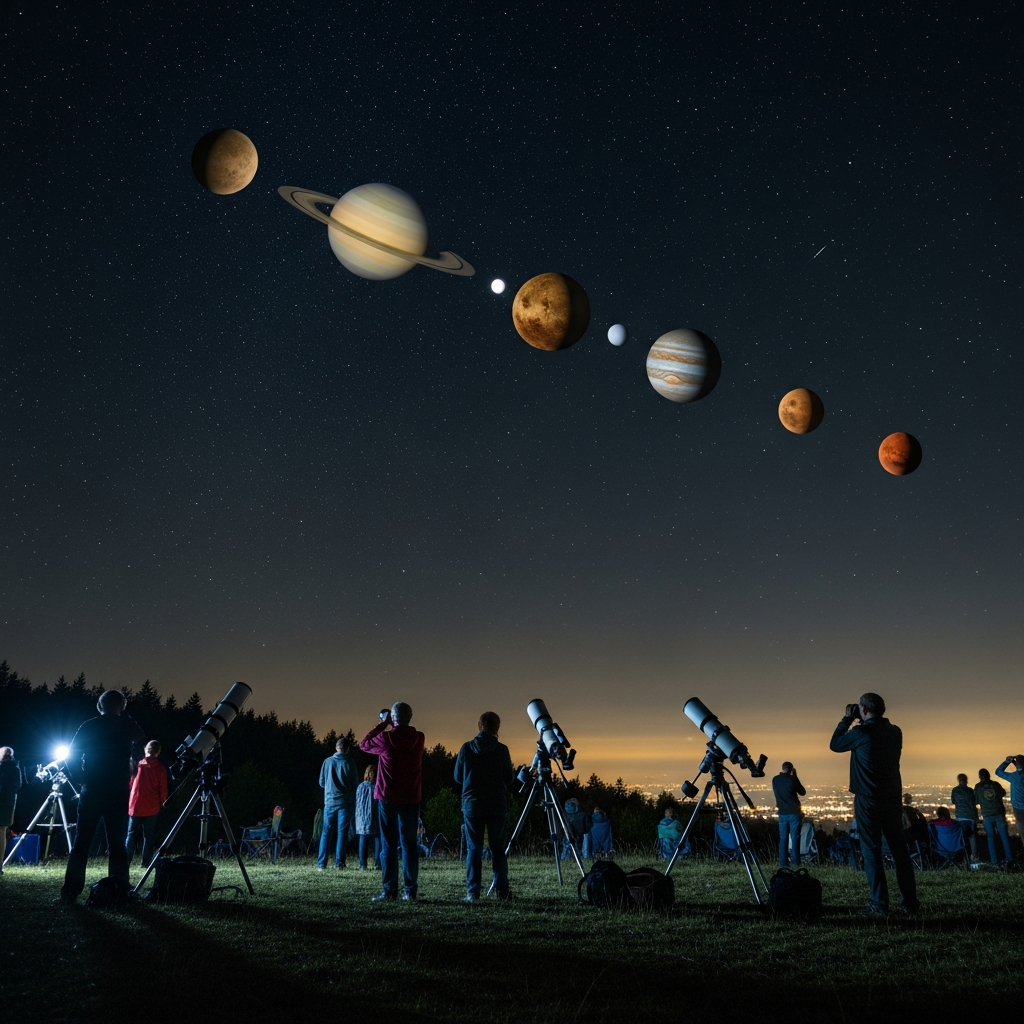
Similarly, a planetary parade or alignment happens when multiple planets are simultaneously visible in the night sky. NASA clarifies that planets orbit the Sun in a relatively similar flat plane, a consequence of our solar system’s formation from a spinning gas cloud, much like “pizza dough flattening out.” When several of these planetary orbits align from Earth’s viewpoint, they appear “bunched together” or “roughly formed a line.” While parades involving a few planets happen annually, seeing a rare alignment of six or more is a significantly less common event, making them especially thrilling.
Your 2026 Stargazing Calendar: Upcoming Celestial Spectacles
The years 2025 and 2026 promise several exciting opportunities to witness planets in close visual proximity. Focus your attention on early 2026 for some truly remarkable events.
The Dazzling Venus-Saturn Conjunction
Mark your calendars for March 7 and March 8, 2026. This particular Venus-Saturn pairing is considered one of the most notable naked-eye planetary alignments of the year. Observers should head outdoors approximately 45 minutes after sunset to catch the spectacle.
Look low in the western twilight sky with an unobstructed view. Venus will be noticeably brighter, dominating the pairing, while Saturn will appear dimmer and more subtle, positioned within about one degree of Venus (roughly the width of a finger at arm’s length). On the evening of Saturday, March 7, Saturn will be slightly above Venus. By Sunday, March 8, their positions will subtly reverse, with Venus appearing just above Saturn. This conjunction represents a “symbolic handover,” as Venus establishes itself as the prominent “Evening Star” for spring, while Saturn approaches its own solar conjunction before reappearing in the morning sky.
The Rare Six-Planet Parade
Just preceding the Venus-Saturn conjunction, late February and early March 2026 will host a truly special event: a six-planet alignment. Mercury, Venus, Jupiter, Saturn, Uranus, and Neptune are all expected to be visible above the horizon simultaneously. The optimal time to observe this extensive alignment is projected to be around Saturday, February 28, 2026, though peak viewing dates may vary slightly by location.
For viewers in the UK, Sunday, March 1, is highlighted as a prime night. From locations like New York, Athens, and Tokyo, February 28 is the projected peak. Jess Lee, an astronomer at the Royal Observatory Greenwich, notes that such an alignment is “particularly exciting as it gives you the opportunity to see various worlds during one evening.”
Visibility Challenges for the Six-Planet Parade
While six planets will be in the sky, seeing all of them presents a significant challenge:
Naked Eye: Mercury, Venus, Saturn, and Jupiter should be discernible without optical aid.
Binoculars/Telescope Needed: Uranus and Neptune will require binoculars or a small telescope. Mercury, too, can be challenging without assistance, appearing quite dim despite its proximity to the brighter Venus.
Positioning: Mercury, Venus, Saturn, and Neptune will appear clustered low in the western sky immediately after sunset, demanding an unobstructed western horizon and a narrow viewing window of 30-60 minutes.
Jupiter: This gas giant will be the easiest to spot, shining exceptionally bright and positioned higher in the southern sky near the stars Castor and Pollux in the constellation Gemini. It will be visible for much of the night.
Uranus: Found higher in the constellation Taurus, beneath the Pleiades star cluster, Uranus will appear as a faint point of light even with binoculars.
Neptune: This distant ice giant will be the most difficult to observe, likely impossible without a telescope and extreme caution due to its very low position near the western horizon.
Other Notable Moon-Planet Encounters in March 2026
Beyond these major events, March 2026 offers additional opportunities for skywatchers to observe the Moon in close proximity to various planets:
March 17: A thin crescent Moon near Mercury and Mars in Aquarius, though these will be difficult due to solar proximity.
March 19: Moon near Neptune and Saturn in Pisces, again challenging due to the Sun.
March 20: The Moon near Venus in Pisces during evening twilight. Venus will be exceptionally bright and easy to spot near the western horizon.
March 23: The crescent Moon near Uranus in Taurus, with a rare lunar occultation of the Pleiades visible in specific northern regions.
- March 26: The Moon near Jupiter in Gemini, both highly visible in the southwestern sky.
- www.aol.com
- m.economictimes.com
- www.bbc.com
- starwalk.space
- www.skyatnightmagazine.com
Essential Stargazing Tips for Unforgettable Viewing
Successful stargazing, especially for subtle events like distant planets, requires careful planning and a few simple techniques.
Choose Your Location Wisely
Seek out an area with minimal light pollution and a clear, unobstructed view of the horizon. City lights wash out fainter celestial objects, making rural or semi-rural locations ideal. An open field, a hilltop, or even a large backyard can work if surrounding buildings or trees don’t block your view, particularly of the crucial western horizon for the early evening alignments.
Check the Weather and Time
A clear sky is absolutely crucial for visibility. Check your local weather forecast beforehand for cloud cover. The optimal viewing window for the low-lying planets is narrow—often just 30 to 60 minutes after sunset. Be prepared to head out at the precise time. For North American observers, remember that daylight-saving time begins on March 8, 2026, meaning sunsets will occur an hour later.
Allow Your Eyes to Adapt to Darkness
Our eyes take time to adjust to faint starlight. Spend 5-10 minutes indoors in a dark room before going outside, or simply remain outside in the dark for about 15-20 minutes without looking at bright screens. If using a phone app to locate planets, activate its red light feature, as red light has less impact on night vision than bright white light.
What You’ll Need: Naked Eye, Binoculars, or Telescope?
Many events, like the Venus-Saturn conjunction and the brighter planets in the parade (Jupiter, Venus), are easily visible to the naked eye. However, binoculars (a 10×50 pair is often recommended) can significantly enhance your view, making fainter objects like Uranus discernible and providing a clearer image of bright planets against the twilight glow. For distant Neptune, a telescope is generally required.
Distinguishing Planets from Stars
Planets like Jupiter and Venus are often significantly brighter than most stars. Unlike stars, planets tend to shine with a steady light rather than twinkling, and they often exhibit distinct colors: Venus (pale yellow), Mars (pale pink/red), Jupiter (orange), and Saturn (gold).
Stay Comfortable
Stargazing often involves standing or sitting still in cooler evening temperatures. Dress warmly, even on mild nights, and consider a picnic blanket or lounge chair to avoid neck strain and enhance comfort.
Crucial Safety First: Protect Your Eyes!
This is paramount. Many of the visible planets, especially Mercury, Venus, and Saturn, will appear close to where the Sun has just set. NEVER, under any circumstances, look directly at the Sun, especially with binoculars or a telescope. Accidental solar exposure can cause severe and permanent eye damage. Always wait until the Sun has completely vanished below the horizon before beginning any sky scanning, particularly if using optical aids.
Maximizing Your Experience with Technology
Modern technology can be an invaluable companion for stargazers. Stargazing applications like “Sky Tonight” or “Star Walk 2” offer real-time identification of celestial objects, provide detailed information, and help determine optimal viewing times tailored to your precise location. Use their search and time-scrolling functions to pinpoint when objects are best positioned.
If you’re interested in astrophotography, these apps can help plan your shots. Check their weather features for clear skies, determine the apparent distance and altitude of objects for lens selection, and use AR mode to visualize compositions. Always use a tripod for stability to achieve sharp images.
Frequently Asked Questions
What’s the difference between a planetary conjunction and a planetary parade?
A planetary conjunction describes when two celestial bodies, like Venus and Saturn, appear very close together in the sky from Earth’s perspective. It’s a visual alignment, not a physical one. A planetary parade, or alignment, is a broader term for when multiple planets are simultaneously visible in the night sky, often appearing “bunched together” along the ecliptic plane. While conjunctions are frequent, multi-planet parades involving six or more planets are much rarer.
When are the best opportunities to view major planetary events in the near future?
The next significant opportunities are in early 2026. A notable Venus-Saturn conjunction will occur on March 7-8, 2026, visible low in the western sky after sunset. Just before this, a rarer six-planet alignment (Mercury, Venus, Jupiter, Saturn, Uranus, Neptune) is anticipated around February 28, 2026, with viewing challenges depending on the planet. Several Moon-planet conjunctions will also dot the March 2026 calendar.
What essential equipment and safety precautions should I consider for stargazing?
For viewing events like the Venus-Saturn conjunction or brighter planets in a parade, your naked eye is sufficient. However, binoculars (e.g., 10×50) greatly enhance the experience, especially for fainter planets like Uranus or Mercury. A telescope is generally required for Neptune. Crucially, never look directly at the Sun, especially with optical aid, and always wait until it has completely set before starting your observations, as some planets appear near the western horizon. Additionally, find a location with minimal light pollution and allow your eyes 15-20 minutes to adjust to the darkness.
Conclusion: Look Up and Be Amazed
The upcoming Venus-Saturn conjunction and the magnificent six-planet parade in early 2026 offer spectacular reasons to cast your gaze skyward. These accessible celestial events are powerful reminders of the dynamic beauty within our solar system. By following these practical tips and prioritizing safety, you’re well-equipped to witness these rare cosmic dance-offs. So, prepare your viewing spot, dress warmly, and step outside to experience the enduring wonder of our universe. The stars (and planets) are waiting.