The sun has dramatically awakened, unleashing a relentless barrage of solar flares from a colossal sunspot now aimed directly at Earth. Over a single 24-hour period, a newly intensified region designated Sunspot 4366 fired off an astonishing 27 flares, including four powerful X-class outbursts. This includes the most intense solar eruption recorded in years, an X8.1-class flare, triggering immediate radio blackouts and raising the prospect of spectacular auroras visible at unusually low latitudes later this week.
Space weather experts from NASA and the National Oceanic and Atmospheric Administration (NOAA) are closely monitoring this unprecedented activity. The rapid growth and instability of Sunspot 4366 signify a powerful phase in the sun’s 11-year cycle, known as solar maximum, promising continued dynamic space weather events. Understanding these solar flares and their potential effects on our planet is crucial as our reliance on technology grows.
The Sun Awakens: Sunspot 4366’s Unprecedented Barrage
Our sun, usually a picture of serene stability to the naked eye, is currently undergoing a period of intense turbulence. At the heart of this activity is Sunspot Region 4366, a magnetic behemoth that has rapidly emerged and expanded across the solar disk. This “monster” sunspot quickly grew to roughly half the size of the infamous Carrington Event sunspot, which triggered the most destructive geomagnetic storm in recorded history back in September 1859. Its swift, massive growth has left Sunspot 4366 highly unstable, making it a veritable “solar flare factory.”
A “Monster” Emerges: Rapid Growth and Instability
Between Sunday and Monday, February 1st and 2nd, 2026, Sunspot 4366 erupted with an extraordinary display of power. It launched over 20 solar flares in just 24 hours. This included a flurry of at least 23 M-class flares and four X-class flares—the most powerful category of solar eruption. This level of sustained activity is a clear indicator of the sunspot’s extreme magnetic complexity and volatility. NASA’s Solar Dynamics Observatory (SDO) has been capturing breathtaking images of these outbursts, providing scientists with critical data.
The Flare Frenzy: X-Class Eruptions Rock the Solar Surface
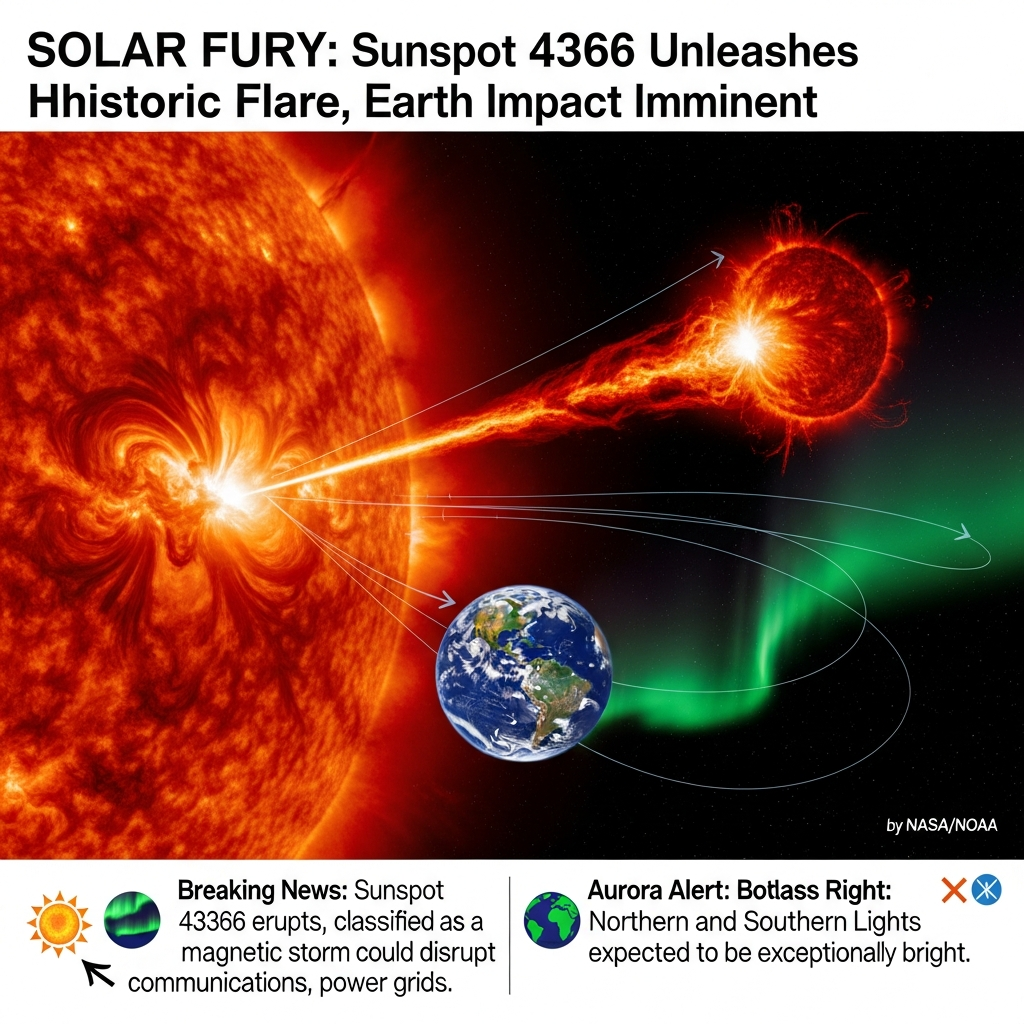
The peak of this dramatic activity occurred on Sunday, February 1st, around 6:57 p.m. EST. At this moment, Sunspot 4366 unleashed an X8.1-class solar flare. This particular eruption stands out as the strongest observed since an X9.0 outburst in October 2024. The other significant X-class flares recorded during this period were classified as X1.0, X2.8, and X1.6, showcasing the sunspot’s consistent output of high-energy events. The sheer intensity of these X-class flares means they have the potential to significantly impact Earth and our space-based infrastructure. This X8.1 flare alone has already surpassed the strongest flare of 2025, an X5.1 eruption recorded in November of that year, setting a new benchmark for 2026.
Earth on Alert: Predicting Impacts from Solar Flares
The immediate effects of these powerful solar flares were felt across the globe. When an X-class flare erupts, it sends out a surge of extreme ultraviolet and X-ray radiation. This radiation travels at the speed of light, reaching Earth in just about eight minutes. Upon impact, it ionizes our planet’s upper atmosphere, causing significant disruptions.
Radio Silence: Immediate Effects on Communication
The direct consequence of the recent X-class flares was the triggering of strong R3 radio blackouts. These blackouts affected parts of the South Pacific, with shortwave radio disruptions specifically reported in eastern Australia and New Zealand. Such events highlight how rapidly solar activity can interfere with our technologically dependent world. Pilots and maritime communicators often rely on these frequencies, making accurate space weather forecasting critical for safety.
The CME Threat: A Glancing Blow and Aurora Potential
Beyond the immediate radiation, many of these flares, including the X8.1, launched slower-moving blasts of plasma called Coronal Mass Ejections (CMEs). A CME from Sunspot 4366 is currently hurtling through space towards Earth. NOAA’s Space Weather Prediction Center (SWPC) anticipates this CME will deliver a “glancing blow” to Earth around Thursday, February 5th. If this impact occurs, charged solar particles will race toward Earth’s magnetic poles. This interaction could result in bright, vibrant auroras, or northern lights, visible at much lower latitudes than usual. Forecasters suggest that areas as far south as northern Michigan and Maine might witness these stunning celestial displays, provided the CME’s magnetic field aligns favorably with Earth’s.
Beyond Auroras: Broader Risks of Space Weather
While the prospect of widespread auroras is exciting, intense solar radiation storms and powerful CMEs pose more serious risks. Such events can cause widespread radio blackouts, disrupt GPS signals, and potentially damage orbiting satellites and spacecraft. A direct, powerful hit could even affect electrical power grids, leading to outages lasting days or even weeks in vulnerable regions. This underlines the importance of global monitoring efforts and preparedness strategies. Scientists also continuously observe various solar phenomena, like the unusually large solar tornado and eruptive prominence captured in August, which can contribute to the complex space weather environment, although not directly impacting Earth in that instance.
Navigating the Solar Maximum: Historical Context and Future Outlook
The current surge in sunspot activity and solar flares is not unexpected. It is a defining characteristic of the sun’s natural 11-year cycle, which is currently experiencing its solar maximum. During this period, the sun’s magnetic field weakens and eventually flips, leading to a significant increase in the frequency and intensity of solar flares and CMEs.
A Glimpse into History: The Carrington Event Parallels
The rapid growth of Sunspot 4366 to half the size of the 1859 Carrington Event sunspot serves as a powerful reminder of history’s most severe recorded geomagnetic storm. That event caused telegraph systems to spark and fail, and auroras were seen globally, even near the equator. A similar event today could have far more severe implications for our modern infrastructure, impacting everything from satellite electronics and GPS signals to electrical power grids. Research has highlighted that a Carrington-level storm could cause blackouts lasting weeks, particularly in vulnerable areas like the U.S. Midwest and East. This historical context underscores the significance of the ongoing activity from Sunspot 4366.
Solar Cycle 25: Why This Activity is Expected
NASA confirmed in 2024 that the solar maximum for Solar Cycle 25 was well underway. This means elevated space weather, including strong flares and CMEs, is expected to remain high through at least 2026. While the sun may eventually pass the absolute peak of its current cycle, significant solar events remain frequent occurrences as the magnetic energy continues to discharge. For example, a strong X1.2 flare was observed in June 2025, further illustrating the sun’s consistent energetic output during this cycle.
Advanced Warning Systems: Humanity’s Shield Against Solar Storms
Fortunately, humanity is significantly better prepared for solar storms today than in the 19th century. A network of satellites, including NASA and NOAA’s Deep Space Climate Observatory, provides crucial early warnings for incoming solar storms. This advanced notice gives power grid operators, satellite controllers, and astronauts vital time to brace for potential impacts. NOAA’s Space Weather Prediction Center serves as the official U.S. government source for space weather forecasts, watches, warnings, and alerts, while NASA acts as a critical research arm, continuously observing the sun and Earth’s space environment with a fleet of specialized spacecraft. These systems are our first line of defense, allowing us to mitigate the risks posed by the sun’s powerful temper tantrums.
Frequently Asked Questions
What exactly are solar flares and sunspots, and why are they so active now?
Solar flares are powerful bursts of radiation from the sun’s surface, often originating from sunspots. Sunspots are cooler, darker regions on the sun where intense magnetic fields become tangled. When these magnetic field lines violently snap and reconnect, they release enormous amounts of energy, causing solar flares and sometimes launching plasma into space as Coronal Mass Ejections (CMEs). This heightened activity is due to the sun currently being in its “solar maximum” phase, the most active period of its approximately 11-year solar cycle. During solar maximum, the sun’s magnetic poles flip, leading to an increase in sunspot formation and more frequent, intense solar storms like those seen recently from Sunspot 4366.
How might Sunspot 4366’s recent activity impact daily life on Earth?
The recent flurry of solar flares and the associated Coronal Mass Ejection (CME) from Sunspot 4366 could have several impacts. Immediately, powerful X-class flares can cause radio blackouts, particularly affecting shortwave communication in regions like the South Pacific, eastern Australia, and New Zealand. If the incoming CME delivers a significant “glancing blow” to Earth, it could trigger a geomagnetic storm, potentially disrupting GPS signals and even causing minor fluctuations in electrical power grids. The most widely anticipated, and visually stunning, impact is the possibility of auroras (Northern and Southern Lights) being visible at much lower latitudes than typical, possibly around February 5th.
Where can I get reliable updates on space weather and aurora forecasts?
For the most accurate and up-to-date information on space weather and potential aurora displays, you should refer to official sources. The National Oceanic and Atmospheric Administration’s (NOAA) Space Weather Prediction Center (SWPC) is the official U.S. government source for space weather forecasts, watches, warnings, and alerts. Their website (spaceweather.gov) provides real-time data and predictions. Additionally, NASA continuously monitors the sun and its space environment with a fleet of specialized spacecraft, often sharing updates through their science and news channels. These resources are crucial for tracking solar activity and understanding its potential effects on Earth.
Conclusion
The recent eruption of Sunspot 4366, unleashing a record-breaking number of solar flares including an X8.1 powerhouse, serves as a vivid reminder of the sun’s dynamic and unpredictable nature. As our star marches through its solar maximum, such intense bursts of space weather are becoming more common. While these events promise the potential for spectacular auroral displays for skygazers, they also carry the very real possibility of impacting our technology-dependent world through radio blackouts, GPS disruptions, and even risks to power grids. The diligent work of scientists and space weather forecasters, utilizing advanced monitoring systems, provides a critical shield, allowing us to understand, prepare for, and ultimately live with our active sun. Stay informed and look to the skies—the sun’s performance is just beginning.