Scientists using the Large Hadron Collider (LHC) at CERN in Geneva have detected unusual energy signals that do not conform to known physics, potentially offering the first experimental hints of phenomena beyond the long-established Standard Model. these faint patterns, found by the Compact Muon Solenoid (CMS) detector, could be incredibly significant. They might provide tantalizing clues about elusive cosmic mysteries like dark matter, which makes up a vast portion of the universe but remains invisible and undetected. This discovery represents a crucial step in the ongoing quest to understand the fundamental forces and particles that govern our reality. It suggests we may be on the verge of uncovering a “dark sector” of particles that interacts only weakly with ordinary matter.
The Universe’s Unseen Forces: Dark Matter and Dark Energy
For decades, physicists have grappled with profound questions about the universe’s composition and evolution. They revisit foundational theories to explain forces we still poorly understand, such as dark matter and dark energy. These unseen components have become essential to our cosmic models. Scientists rely on them to explain much of what telescopes observe, even though they cannot be seen directly.
The idea of dark matter first arose in 1933. Astrophysicist Fritz Zwicky studied the Coma Cluster of galaxies. He noticed galaxies were moving too fast to be held together only by their visible mass. This suggested an unseen gravitational influence. Zwicky proposed a kind of “cosmic glue.” This invisible substance added extra gravity, keeping galaxy clusters from flying apart.
Around the same time, in 1929, Edwin Hubble showed the universe is expanding. This led to a new puzzle. If something invisible was holding galaxies together, what was pushing them apart? In 1998, studying distant exploding stars called supernovas, a team led by astrophysicist Michael Sutter found an answer. They proposed another unseen force: dark energy. This force explained the accelerating expansion of the cosmos. While neither dark matter nor dark energy has been definitively proven, they remain leading explanations for how the universe behaves on the largest scales.
The Standard Model: Our Current Understanding
The Standard Model of particle physics is our most successful framework for describing the universe’s smallest building blocks. It explains how fundamental particles like electrons, quarks, and neutrinos interact. It focuses on three fundamental forces: the electromagnetic force, the weak nuclear force, and the strong nuclear force. Decades of experiments in laboratories and particle accelerators have rigorously tested and confirmed the Standard Model.
Despite its success, the Standard Model has significant gaps. Crucially, it does not include gravity. Gravity is explained by Einstein’s general theory of relativity. This theory describes how mass warps space and time. But gravity operates differently from the other fundamental forces. It has not been successfully integrated into the Standard Model’s quantum framework.
Even more perplexing, the Standard Model offers no explanation for dark matter or dark energy. These mysterious components dominate the universe’s mass and energy content. Their existence points to physics beyond the Standard Model. These missing pieces have inspired physicists to develop new theoretical frameworks. Ideas like supersymmetry (suggesting every known particle has a heavier partner), extra spatial dimensions, and string theory attempt to unify forces and explain observed phenomena. Many of these advanced theories include the possibility of hidden, weakly interacting particles.
Searching for “New Physics” at CERN
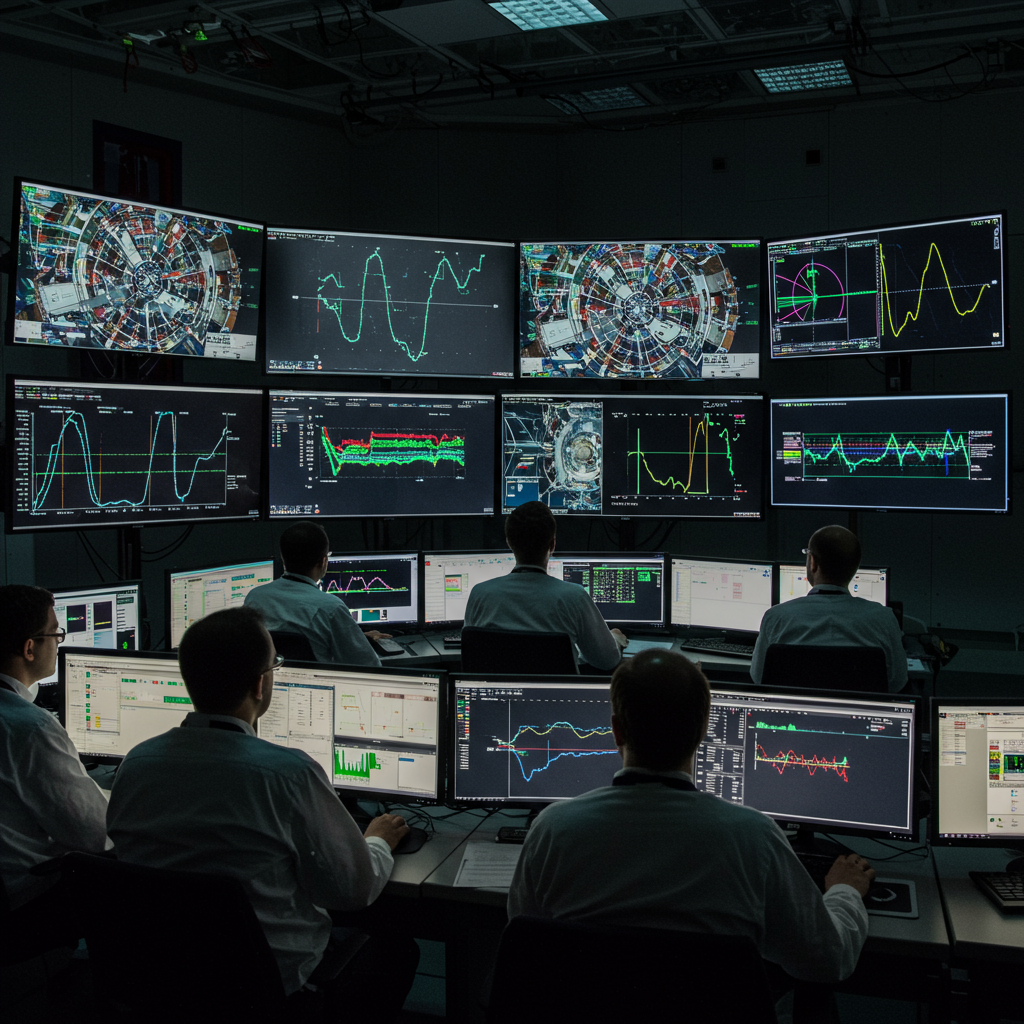
Scientists are actively seeking experimental evidence for physics beyond the Standard Model. A recent effort at CERN’s Large Hadron Collider focuses on a new type of search. Using the Compact Muon Solenoid (CMS) detector, researchers are looking for “soft unclustered energy patterns.”
What exactly are these patterns? They are faint energy signals detected in the aftermath of particle collisions. Unlike the signals from known particles, these do not group together into distinct, identifiable clusters. Traditional particle searches look for energetic, clustered signals that fit predictions for known particles or theorized heavier ones. These “soft unclustered” patterns are different. They are spread out and low-energy.
Some newer theories predict that these faint, unusual energy patterns could be signatures of unknown particles. These hypothetical particles would be difficult to detect directly. They might interact very weakly with the detectors.
Daniel Whiteson, a physicist not involved in this specific study, commented on these findings. He explained that such soft energy patterns do not necessarily point to just one specific new particle. Instead, they match predictions from a range of theoretical models. These models often involve unknown particles that interact primarily with each other. They would interact only minimally with the particles described by the Standard Model.
The Hypothetical “Hidden Valley”
One theoretical concept that could explain these observations is called the “Hidden Valley.” This is a hypothetical realm or sector of particles. It is proposed to exist alongside our visible universe. However, it interacts very weakly with the particles we know (electrons, quarks, etc.).
Think of it as a parallel world of particles. Particles within the Hidden Valley interact strongly among themselves. But their interaction with Standard Model particles is extremely faint. This weak interaction makes them incredibly difficult to detect. This “dark sector” could potentially explain phenomena like dark matter. Dark matter seems to make up a large part of the universe. Yet, it cannot be seen or detected by conventional means.
The theories aiming to go beyond the Standard Model often include such possibilities. Supersymmetry, extra dimensions, and string theory frameworks frequently incorporate new particles. These particles might inhabit a Hidden Valley. Their primary interactions would be within their own group. They would only occasionally, weakly, interact with the matter we experience daily. The search for these specific soft unclustered energy patterns at CERN represents an experimental attempt. It seeks tangible evidence that could support such theories and shed light on the nature of dark matter and physics beyond the Standard Model.
The Significance of the Finding
Detecting these soft unclustered energy patterns is not definitive proof of new physics. It is a potential hint. It suggests something unusual is happening in particle collisions that isn’t easily explained by the Standard Model. It aligns with theoretical predictions for weakly interacting particles, such as those in a Hidden Valley.
If confirmed and understood, this finding could be profoundly significant. It could provide the first experimental evidence for a dark sector. It might open a new avenue for searching for dark matter particles. Currently, dark matter searches look for direct interactions or annihilation products. Finding evidence of its hidden interactions in particle collisions would be revolutionary. It would challenge our fundamental understanding of the universe. It would validate decades of theoretical work on physics beyond the Standard Model. However, researchers need much more data and analysis to confirm these patterns are not simply background noise or complex Standard Model processes. This is just a potential first step.
Frequently Asked Questions
What are “soft unclustered energy patterns”?
These are faint energy signals detected in particle collisions at CERN. Unlike most signals from known particles, which group together in distinct patterns, these signals are spread out and have low energy. They don’t form the expected “clusters.” Scientists are investigating if they could be evidence of new, weakly interacting particles not described by the Standard Model of physics.
How do these patterns relate to dark matter?
These unusual energy patterns align with predictions from theories that propose a “dark sector” of particles. This dark sector includes hypothetical particles that interact very weakly with regular matter but could interact among themselves. Some scientists believe dark matter might be composed of such particles located within this dark sector, also known as a “Hidden Valley.” The CERN experiment is looking for experimental hints of this hidden realm.
What is the “Hidden Valley” concept in physics?
The Hidden Valley is a theoretical idea suggesting a parallel realm or sector of particles that exists alongside our known universe. Particles in the Hidden Valley would interact strongly with each other but only very weakly with the particles of the Standard Model (like electrons and quarks). This weak interaction makes them “hidden” from our usual detection methods. The concept is being explored as a potential explanation for dark matter and other phenomena not explained by current physics models.
Looking Ahead
The search for new physics continues. The unusual energy patterns observed at CERN are intriguing. They offer a potential glimpse into a hidden part of the universe. Future experiments and more extensive data analysis will be crucial. They will help determine if these signals are indeed the first whispers of a dark sector or entirely new particles. This ongoing work at the cutting edge of particle physics holds the promise of unlocking deeper mysteries of the cosmos and reshaping our understanding of reality itself.