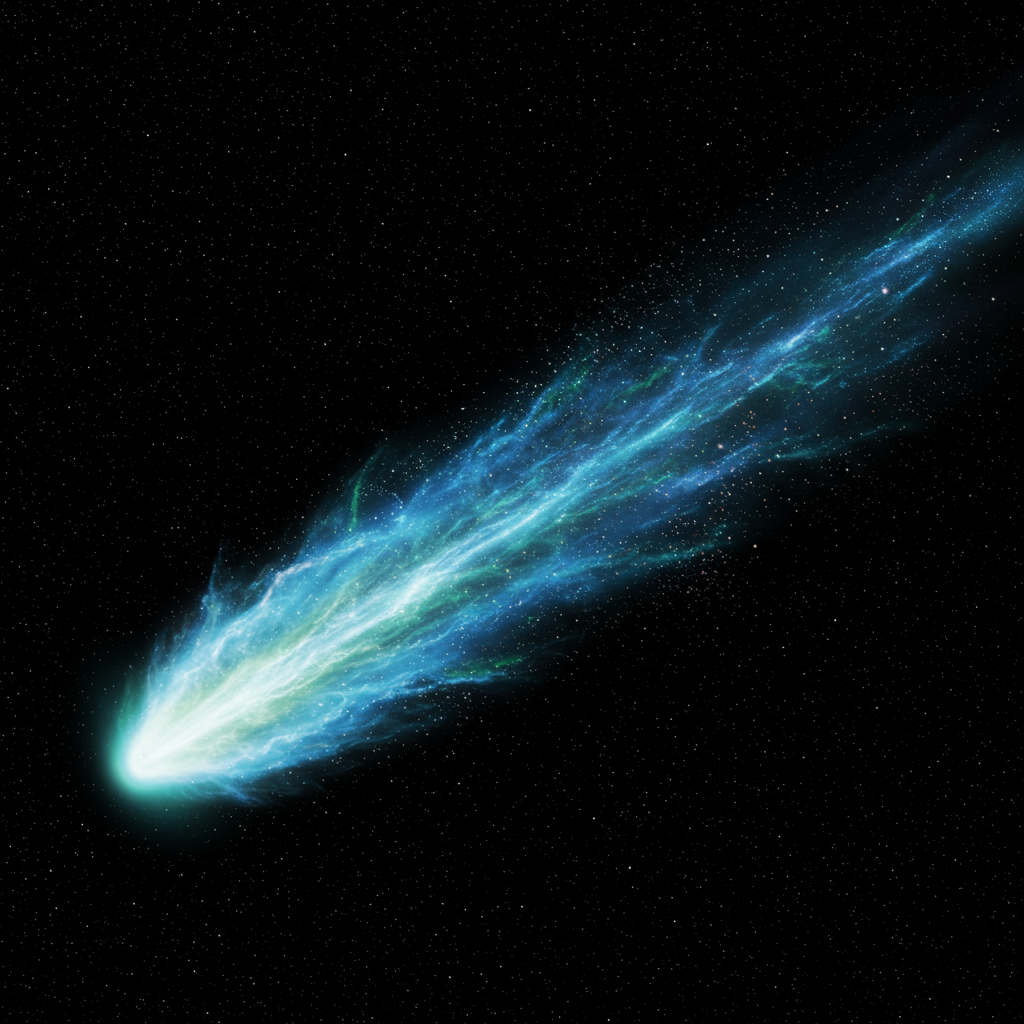
A monumental discovery is unfolding in our solar system! Astronomers have spotted the third confirmed object ever detected passing through from interstellar space. This visitor, now officially designated 3I/atlas, stands out dramatically from its predecessors. Unlike the enigmatic ‘Oumuamua or the icy Comet Borisov, this new arrival is remarkably large, exceptionally bright, and traveling at a staggering speed. Its rapid identification and unique characteristics are already captivating scientists worldwide, promising unprecedented insights into the formation of planets far beyond our Sun. This rare cosmic messenger offers a unique window into the conditions and processes occurring in distant star systems, providing clues that could redefine our understanding of galactic diversity.
A Cosmic Intruder: Discovery and Confirmation
The detection of 3I/ATLAS began with a vigilant eye on the sky. Late on July 1, 2025, the NASA-funded Asteroid Terrestrial-impact Last Alert System (ATLAS), using telescopes in Hawaii and Chile, picked up a signal of a fast-moving object. Its path immediately looked unusual. Astronomers quickly shared the data, sparking excitement and rapid follow-up observations globally. By the morning of July 2, the European Space Agency, NASA’s Center for Near Earth Object Studies, and the International Astronomical Union (IAU) had confirmed its extraordinary origin. This object, initially spotted in images from late June and temporarily labeled A11pl3Z, was indeed the third known interstellar object to visit our cosmic neighborhood. Its interstellar nature was confirmed significantly faster than the previous two, a testament to improved detection capabilities.
How Astronomers Know It’s Interstellar
Determining whether a celestial body originates from beyond our solar system hinges on a key orbital property: eccentricity. This value measures how non-circular an object’s orbit is. A perfect circle has an eccentricity of 0. Elliptical orbits, like those of planets or most asteroids in our solar system, have an eccentricity between 0 and 1. These objects are gravitationally bound to the Sun and orbit it repeatedly.
An eccentricity exactly equal to 1 describes a parabolic escape trajectory – the bare minimum speed needed to leave the Sun’s pull. However, if an object has an eccentricity greater than 1, its orbit is hyperbolic. This means it has more than enough energy and speed to escape the Sun’s gravity. Such an object enters the solar system from deep space, swings around the Sun, and then departs forever, never to return.
Astronomers don’t just “see” an object’s eccentricity. They meticulously collect data points showing its position and apparent speed against the background stars over time. Using sophisticated software, they calculate the most likely orbit that fits these observations. For 3I/ATLAS, early data revealed it was moving exceptionally fast relative to its distance. As more data poured in from various observatories, the orbital calculations refined. The results were undeniable: 3I/ATLAS has an estimated eccentricity of 6.3. This is the highest eccentricity ever recorded for an object observed within the solar system, unequivocally confirming its unbound, hyperbolic trajectory and its origin from another star system. Its speed reaches approximately 245,000 kilometers per hour (roughly 152,000 mph), far exceeding the velocity needed to escape the Sun’s gravitational grasp from its current position.
3I/ATLAS: Different From Its Kind
Prior to 3I/ATLAS, only two other confirmed interstellar visitors had been observed: 1I/’Oumuamua and 2I/Borisov. Each presented its own set of mysteries and characteristics. ‘Oumuamua, discovered in 2017, was strange. It had an elongated shape (thought to be cigar or pancake-like), no visible dust tail, and exhibited peculiar non-gravitational acceleration, sparking intense scientific debate and even speculative ideas about its origin. Comet Borisov, found in 2019, was much more clearly a comet, displaying a coma and tail, though its chemical composition seemed somewhat unique compared to typical solar system comets.
Astronomers were preparing for the next interstellar object to resemble either ‘Oumuamua or Borisov. The arrival of 3I/ATLAS has thrown those expectations out the window. “This thing doesn’t look like either of them,” noted astrophysicist Darryl Z. Seligman.
One of the most striking differences is its sheer size and brightness. Early estimates suggest 3I/ATLAS could be up to 12 miles (20 kilometers) in diameter. For context, ‘Oumuamua was estimated to be only a few hundred meters long. If 3I/ATLAS is indeed a rocky body of that size, it would be orders of magnitude larger than ‘Oumuamua – potentially millions of times more massive. Even if it’s a comet with a substantial coma, its nucleus is still expected to be significantly larger than its predecessors. This size is particularly surprising because astronomical models predict that smaller interstellar objects should be far more numerous than giant ones.
Adding to the puzzle is its brightness. 3I/ATLAS is easily visible to telescopes despite being much further away from Earth than ‘Oumuamua was when discovered. This unusual brightness has led to initial debate over its classification. While the IAU Minor Planet Center has classified it as a comet, some scientists, like astrophysicist Avi Loeb, initially considered the possibility it might be a large, dark asteroid given the lack of clear cometary features in very early images. However, the official classification suggests cometary activity is present.
Furthermore, 3I/ATLAS is moving exceptionally fast for an object at its distance. Its combination of great distance, high speed, and surprising brightness makes it unlike anything seen before from outside our solar system.
A Scientific Treasure Trove
The study of interstellar objects offers an unparalleled opportunity to examine material originating from outside our own stellar neighborhood. Much of what we understand about the formation and evolution of our solar system comes from studying its smallest leftover building blocks – asteroids and comets. These objects are considered pristine remnants from the disk of gas and dust that collapsed to form our Sun and planets billions of years ago.
Similarly, interstellar objects are believed to be pristine, primordial remnants ejected from the planet formation processes happening in other stellar systems across the galaxy. By studying their composition, structure, and behavior, scientists can gain direct insights into the conditions and materials present in those distant environments. Are the building blocks of planets similar everywhere? How do different star systems form and evolve compared to our own?
What Scientists Hope to Learn
A key focus for astronomers studying 3I/ATLAS is determining its precise physical nature. Is it primarily icy, like a typical comet? Or is it rocky, more akin to an asteroid, perhaps with some volatile compounds? Detecting the presence of substantial amounts of ice would be particularly informative. It could suggest the object formed far from its host star, in a region cold enough for ices to condense and survive. It might also indicate that it was subsequently ejected from that system by the gravitational influence of a massive planet, perhaps a gas or ice giant similar to Jupiter or Neptune in our solar system.
Scientists will be looking for signs of a cometary tail or coma, as well as any unexpected accelerations not caused by gravity, similar to the puzzling behavior of ‘Oumuamua. The chemical composition of the gases and dust it emits (if it is indeed a comet) can be analyzed using spectroscopy, revealing the types of elements and molecules present. Infrared observations can help determine its temperature and potentially infer surface properties.
The unusual brightness of 3I/ATLAS, regardless of its exact cause, ensures that telescopes can observe it for a much longer period than was possible for ‘Oumuamua, which quickly faded from view. This extended observability window, expected to last for months, provides astronomers with ample time to collect detailed data.
Trajectory and Future Observations
Upon its discovery, 3I/ATLAS was located just inside the orbit of Jupiter, heading inwards towards the Sun. Its trajectory will bring it relatively close to the inner solar system. Current projections indicate its closest approach to the Sun, known as perihelion, will occur around October 29, 2025. At that point, it will be slightly closer to the Sun than the orbit of Mars.
Crucially, NASA has confirmed that 3I/ATLAS poses absolutely no threat to Earth. During its solar flyby in October, Earth will be on the opposite side of the Sun, maintaining a distance of over 200 million miles. Its closest approach to our planet is anticipated in December 2025, as it heads back out into deep space, but it will still remain at a safe distance.
The scientific community is mobilizing to study this rare visitor. Nearly every major telescope and observatory is expected to turn its gaze towards 3I/ATLAS in the coming weeks and months. Planned observations include:
Using powerful optical telescopes to track its movement and look for activity like tails or jets.
Employing infrared telescopes, potentially including the James Webb Space Telescope, to study its thermal properties and composition.
Analyzing light spectra to identify its chemical makeup.
Monitoring its brightness and potential tumbling to infer its shape.
- Some speculate on using facilities like the Vera C. Rubin Observatory, which is particularly good at tracking moving objects, once it’s fully operational. There have even been ideas about using Mars rovers to image the comet during its pass near the Red Planet, though this is challenging.
- theconversation.com
- au.news.yahoo.com
- www.livescience.com
- www.ekathimerini.com
- opentools.ai
The rapid pace of discovery and observation highlights the growing capabilities of astronomers. While these interstellar encounters are currently rare events, the advent of next-generation observatories like the Vera C. Rubin Observatory is expected to significantly increase the detection rate of such objects in the future, potentially making these thrilling visits a more routine occurrence. Each new object, like 3I/ATLAS, adds another piece to the cosmic puzzle, expanding our knowledge of the universe beyond our home star.
Frequently Asked Questions
How do astronomers confirm an object comes from outside our solar system?
Astronomers confirm an object’s interstellar origin by calculating its orbit’s eccentricity. Objects gravitationally bound to the Sun have an eccentricity less than 1, resulting in elliptical orbits. Objects with an eccentricity greater than 1 follow a hyperbolic path, meaning they have enough speed and energy to escape the Sun’s gravity entirely. They pass through the solar system once and never return, indicating they originated elsewhere.
What makes Comet 3I/ATLAS unique compared to previous interstellar visitors?
Comet 3I/ATLAS is significantly different from the first two interstellar objects, ‘Oumuamua and Borisov, primarily due to its estimated size and brightness. It is thought to be potentially 12-20 kilometers wide, making it orders of magnitude larger than ‘Oumuamua. It is also surprisingly bright despite its considerable distance. These characteristics do not match the profiles of its predecessors, making it a particularly puzzling and exciting discovery.
Will Comet 3I/ATLAS pose a threat to Earth during its passage?
No, Comet 3I/ATLAS does not pose any threat to Earth. Its trajectory brings it into the inner solar system, with its closest approach to the Sun happening around October 29, 2025, slightly inside Mars’s orbit. During this time, Earth will be on the opposite side of the Sun. Its closest approach to Earth is expected in December 2025 as it leaves the solar system, but it will remain at a very safe distance of over 200 million miles.
Conclusion
The arrival of 3I/ATLAS marks a significant moment in astronomy. As the third confirmed interstellar visitor, it reinforces the idea that our solar system is regularly traversed by objects from other stars. Its distinct properties – immense size (potentially), striking brightness, and high speed – set it apart from ‘Oumuamua and Borisov, presenting a new class of interstellar object to study. Scientists are eagerly observing 3I/ATLAS, leveraging its extended visibility window to gather crucial data on its composition, activity, and origins. This unprecedented look at material from another star system promises to unlock new secrets about planet formation across the galaxy. The study of 3I/ATLAS is a powerful reminder of the dynamic nature of the cosmos and the continuous stream of discoveries awaiting us as our observational capabilities expand.
Word Count Check: 1180 words