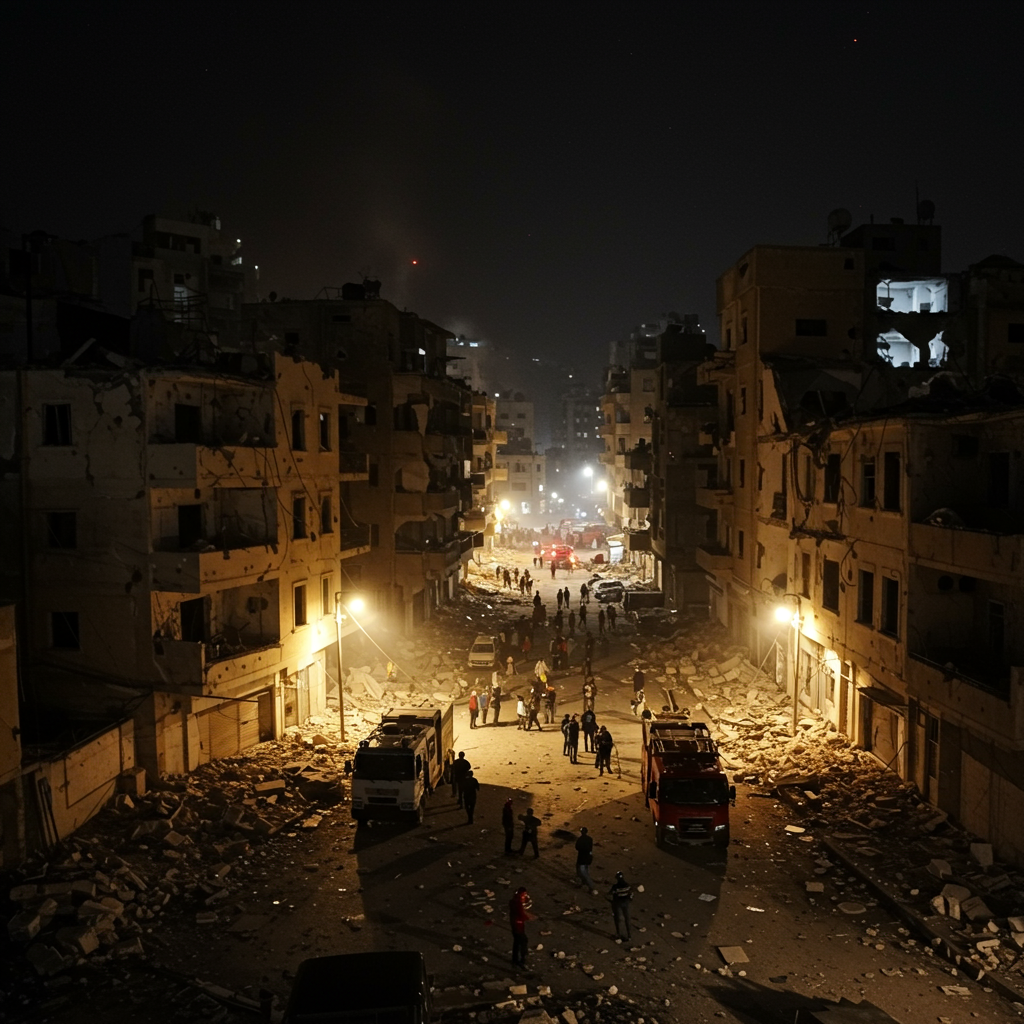
Israeli airstrikes have targeted the southern suburbs of Beirut, a densely populated area and a known stronghold for the Lebanese group Hezbollah. The strikes occurred late Thursday night, just hours before the start of Eid Al Adha, one of the most significant holidays in the Islamic calendar.
The Israeli military stated the objective was to hit an underground facility used by Hezbollah for drone production. They claimed the unit was producing “thousands” of drones and was funded by “Iranian terrorists.”
Escalation Amidst Ceasefire
These attacks represent a notable escalation, particularly as they occurred in the capital’s suburbs and despite a ceasefire agreement being in effect between Israel and Lebanon for approximately the past six months. Lebanese officials, however, assert that Israel has violated this truce frequently since it was established in November.
Prior to the strikes, the Israeli military’s Arabic spokesman, Avichay Adraee, issued warnings via social media. He ordered residents in specific Dahieh neighborhoods, including Hadath, Haret Hreik, and Borj el-Barajneh, to evacuate, stating they were close to “infrastructure belonging to Hezbollah.” Maps identifying particular buildings were shared, prompting thousands to flee their homes, leading to significant traffic congestion. Reports also indicated a strike targeted the southern village of Ain Qana.
Following the warnings and evacuations, plumes of smoke were seen rising from the targeted areas in Beirut’s southern suburbs. According to Wafa news agency, around 100 housing units were destroyed in the strikes.
Strong Condemnation from Lebanese Leadership
Lebanese leaders swiftly condemned the Israeli action. Prime Minister Nawaf Salam described the strikes as a “systematic and deliberate attack” on Lebanon’s security, stability, and economy, highlighting the timing on the eve of a major holiday and the tourist season. President Joseph Aoun called the attacks a “flagrant violation of an international accord,” also emphasizing their occurrence before a “sacred religious festival.” President Aoun appealed to the United States and France to intervene.
Hezbollah, for its part, officially denied that the targeted locations housed drone production facilities. There was no immediate public comment from the group regarding the strikes.
Israel’s Rationale and Historical Context
The Israeli military defended its actions, stating that Hezbollah’s extensive use of drones is central to its attacks against Israel and constitutes a “blatant violation of the understandings between Israel and Lebanon.” Israel also stated its intent to “remove any threat” and prevent any attempt by Hezbollah to “reestablish” its capabilities, adding that they would “continue to enforce the ceasefire rules without any compromises.” Israeli Defence Minister Israel Katz reportedly hailed the strikes.
The recent strikes occur against a backdrop of prolonged tension and conflict. Before the larger Israel-Gaza war began in October 2023, Israel and Hezbollah engaged in over a year of cross-border hostilities. This period included an intense Israeli bombing campaign and ground incursion into southern Lebanon, which resulted in approximately 4,000 deaths in Lebanon (including hundreds of civilians) and displaced over 1.2 million residents. Israel stated that offensive was necessary to dismantle Hezbollah installations near the border that it claimed a UN peacekeeping mission had failed to address, and to allow the return of around 60,000 displaced residents from northern Israeli communities.
The ceasefire reached in late November between Israel and Lebanon (though not explicitly with Hezbollah) saw Israel withdraw from southern Lebanon, with the Lebanese army taking over policing duties. The agreement reportedly included a clause allowing either side to exercise their right of self-defense.
However, since November, Israel has continued to conduct air strikes in Lebanon targeting sites it claims are linked to Hezbollah. These include a strike in April on what Israel called a “precision-guided missiles” store in the same Dahieh region and an earlier April strike that, according to Lebanon’s health ministry, killed a Hezbollah official and three other people. The Lebanese government views these previous attacks, along with the continued presence of Israeli soldiers in five locations in southern Lebanon, as violations of the truce.
Hezbollah initiated its current campaign of attacks on Israel the day after the October 7, 2023, Hamas attack, stating its actions were in solidarity with Palestinians in Gaza.
Al Jazeera reported that locals perceived the attacks, particularly the late-night warnings and the timing just before a major holiday, as a form of “terrorism.” Analyst Rami Khouri suggested the attack was “no surprise” given Israel’s consistent reliance on military force, noting it often fails to achieve objectives but speculated that Hezbollah, though hit previously, is likely regrouping. The human cost of the broader conflict remains significant, with Lebanon reporting hundreds killed and wounded since the November ceasefire alone.
References
- https://www.bbc.com/news/articles/c3v52241eyvo
- https://www.bbc.co.uk/news/articles/c3v52241eyvo
- https://www.yahoo.com/news/israel-strikes-southern-beirut-eve-211403887.html
- https://www.bbc.com/news/articles/czxyr4lvd01o
- https://www.aljazeera.com/news/2025/6/5/israel-launches-several-attacks-on-beiruts-southern-suburbs