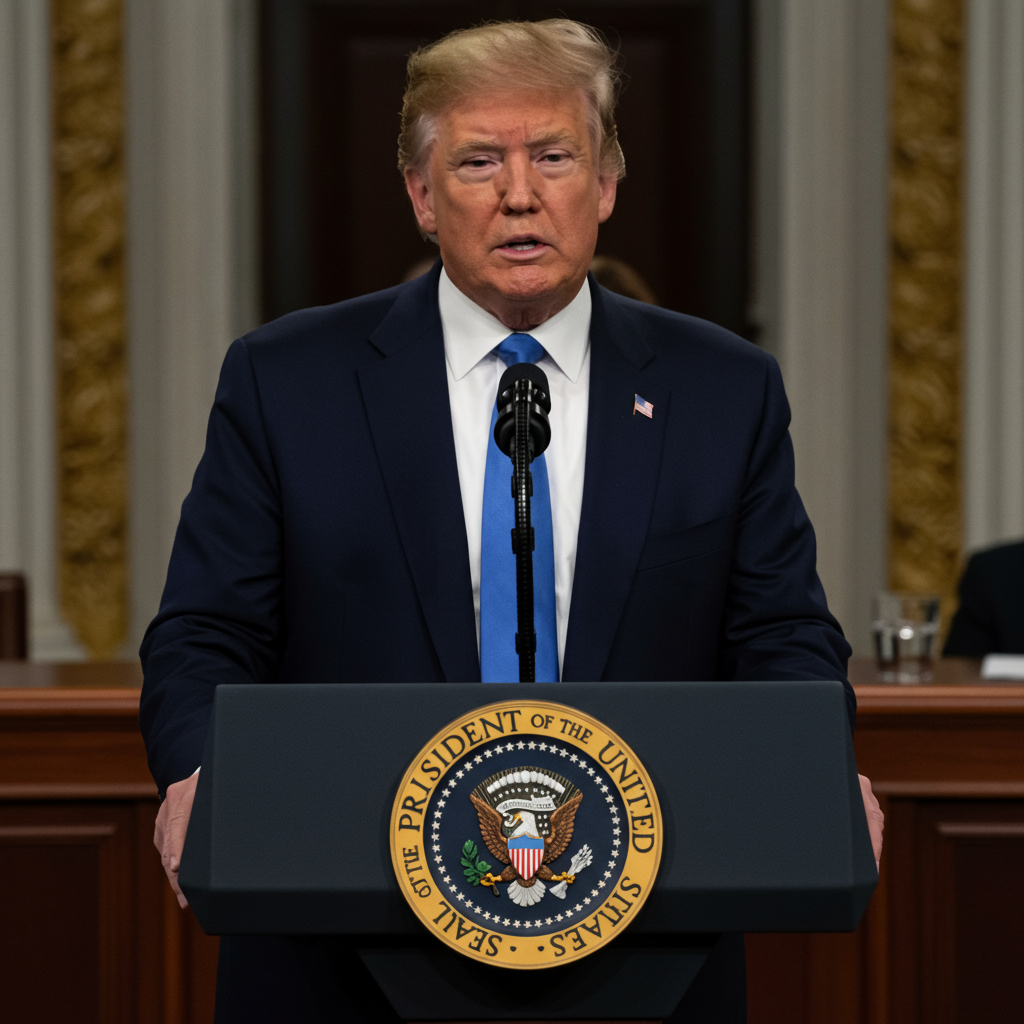
US President Donald Trump has announced a sweeping new travel ban, revisiting a contentious policy from his first term in office. This latest order targets individuals from 12 countries, marking a significant move in his administration’s approach to immigration and national security. However, unlike the initial ban in 2017, this new iteration appears strategically designed to navigate and potentially overcome the legal hurdles that plagued its predecessor.
A Policy Reimagined: Learning from Past Legal Battles
The original travel ban, issued just a week into Trump’s first presidency, sparked immediate controversy and was quickly dubbed the “Muslim ban” by critics due to its focus on seven predominantly Muslim-majority nations. This led to a series of swift legal challenges, with opponents arguing it was unconstitutional and discriminatory based on religion. The ban faced multiple defeats in court and required two amendments before a scaled-back version was eventually upheld by the US Supreme Court in 2018.
Legal experts observing the new policy suggest that lessons have been learned from this turbulent history. They indicate that the current order seems more legally robust and better prepared to withstand judicial scrutiny.
Expert Analysis: Built to Withstand Challenges?
According to analyses by immigration law experts, the new ban features key differences aimed at bolstering its legal standing. Compared to the first ban, which was criticized for a lack of clarity, the new restrictions are described as “wider in scope” with “clearly defined” exemptions.
Crucially, while there is overlap in the countries listed between the 2017 and 2025 orders, Muslim-majority states are not the explicit focus of the latest ban. This strategic shift, according to analysts, makes the policy potentially more palatable to courts and increases its likelihood of being upheld by the Supreme Court if challenged.
While the President holds broad powers concerning immigration policy, the specific criteria used for selecting countries could still face legal questions.
Who is Affected? The Targeted Nations
The new ban imposes the harshest restrictions, effective from June 9, on travellers from 12 countries primarily located in the Middle East, Africa, and the Caribbean. Notable nations on this list include Afghanistan, Iran, and Somalia.
Additionally, travellers from another seven countries, including Cuba and Venezuela, will face partial restrictions under the new order.
Justification and Points of Contention
President Trump stated that the severity of restrictions is graded based on the perceived threat level, including from terrorism. He also cited high rates of visa overstays as a reason for listing certain countries.
However, these justifications have drawn scrutiny. Notably, besides Iran, none of the 12 countries facing the outright ban are currently listed by the US government as state sponsors of terrorism. Furthermore, the lack of a clearly defined threshold for what constitutes an “excessive overstay rate” could become a basis for legal challenges, as some immigration lawyers have pointed out.
Key Differences from the 2017 Order
A significant departure from the original ban, which was initially limited to 90-120 days, is that the new order has no specified end date.
Legal experts also note that the structure of the new ban appears to make it harder for large groups of affected individuals to organize and file class-action lawsuits compared to the 2017 version, suggesting the administration “put more thought into it.” The 2017 ban famously triggered widespread protests and disruptions before being repealed by President Joe Biden in 2021, who called it “a stain on our national conscience.”
Potential Consequences and Global Reaction
The new restrictions are anticipated to have practical consequences for various individuals attempting to enter or return to the United States. This includes:
Students stuck abroad during administrative processing.
Winners of the diversity visa lottery who have completed interviews and paid fees.
EB-5 investors who have committed significant capital to the US economy.
H-1B visa holders currently outside the US, waiting to return to their employers.
Initial reactions from the targeted countries have varied, with some expressing dismay while others indicate a willingness to engage in dialogue with the US administration. Venezuela, for instance, issued sharp criticism, while Somalia stated it would seek dialogue to address the concerns raised.
Overturning this new order is expected to be an uphill battle for opponents, largely due to the President’s broad authority over immigration matters and the seemingly more carefully constructed legal framework of the ban itself.
References
- https://www.bbc.com/news/articles/cd7gp8l1241o
- https://www.bbc.co.uk/news/articles/cd7gp8l1241o