Crimson Desert, an ambitious open-world action RPG from developer Pearl Abyss, arrives with immense visual appeal and grand aspirations. This extensive Crimson Desert review dives into a world overflowing with possibility, yet often struggles to refine its myriad ideas. After exploring hundreds of hours of gameplay, we uncover a title that is undeniably breathtaking to behold but frequently stumbles under the weight of its own ambition, leaving players to wonder if its sprawling beauty outweighs its frustrating complexities.
The World of Pywel: A Visual and Technical Marvel
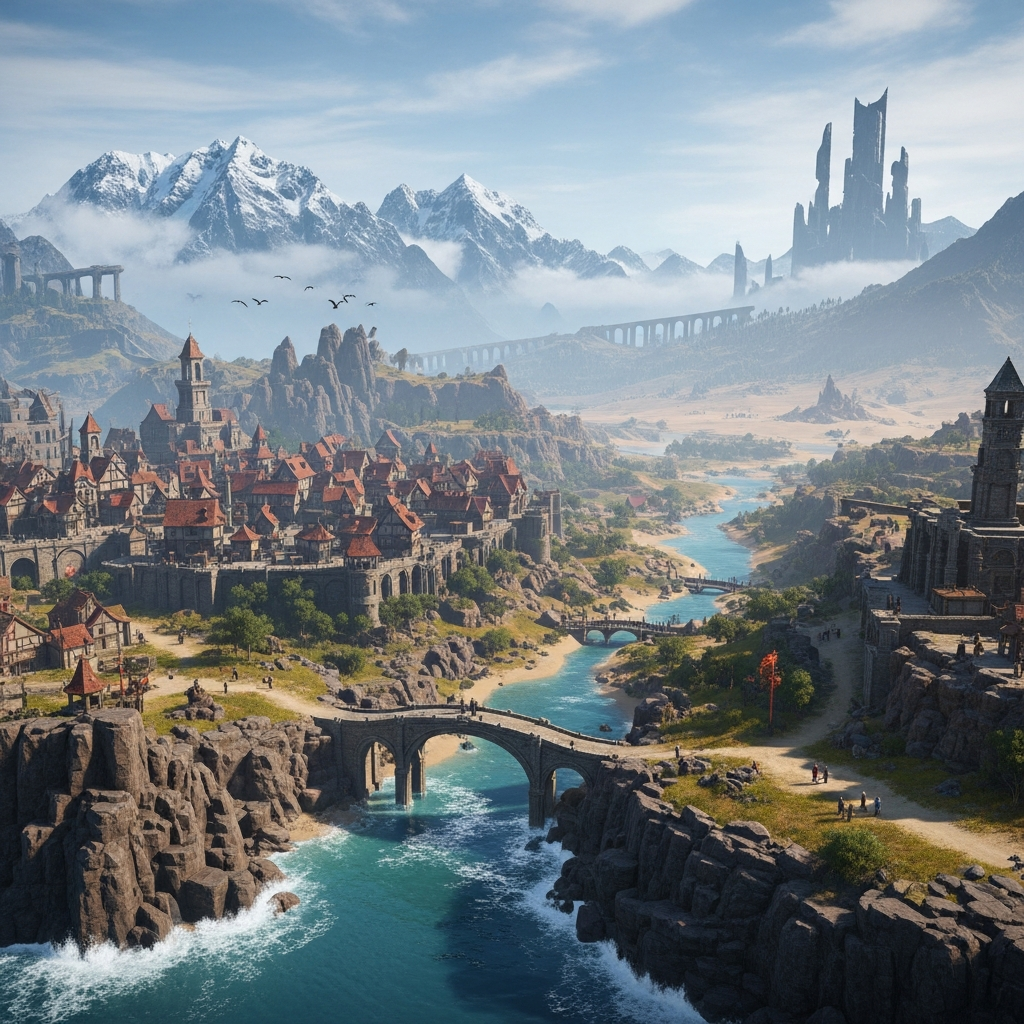
From the moment you step into Pywel, the setting for Crimson Desert, its visual and technical prowess is immediately apparent. Pearl Abyss has crafted a truly stunning fantasy world, a single, contiguous landmass so expansive you can literally see every inch of it from a high vantage point. Imagine a clockwork city where intricate machine beings tend vast farms, or a labyrinth of ancient ruins seemingly floating in the sky. These sights contribute to a “breathtaking” aesthetic that reviewers universally praise. The sheer fidelity and seamless rendering make Pywel one of the most jaw-droppingly immersive open worlds seen in recent memory.
However, this visual splendor introduces the game’s central paradox: an “overwhelming” sense of scale that simultaneously captivates and exhausts. The developers clearly drew inspiration from titans like The Legend of Zelda: Breath of the Wild and Dragon’s Dogma, adopting a minimalist approach to tutorials and encouraging discovery through pure experimentation. While this design initially fosters a compelling sense of wonder, it also contributes to a steep learning curve and information overload, as players are often left to decipher complex systems on their own.
Kliff’s Journey: A Story Lacking Soul
The core narrative of Crimson Desert centers on Kliff, leader of the Greymanes peacekeeping corps, who is revived by supernatural forces after an ambush to save Pywel from dark threats. Despite this epic premise, the story often feels “a mess,” criticized for being “hard to follow to downright nonsensical.” Reviewers note a focus on “spectacle and bombast” over genuine character development or emotional payoff. Comparisons to watching a “Game of Thrones’ best moments” compilation without the underlying narrative depth highlight this issue. Kliff, despite being the protagonist, is often passive, acting more like a conduit for events than a deeply involved character.
While there are glimpses of emotional resonance, particularly when reuniting the scattered Greymanes and rebuilding their camp, these moments are often optional and easily missed. This lack of a compelling narrative thread leaves players feeling ungrounded in the beautiful world, diminishing the impact of their actions. Side quests, too, frequently disappoint, devolving into repetitive, menial tasks that do little to enrich the overarching lore or player engagement.
Gameplay Mechanics: A Cornucopia of Systems
Crimson Desert is a game that truly wants to be everything. It packs in an “utterly overwhelming” number of features: base building and soldier management, “crunchy melee combat” with wrestling moves, realistic physics, complex Zelda-esque puzzles, hundreds of side quests, dynamic relationship systems with NPCs and animals, and even dragon riding. This “sense of excess” is both a strength and a weakness.
On one hand, the sheer variety offers immense replayability and ensures there’s always something new to discover. Finding a sentient tree that needs its hat stolen for magical beings, or defeating a Spirit Knight boss to unlock a game-altering weapon ability, are genuinely thrilling moments. These “quiet moments” of exploration and unexpected discoveries are often highlighted as the game’s shining achievements.
However, this “amalgamation of perhaps slightly too many ideas” means many systems feel “stretched too thin” and underdeveloped. Instead of refining a few core mechanics, Crimson Desert presents a deluge of options, leading to a cluttered rather than coherent experience. Critical information is often buried deep in menus, further complicating the learning process.
Combat: Flashy Potential, Frustrating Execution
The combat system in Crimson Desert initially impresses with its frenetic, action-game intensity, offering a wide array of stylish abilities. However, the experience often veers into tedium. Early encounters can be a slog due to repetitive enemy execution animations, which become particularly aggravating when facing dozens of foes. While the late-game promises more depth as skills unlock, reaching that point requires significant perseverance.
Boss battles are a frequent source of “nauseatingly frustrating” experiences. Characterized by huge, wide-reaching attacks, tiny damage windows, and restrictive arenas, they often feel unbalanced. Players are pushed to find “Abyss artifacts” and gather resources to upgrade Kliff’s stats, but the absence of a “tangible stat or levelling system” makes it difficult to assess preparedness. As more abilities unlock, the control scheme can become overloaded, with multiple actions mapped to the same inputs, leading to misread intentions during critical moments.
Adding to the combat woes is the healing system, which relies exclusively on consumable food. Boss fights quickly deplete food supplies, forcing players into constant cycles of resource gathering and cooking, disrupting the flow of combat and exploration.
Time-Wasting Design: An Unnecessary Drag
Perhaps the most significant criticism leveled against Crimson Desert is its propensity for “time-wasting.” The game, while appreciated for its emphasis on exploration, lacks easy fast travel options. Players often spend 20-30 minutes riding between quests, and fast travel points only unlock after successfully solving complex puzzles. This means failing a puzzle forces a long trek back, rather than granting a convenient return point.
Similarly, gear upgrades demand extensive grinding for materials like wood and ore. Even seemingly simple quests are needlessly drawn out; a dye quest, for example, might involve multiple trips across the map for trivial steps. This intentional padding, combined with a limited inventory that necessitates frequent trips to unload items, accumulates into a frustrating experience. Reviewers suggest that a game played for 100 hours could have been a more enjoyable 50-60. These “little frustrations” quickly pile up, detracting from the otherwise enjoyable moments of discovery.
Performance and Bugs: A Mixed Bag
From a technical standpoint, Crimson Desert presents a mixed picture. Some reviewers laud its “one of the most well-optimized PC games in years,” running smoothly across various hardware configurations, even on lower-end systems and handhelds like the Xbox Ally X. The exceptional draw distance, stunning environmental details, and dynamic lighting create a truly beautiful visual experience.
However, this optimization sometimes comes at the cost of graphical quality on less powerful systems, requiring ‘low’ settings for playable frame rates. More concerning are the “significant bugs” reported, including hard crashes, stuck companions, and even game-breaking main story bugs that forced reloads of hours-old saves. While Pearl Abyss is actively working on fixes, the sheer scale of the game suggests that eradicating all issues will be a substantial challenge.
Frequently Asked Questions
What makes Crimson Desert’s open world both breathtaking and overwhelming?
Crimson Desert’s world, Pywel, is praised as a “visual and technical marvel” due to its stunning graphics, seamless rendering, and immense scale. From floating ruins to clockwork cities, it offers “unbeatable vistas” and a strong “sense of discovery.” However, this vastness also contributes to an “overwhelming” experience, with countless systems and a minimalist approach to guidance, leaving players to decipher complex mechanics on their own.
How should players approach Crimson Desert’s challenging combat and progression systems?
Players are advised to prioritize exploration and engaging with side activities to level up Kliff and gather resources early on. The combat is tough and initially tedious, with no difficulty adjustments, so unlocking parry and block abilities through skill upgrades is crucial. Since fast travel is limited and progression feedback is unclear, patience for grinding and experimenting with different combat abilities is key to overcoming “nauseatingly frustrating” boss battles and preparing for main quests.
Is Crimson Desert a worthwhile experience for fans of open-world RPGs?
Crimson Desert is an ambitious yet flawed RPG that will appeal to players who appreciate breathtaking open-world exploration, diverse activities, and intricate gameplay systems, even if they come with a steep learning curve and significant frustrations. While its narrative and some combat elements are weak, the “quiet moments” of discovery and the sheer scale can be genuinely captivating. Fans of The Elder Scrolls, Red Dead Redemption 2, or The Witcher 3 who are prepared for its “overdesigned” nature and occasional time-wasting elements might find a unique, if imperfect, adventure.
Conclusion: A Diamond in the Rough, Buried by Ambition
Crimson Desert is a game of stark contrasts. It boasts a world of unparalleled beauty and an ambition that few other titles can match. The “quiet moments” of exploration, discovering hidden secrets in the sprawling lands of Pywel, are genuinely special and hint at a masterpiece beneath the surface. Yet, its vision is constantly hampered by an “overdesigned” approach, a weak narrative, and gameplay mechanics that often feel more like a grind than an engaging challenge.
Pearl Abyss, in its first single-player venture, has created a truly “ambitious yet flawed RPG.” While the “cornucopia of little frustrations” and “stark lack of narrative depth” prevent it from reaching its full potential, the underlying foundation is undeniably strong. For those who can overlook its issues and embrace the overwhelming scale, Crimson Desert offers moments of wonder. However, its ultimate success may hinge on future patches that refine its systems, simplify its complexities, and perhaps, finally cut away those “unneeded layers” to reveal the true hidden gem within.
Word Count Check: 1215 words