
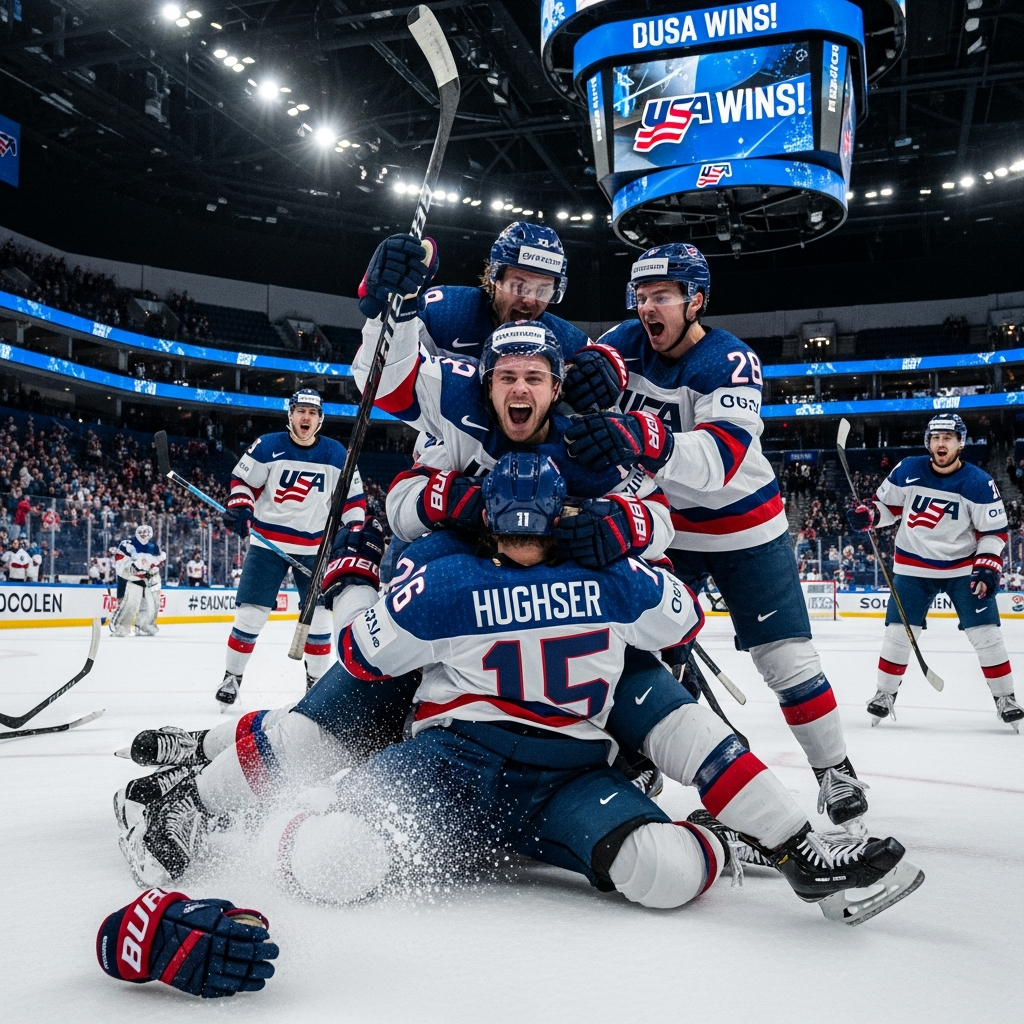
The 2026 Olympic Winter Games in Milano Cortina delivered an unforgettable chapter in American sports history as the United States men’s ice hockey team clinched its first gold medal since the legendary “Miracle on Ice” of 1980. This monumental victory, achieved in a thrilling 2-1 sudden-death overtime against arch-rival Canada, marked the culmination of a “white-knuckle contest” and a remarkable tournament run. Held 46 years to the day after the iconic Lake Placid triumph, this “Marvel in Milan” not only secured the gold but also propelled Team USA to a record-breaking 12 gold medals overall in the Winter Games, cementing its place as a standout performance in American Olympic history.
A Gold Medal Showdown: USA vs. Canada
The highly anticipated gold medal game between the United States and Canada was everything hockey fans could have hoped for. Played on February 22, 2026, the contest pitted two hockey powerhouses against each other, with Canada dominating much of the play, outshooting the U.S. 42-28. Despite Canada’s offensive pressure, the Americans, fueled by a stellar defensive effort and an impenetrable goaltender, found a way to win. The U.S. scored first in the opening period, only for Canada to level the score in the second, setting the stage for a tense third period and an eventual overtime showdown.
The victory was particularly sweet for Team USA, offering redemption for a previous 3-2 overtime loss to Canada in the 2025 4 Nations Face-Off. This time, the stakes were higher, and the Americans delivered.
Connor Hellebuyck: The Unsung Hero in Goal
The United States’ triumph owed immensely to the “sensational performance” of goaltender Connor Hellebuyck. The Winnipeg Jets netminder truly “stood on his head,” making 41 crucial saves, including stonewalling dangerous shots from Canadian superstars like Connor McDavid and Macklin Celebrini on breakaways. Hellebuyck also denied Devon Toews from point-blank range and delivered a string of critical saves during a lengthy Canadian five-on-three power play in the second period, with the U.S. penalty kill remaining “immaculate” throughout the tournament, finishing 18-for-18.
His teammates universally praised Hellebuyck, with Jack Hughes calling him “our best player tonight, by a mile.” Hellebuyck’s 41 saves set a new record for most saves in an NHL-participated gold medal game, surpassing Ryan Miller’s 36 saves in 2010. Finishing the tournament with an undefeated 5-0-0-0 record, an impressive 1.18 goals-against average, and a .956 save percentage, Hellebuyck’s heroics were instrumental in Team USA’s long-awaited gold. He described the win as “a dream come true” and “surreal.”
Jack Hughes’s Golden Goal and Gritty Performance
The decisive moment came just 1 minute and 41 seconds into sudden-death overtime from 24-year-old New Jersey Devils center Jack Hughes. His game-winning goal, buried through the five-hole after a cross-ice pass from Zach Werenski, was immediately etched into Olympic lore. What made Hughes’s heroics even more remarkable was his display of grit and resilience. Late in the third period, he lost two teeth after taking a high stick to the face from Canada’s Sam Bennett, yet returned to the ice almost immediately.
In a candid post-game interview, despite a bloody smile and missing teeth, Hughes famously joked, “I’m lucky I’m from the best country in the world, and we’ve got great dentists there, too. I’m lucky I’m American, and they’re gonna fix me right up.” This statement not only highlighted his patriotism but also became an instant viral moment.
Hughes’s journey to this golden moment had been “turbulent” in the preceding 12 months, marked by criticism, shoulder surgery, a sliced thumb injury, and even tabloid attention for his relationship with pop star Tate McRae. Starting the tournament on the fourth line, his triumph was a testament to his mental toughness and passion for the game. His older brother, Quinn Hughes, who led the U.S. team with eight points, called Jack “an animal” and praised his resilience. American center Tage Thompson echoed these sentiments, stating Hughes “is built for these moments,” thrives under pressure, and “wants the puck on his stick at all times.” Jack finished the Olympics with seven points, second only to his brother.
Team USA’s Path Through the Tournament
Team USA’s road to gold was paved with strong performances and hard-fought victories. In the semifinals, they faced Slovakia, a “hockey minnow” described as the youngest team in the tournament and fueled by an underdog spirit. Despite Slovakia’s impressive run, including an upset over Finland in the preliminary round, the U.S., with its deep roster and tournament’s best blue line, secured a tight 2-1 overtime win against Sweden in the quarterfinals, demonstrating their veteran composure. Forward Matthew Tkachuk acknowledged Slovakia’s “incredible” play, while Dylan Larkin identified Juraj Slafkovský as “extremely dangerous.” While “on paper, the U.S. should win this game easily” against Slovakia, the Americans recognized the challenge posed by their determined adversaries. The U.S. did not underestimate Slovakia, ultimately advancing to the final to face Canada.
The return of NHL players to the Winter Games after a 12-year absence added another layer of significance to the American team’s “fairytale ending.” This victory marked Team USA’s third Olympic gold medal in men’s hockey, adding to their previous wins in 1960 and 1980.
A Record-Breaking Olympics for Team USA
Beyond the men’s ice hockey gold, the 2026 Winter Olympics proved to be the most successful in Team USA’s history in terms of gold medals. The men’s hockey victory, the 12th gold, surpassed the previous American record of 11 Winter Olympics gold medals, which had been set just the day prior. This remarkable achievement showcased the breadth of American talent across various winter sports.
Other gold medals secured by Team USA included:
Breezy Johnson in women’s downhill skiing
Team figure skating
Elizabeth Lemley in women’s ski moguls
Jordan Stolz in men’s 1000-meter speed skate
Jordan Stolz in men’s 500-meter speed skate
Elana Meyers Taylor in women’s monobob
Mikaela Shiffrin in women’s skiing slalom
Women’s ice hockey
Alysa Liu in women’s figure skating
Alex Ferreira in men’s ski halfpipe
Mixed team ski aerials
While Norway dominated the overall medal standings with an astonishing 18 gold and 41 total medals, Team USA finished a strong second with 12 gold and 33 total medals, just one shy of their all-time record set in 2002.
Individual Honors and All-Star Recognition
The 2026 Milano Cortina Games also celebrated outstanding individual performances, with several players earning top honors and selection to the Olympic All-Star Team.
Connor McDavid (Canada) was named the tournament’s Most Valuable Player (MVP) and Best Forward. As Canada’s captain, McDavid led offensively with 13 points (two goals, 11 assists) in six games, breaking the record for most points in an Olympics with NHL participation.
Connor Hellebuyck (USA) earned Best Goaltender honors, a testament to his gold medal-winning heroics.
Quinn Hughes (USA) was recognized as the Best Defenseman, instrumental for Team USA and scoring the overtime goal in the quarterfinals against Sweden. He tied a record for defensemen in a single Olympic tournament with 8 points (one goal, seven assists).
The media-selected Olympic All-Star Team further recognized these standout athletes:
Goaltender: Connor Hellebuyck (USA)
Defenseman: Quinn Hughes (USA)
Defenseman: Cale Makar (Canada) – Contributed six points and tied a Canadian defenseman record. He scored Canada’s tying goal in the gold medal game.
Forward: Connor McDavid (Canada)
Forward: Macklin Celebrini (Canada) – The 19-year-old finished second in Olympic scoring with 10 points.
Forward: Juraj Slafkovsky (Slovakia) – Led fourth-place Team Slovakia with eight points.
Jack Eichel, another key U.S. forward, proudly stated that the win meant “USA Hockey was on top of the hockey world” after a long time. The “golden goal” by Jack Hughes, joining Sidney Crosby (2010) as only the second player to score an overtime winner in an Olympic gold medal game featuring NHL players, marked a moment of immense national pride and redemption.
Frequently Asked Questions
What was the final score and who scored the winning goal in the USA vs. Canada Olympic Men’s Hockey Gold Medal Game?
The United States defeated Canada in a thrilling 2-1 sudden-death overtime victory to claim the gold medal in men’s ice hockey at the 2026 Milano Cortina Winter Olympics. The game-winning goal was scored by 24-year-old New Jersey Devils center Jack Hughes just 1 minute and 41 seconds into overtime. Hughes, who had lost two teeth earlier in the game, sealed the historic win for Team USA.
Which players were named to the Olympic All-Star Team and won individual awards at the 2026 Milano Cortina Games?
Connor McDavid of Canada was named the tournament’s Most Valuable Player (MVP) and Best Forward. Connor Hellebuyck (USA) earned Best Goaltender, and Quinn Hughes (USA) was recognized as Best Defenseman. The media-selected Olympic All-Star Team included Hellebuyck, Quinn Hughes, Cale Makar (Canada) on defense, and McDavid, Macklin Celebrini (Canada), and Juraj Slafkovsky (Slovakia) at forward.
How significant was Team USA’s men’s hockey gold medal win in the context of their overall 2026 Winter Olympics performance?
Team USA’s men’s hockey gold medal was incredibly significant, as it was their first since the 1980 “Miracle on Ice” and secured on the 46th anniversary of that win. More broadly, it propelled the United States to a record-breaking 12 gold medals at the 2026 Winter Olympics, marking the nation’s most successful performance in terms of gold medals in Winter Games history. This achievement showcased a strong overall showing for American athletes across various disciplines.
Conclusion
The 2026 Olympic Winter Games delivered a gold medal moment that will be remembered for generations. Team USA’s men’s ice hockey victory over Canada in Milano Cortina was a testament to resilience, exceptional goaltending, and a defining clutch performance by Jack Hughes. This triumph not only broke a 46-year gold medal drought but also underscored a record-breaking performance for the United States at the Games. The “Marvel in Milan” serves as an inspiring narrative, highlighting the power of teamwork and individual determination on the world’s biggest stage. It reaffirms USA Hockey’s place among the elite and promises to inspire future generations of American athletes.