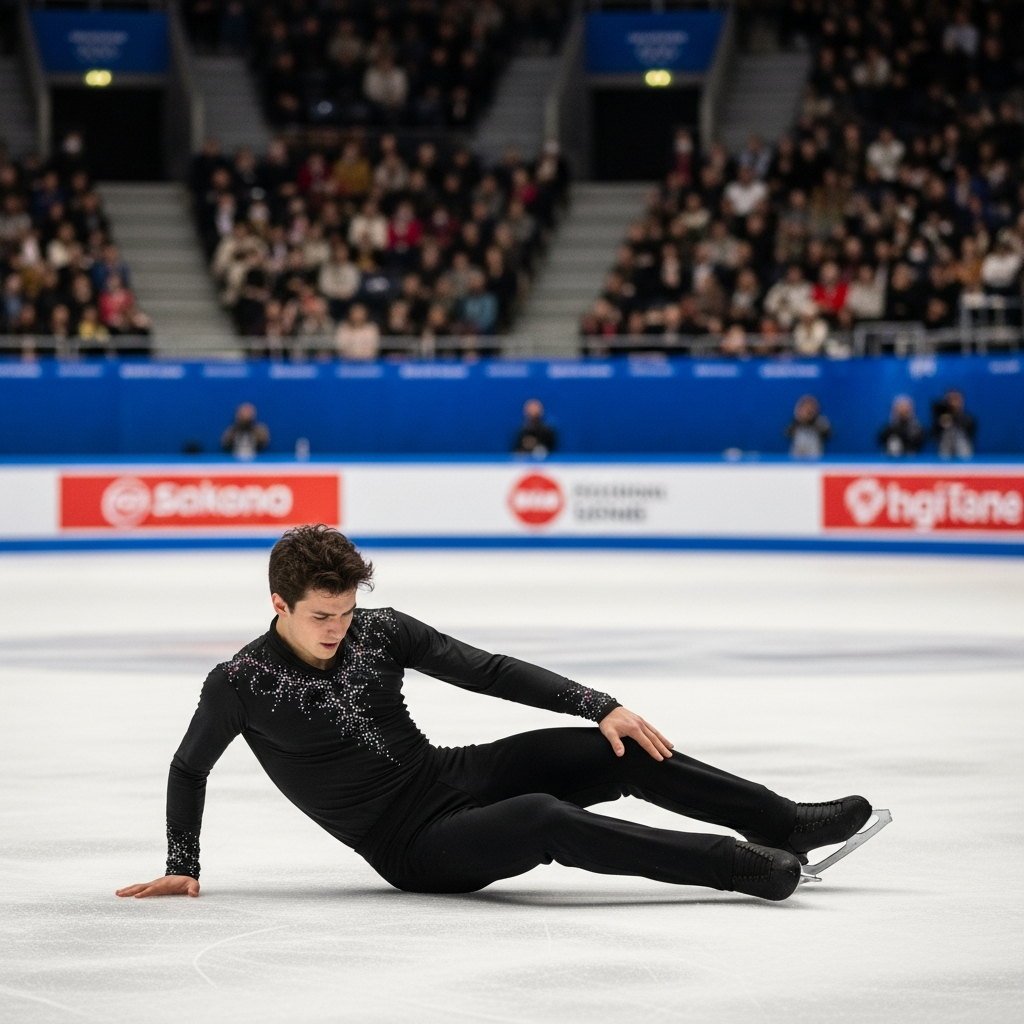
The 2026 Milan-Cortina Winter Olympics delivered an unparalleled moment of athletic drama. Figure skating fans worldwide watched in disbelief as American sensation Ilia Malinin, dubbed the “Quad God” and the undeniable favorite for gold, suffered a catastrophic collapse. What was expected to be a triumphant coronation turned into one of the most unexpected breakdowns in Olympic history, leaving spectators stunned and Malinin in an incomprehensible eighth place.
Malinin, 21, arrived at his first Winter Games with immense expectations. He boasted a two-plus-year unbeaten streak across 14 competitions, including two world championships, and had already helped Team USA secure a second consecutive team gold in Milan. After the short program, Malinin held a commanding lead of over five points. With his primary Japanese rival having delivered a shaky performance, many believed Malinin wouldn’t even need to attempt his signature quadruple axel to secure the gold. Yet, the pressure of the Olympic stage proved to be an entirely different challenge.
The Unraveling: A Detailed Look at Malinin’s Free Skate Implosion
What seemed inevitable for Ilia Malinin became tragically inconceivable during his free skate. The program, planned with an ambitious record-tying seven quadruple jumps, began promisingly. Malinin landed a quad flip, earning a near-perfect 15.84 points. However, the subsequent jumps painted a different picture.
The Critical Mistakes That Cost Gold
The turning point arrived with his highly anticipated quad axel attempt. A jump only Malinin has successfully landed in competition, requiring 4½ revolutions, it held a base score of 12.50 points, with potential for an additional five points. Instead, he “popped” the jump, aborting it into a single axel and receiving little more than a point. This single error alone cost him a potential 16-point swing.
The dominoes continued to fall. While he managed a quad lutz, the second most difficult four-revolution jump, a planned quad loop was downgraded to a double loop. Then came the first fall on an attempted second quad lutz, preventing a crucial combination. After landing a quad toe loop, he again dropped to the ice on a planned quad salchow. Stunned commentator and 1998 Olympic champion Tara Lipinski estimated Malinin lost almost 72 points solely on these unexpected jumping mistakes.
This series of errors dramatically altered his score. Malinin’s final individual free skate score was 156.33 points, a stark contrast to his personal best competition score of 333.81. He ultimately finished with a total of 264.49 points, plunging from first after the short program to eighth overall.
An Unexpected Podium: Shaidorov’s Golden Moment
While Malinin grappled with his performance, other skaters seized the opportunity. Kazakhstan’s Mikhail Shaidorov, who started in fifth place after the short program, delivered a career-best free skate. He climbed through the ranks to clinch the gold medal with a total score of 291.58 points. His victory marked Kazakhstan’s first Olympic figure skating champion and only its second Winter Games gold medalist since the nation’s independence in 1994. Shaidorov himself appeared in disbelief, covering his mouth in shock upon realizing his achievement.
Japan’s Yuma Kagiyama, who many expected to challenge Malinin directly for gold, secured his second consecutive Olympic silver medal with 280.06 points. His performance, while not flawless, was buoyed by Malinin’s dramatic struggles. His compatriot, Shun Sato, rounded out the podium, claiming the bronze medal with 274.90 points. The final standings revealed a significant shift from the expected outcome.
Men’s Figure Skating Final Results: Milan-Cortina 2026
Gold: Mikhail Shaidorov (Kazakhstan) – 291.58 points
Silver: Yuma Kagiyama (Japan) – 280.06 points
Bronze: Shun Sato (Japan) – 274.90 points
8th Place: Ilia Malinin (USA) – 264.49 points
The Mental Game: Malinin’s Reflections on Pressure
In the aftermath, a visibly emotional Malinin struggled to articulate what had gone wrong. He later told NBC, “I blew it,” describing the night as “one of the worst of his career.” When pressed on whether his struggles were physical or mental, his answer was unequivocal. “It was definitely mental,” he confessed. “Now, finally experiencing that Olympic atmosphere, it’s crazy. It’s not like any other competition.”
He also attributed some of his struggles to overconfidence. “I felt like going into this competition I was so ready,” he explained. “But I think, maybe, I was too confident that it was going to go well.” This candid admission highlights the immense psychological toll of Olympic competition, even for the most dominant athletes. His implosion drew comparisons to other high-profile Olympic struggles, such as Mikaela Shiffrin’s mental block in slalom or Simone Biles’ loss of positioning in gymnastics.
Malinin also hinted that a lack of prior Olympic experience might have played a role. He suggested that if USA Figure Skating had sent him to the 2022 Winter Games in Beijing, where he finished second nationally at age 17, his failure might have been averted. The unique, overwhelming atmosphere of the Olympics is a common challenge for debut athletes, regardless of their talent.
Beyond Malinin: A Glimpse at Other Olympic Stories
While Malinin’s performance dominated headlines, the 2026 Milan-Cortina Olympics unfolded with many other compelling narratives. The U.S. women’s hockey team continued its dominant march to the semifinals, outshooting Italy 51-6 in their quarterfinal win. Team USA’s women’s curling squad also made history with a 9-8 victory over Canada, their first against their northern rivals in nine Olympic meetings.
The Games also saw emotional performances, like American skater Maxim Naumov, who competed in his first Olympics after tragically losing both parents in a plane crash. Off the ice, Ukrainian skeleton racer Vladyslav Heraskevych faced disqualification for a “helmet of remembrance” honoring athletes lost in the Russia-Ukraine War, sparking debate about political expression at the Games. These stories underscore the diverse blend of triumphs, heartbreaks, and controversies that define the Olympic experience.
Frequently Asked Questions
What were the primary reasons for Ilia Malinin’s unexpected collapse at the 2026 Winter Olympics?
Ilia Malinin attributed his dramatic performance decline primarily to mental pressure and overconfidence, stating the Olympic atmosphere was “crazy” and unlike any other competition. Key errors included “popping” his quad axel into a single, downgrading a quad loop to a double, and falling twice on planned quad lutz and quad salchow jumps. These technical mistakes, fueled by mental factors, led to a loss of approximately 72 points and his subsequent drop to eighth place.
Who won the gold, silver, and bronze medals in the 2026 Men’s Figure Skating Final after Malinin’s fall?
Following Ilia Malinin’s unexpected collapse, the medals in the 2026 Men’s Figure Skating Final were claimed by: Mikhail Shaidorov of Kazakhstan, who secured the gold medal with 291.58 points in a stunning upset; Yuma Kagiyama of Japan, who earned his second consecutive Olympic silver medal with 280.06 points; and Shun Sato, also of Japan, who took home the bronze medal with 274.90 points.
How significant was Ilia Malinin’s attempted Quad Axel in his overall performance breakdown?
Malinin’s attempted quad axel was a critical moment. As the only skater to land it in competition, it was a high-risk, high-reward element. His failure to complete it, reducing it to a single axel, immediately cost him a significant number of points – approximately 16 points compared to a successful execution with high degree of execution. This early error, both technically and psychologically, likely disrupted his confidence and set a negative tone for the rest of his free skate, making it a pivotal point in his overall performance breakdown.
Conclusion: The Enduring Legacy of Olympic Pressure
Ilia Malinin’s shocking performance at the 2026 Winter Olympics serves as a powerful reminder of the immense, almost incomprehensible pressure that elite athletes face on the global stage. Even the most technically brilliant and consistently dominant competitors can succumb when the stakes are at their highest. While his individual medal hopes were dashed, Malinin’s candid reflections offer valuable insight into the mental fortitude required for Olympic success. His story, alongside the unexpected triumphs of Mikhail Shaidorov and the Japanese medalists, will undoubtedly become a memorable chapter in Olympic history, highlighting that in the crucible of the Games, nothing is ever truly guaranteed.