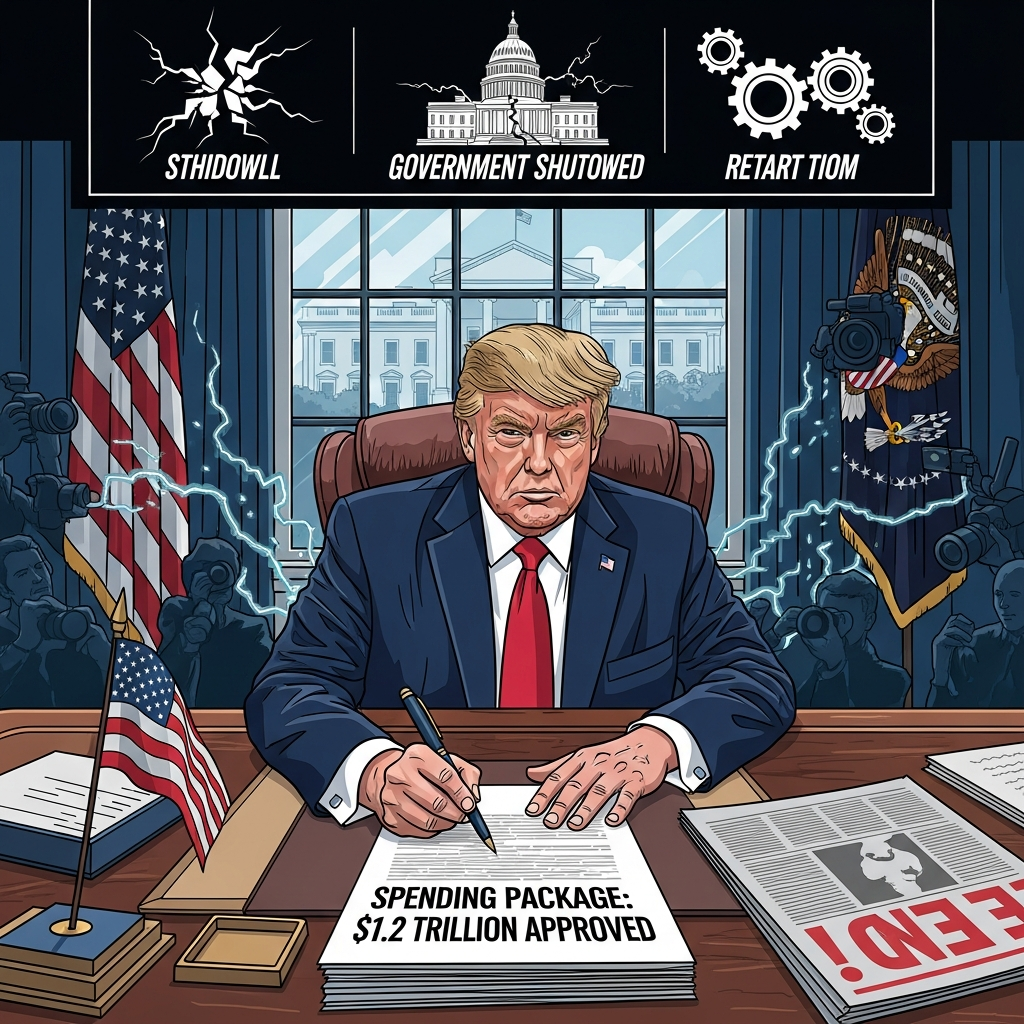
The United States government recently navigated another partial shutdown, a brief but disruptive halt to operations. On February 3, 2026, President Donald Trump signed a substantial $1.2 trillion spending package, effectively ending a four-day impasse that impacted numerous federal services and thousands of employees. While this agreement brought a temporary sense of relief, it simultaneously set the stage for a new and potentially more contentious legislative battle: the future of Department of Homeland Security (DHS) funding. This crucial agency, overseeing everything from border security to disaster relief, received only a two-week extension, creating a looming “budget cliff” set for February 13.
This article delves into the details of the agreement, the profound political divisions surrounding DHS, and what this intense congressional negotiation means for federal operations and the American public.
A Temporary Reprieve: The $1.2 Trillion Spending Deal
The recent partial government shutdown, which began on a Saturday, saw key federal departments like Defense, State, Education, and Treasury operating without full funding. The bipartisan spending package signed by President Trump provides full-year appropriations for most federal agencies through September, marking the end of the 2026 fiscal year. This comprehensive measure, designated H.R. 7148, the Consolidated Appropriations Act, 2026, passed the House of Representatives by a narrow 217-214 vote, following earlier Senate approval.
President Trump lauded the bill as a “great victory for the American people,” emphasizing its “fiscally responsible” nature. A crucial win for federal workers was the explicit guarantee of back pay for those who were furloughed or worked without compensation during the shutdown. This swift action followed initial uncertainty, as the Office of Personnel Management (OPM) had initially indicated that back pay would require specific legislative determination. With the bill’s passage, agencies were directed to promptly reopen, and employees returned to their posts.
However, the consensus achieved for the majority of government operations did not extend to the Department of Homeland Security. This strategic exclusion laid bare the deep political chasms defining current U.S. immigration policy.
The Looming DHS Funding Cliff: A Deeper Dive
The decision to grant DHS only a short, two-week funding extension—with a new deadline of February 13—was a deliberate move by lawmakers. It effectively isolated the most contentious component of the federal budget, allowing the rest of the government to operate while intense negotiations commenced over immigration enforcement and border security. This temporary solution, forged between Senate Minority Leader Chuck Schumer and the White House, immediately triggered a high-stakes 10-day sprint for Congress to find a full-year agreement for the agency.
The Catalyst: Minneapolis Shootings Spark Outcry
The urgency and gravity of the DHS funding debate were dramatically heightened by recent events in Minneapolis. The fatal shootings of two U.S. citizens, Alex Pretti and Renee Good, allegedly by federal immigration agents last month, ignited a national outcry and became a central rallying point for Democrats demanding reform. These tragic incidents brought renewed scrutiny to the tactics and accountability of federal immigration enforcement agencies, particularly Immigration and Customs Enforcement (ICE).
Public outrage over the Minneapolis killings prompted Homeland Security Secretary Kristi Noem to announce that federal agents in Minneapolis would immediately begin wearing body cameras, with a plan for nationwide expansion. However, this executive action was deemed insufficient by many Democrats, who argued that legislative action was necessary to ensure lasting, systemic change rather than relying on administrative policies that could be reversed.
Democratic Demands: Reforming Immigration Enforcement
Democrats, fueled by concerns over alleged abuses and a desire for greater accountability, are pushing for significant reforms within DHS immigration operations. Their demands are clear and specific:
Mandatory Body Cameras: Require federal immigration agents to wear body cameras during operations.
No Masks to Conceal Identity: Prohibit agents from wearing masks that obscure their faces, ensuring transparency and accountability.
Judicial Warrants for Home Entry: Require federal agents to obtain judicial warrants before entering private homes for enforcement purposes.
End Sweeping Patrols: Curb the practice of broad, roving patrols by immigration officials.
Code of Conduct & Use-of-Force Policies: Establish a uniform code of conduct and ensure federal agents adhere to the same use-of-force policies as state and local law enforcement.
Senate Minority Leader Chuck Schumer described these demands as “exceedingly commonsense,” while House Minority Leader Hakeem Jeffries warned that without “bold and meaningful change” to address “lawless, paramilitary tactics” by ICE, there would be “no credible path forward” for the agency’s full-year funding bill.
Republican Counterpoints and Concerns
Republicans, while acknowledging the need for effective border security, have voiced strong reservations about the Democratic reform proposals and the tight two-week negotiating window. House Speaker Mike Johnson, a close ally of President Trump, countered several key Democratic demands:
Impact on ICE and CBP Funding: Johnson argued that ICE and Customs and Border Protection (CBP) had already received substantial funding—$75 billion for ICE and $65 billion for CBP—last year, sufficient to fund them for “the next few years.” He suggested that a lapse in DHS funding would therefore primarily impact other critical agencies within DHS, such as the Federal Emergency Management Agency (FEMA), the Coast Guard, and the Transportation Security Administration (TSA), rather than directly halting immigration enforcement.
Operational Concerns: Johnson expressed concerns that requiring additional arrest warrants for individuals in the country illegally would be time-consuming and strain judicial resources. He also suggested that prohibiting masks and requiring visible identification could “create further danger” for agents.
Negotiation Timeline: Senate Majority Leader John Thune expressed deep skepticism about the two-week timeframe, calling it an “impossibility” given the “very different places” his Republican colleagues stood on the issue. He criticized Democrats for insisting on such a short window, highlighting the complexity of reaching a bipartisan agreement.
President Trump, during the signing of the initial budget, largely sidestepped the Democratic demands, instead focusing on his administration’s efforts to secure the southern border. This indicates the depth of the ideological divide, making a swift, comprehensive resolution challenging.
Beyond DHS: Broader Budgetary Implications
While the spotlight remains firmly on DHS, the larger $1.2 trillion funding package also contained other significant budgetary shifts. It aimed to trim overall discretionary spending while largely rejecting the Trump administration’s broader calls for major cuts across most agencies. A notable exception was the Internal Revenue Service (IRS). The agency saw an $11.6 billion rescission from its multi-year modernization funds, which had originally received $80 billion under the Inflation Reduction Act to rebuild its workforce and upgrade its legacy IT systems. These cuts have now reduced the IRS’s total modernization funding to $26 billion, available through 2031. This decision reflects ongoing political tensions over the agency’s resources and capabilities.
Navigating the Impasse: What Lies Ahead?
The two-week funding window for DHS has initiated a period of intense, high-stakes negotiations. The deep partisan divides on immigration enforcement, border security, and the role of agencies like ICE make achieving a full bipartisan deal exceptionally difficult. Lawmakers face a formidable challenge in bridging these gaps before February 13.
Many experts and congressional leaders, including Representative Robert Aderholt, a senior member of the Appropriations Committee, predict that another “kick the can down the road” scenario is highly probable. This could mean yet another short-term continuing resolution for DHS, potentially pushing a final agreement until March 1 or even later. Such a situation would maintain a state of uncertainty for the agency and its personnel, potentially impacting its long-term planning and effectiveness.
The current political landscape suggests that the debate over DHS funding and immigration enforcement will continue to be a defining feature of congressional activity, with each side maneuvering to achieve its policy goals while navigating the complexities of divided government. The coming days will reveal whether compromise or further temporary measures prevail in this critical legislative battle.
Frequently Asked Questions
What prompted the demands for ICE and DHS reforms?
The primary catalyst for the demands for reforms within Immigration and Customs Enforcement (ICE) and the Department of Homeland Security (DHS) was the fatal shootings of two U.S. citizens, Alex Pretti and Renee Good, by federal immigration agents in Minneapolis last month. These incidents sparked widespread public outrage and intensified calls from Democrats and civil liberties advocates for increased accountability, transparency, and changes to the operational protocols of federal immigration enforcement agencies.
Which federal agencies were impacted by the recent partial government shutdown?
The recent four-day partial government shutdown, which ended on February 3, 2026, primarily impacted federal departments whose full-year funding had not yet been approved. This included critical agencies within the Departments of Defense, State, Education, and Treasury, among others. Thousands of federal employees, including those in the Federal Aviation Administration (FAA) and air traffic control, were either furloughed or forced to work without pay. The shutdown also delayed the release of the Bureau of Labor Statistics’ monthly jobs report.
What are the key policy changes Democrats are seeking for DHS immigration enforcement?
Democrats are advocating for several specific policy changes regarding DHS immigration enforcement. These include mandatory requirements for federal immigration agents to wear body cameras during operations, a prohibition on agents wearing masks to conceal their faces, and a requirement for agents to obtain judicial warrants before entering private homes. Additionally, Democrats are pushing to end broad, roving patrols by immigration officials and to establish a uniform code of conduct and use-of-force policies that align with those of state and local law enforcement.