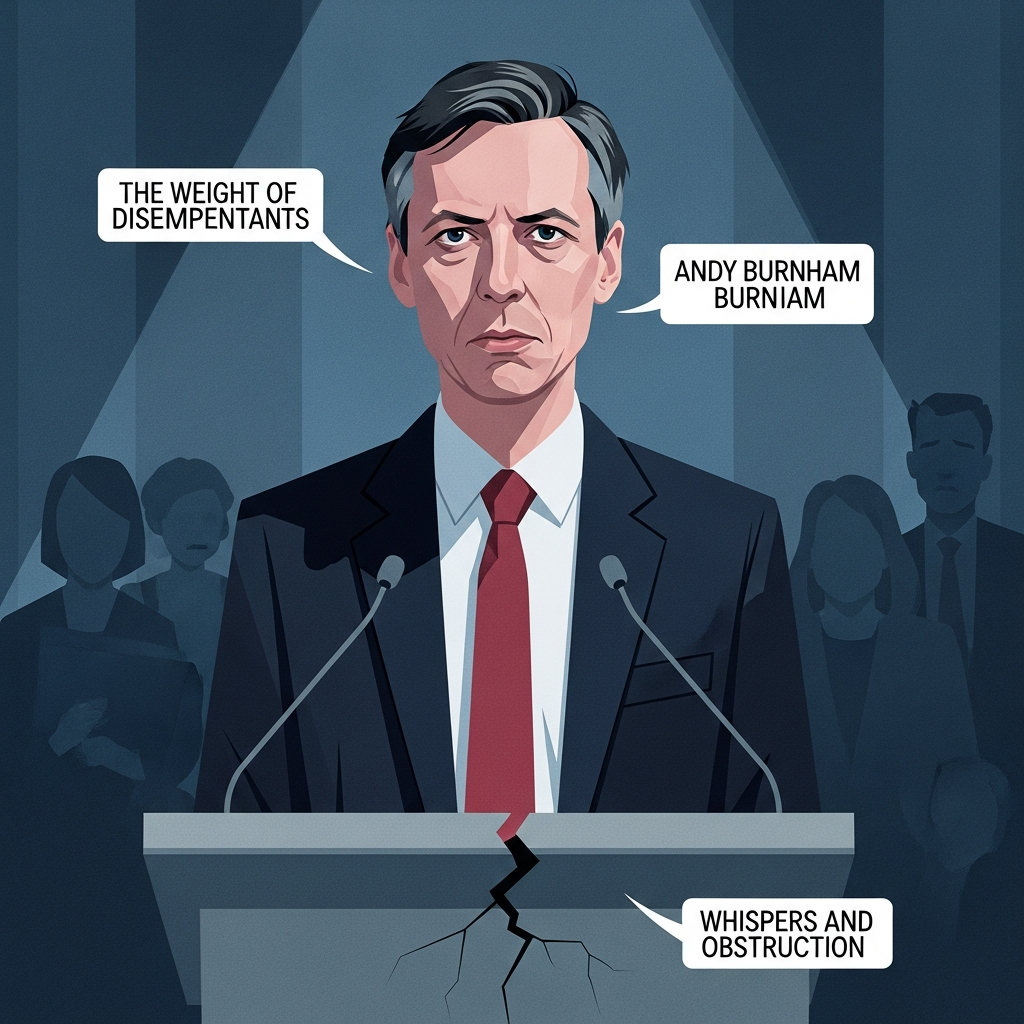
The political landscape within the Labour Party is once again gripped by internal strife following a contentious decision by its ruling body. Andy Burnham, the popular directly elected Mayor of Greater Manchester, has expressed profound “disappointment” after the party’s National Executive Committee (NEC) blocked his application to stand as a candidate in the upcoming Gorton and Denton parliamentary by-election. This move, widely seen as a calculated political gamble by allies of Prime Minister Sir Keir Starmer, has ignited a fierce backlash, exposing deep fault lines within the party at a critical juncture.
Labour’s Stated Reasons for the Block
The Labour Party officially justified its decision by citing practical and financial concerns. The NEC argued that allowing Burnham to stand for Parliament would trigger an “unnecessary mayoral election” for Greater Manchester. Such a contest, they claimed, would deplete “substantial amounts of taxpayers’ money and resources” during a national cost-of-living crisis. The previous mayoral election reportedly cost around £4.7 million, with Labour also facing “hundreds of thousands of pounds” in party campaign expenses.
Furthermore, Labour emphasized the broader strategic implications. With crucial local elections, and contests for the Scottish Parliament and Welsh Senedd on the horizon in May, party resources are stretched thin. Diverting significant campaign efforts to a Greater Manchester mayoral by-election was deemed a “substantial and disproportionate impact.” Despite confidence in retaining the mayoralty, the NEC asserted it “could not put Labour’s control of Greater Manchester at any risk.” Local Government Secretary Steve Reed echoed this, pointing to the “huge inconvenience to two million voters” a snap mayoral election would cause.
The NEC’s Vote: A Display of Central Control
The decisive vote, which took place on Sunday morning, saw 10 members of the NEC, including Sir Keir Starmer himself, weigh in on Burnham’s application. The outcome was a clear 8-1 vote in favour of blocking Burnham’s candidacy. Prime Minister Starmer was among those who voted against. Deputy Leader Lucy Powell was the sole member to vote in favour of allowing Burnham to stand, while Home Secretary Shabana Mahmood, who chaired the NEC meeting, abstained. This vote underscores a firm assertion of control from the party’s central leadership.
Unpacking the Political Subtext: More Than Just Costs
While Labour presented logistical and financial arguments, political analysts and internal critics quickly pointed to deeper, more strategic motivations at play. Many observers view the decision as an “exercise of brute power” by Sir Keir Starmer, consolidating his authority over the party’s institutions since becoming leader. Andy Burnham has long been perceived as a potential leadership challenger should he return to Westminster. Allies of Starmer reportedly feared that Burnham’s presence in Parliament would inevitably lead to questions about his leadership ambitions, creating a “psychodrama” that could destabilize the party.
One senior Labour source supportive of Burnham’s bid bluntly called the decision “madness,” suggesting Starmer’s allies were “gambling the PM’s whole premiership on winning a very hard by-election without their best candidate.” This perspective suggests a deeper fear of internal rivalry, prioritizing Starmer’s stability over democratic choice for local members or the strength a popular figure like Burnham could bring. Scottish Secretary Douglas Alexander explicitly framed the decision as being driven by “focus than factionalism,” aiming to avoid the “distraction of a mayoral by-election.”
Burnham’s Response and Allegations of Process Flaws
Andy Burnham did not shy away from criticizing the decision and its handling. He conveyed his disappointment and concern for the “potential impact on the important elections ahead of us.” More pointedly, he criticized the transparency of the process, alleging that the media was informed of the NEC’s decision before he was. “The fact that the media was informed of the NEC decision before I was tells you everything you need to know about the way the Labour Party is being run these days,” Burnham stated on X, lamenting that “over 30 years of service would count for something but sadly not.” Labour sources, however, “categorically denied” this, stating they attempted to contact him shortly after the meeting.
Burnham had previously sought to allay leadership fears in his letter to the NEC, insisting he would return to Parliament “to support the work of the government, not undermine it.” He cited his motivation as preventing the “divisive politics of Reform from damaging” the region. Despite the setback, he pledged his “full focus” to his mayoral role and full support to Labour’s eventual candidate.
Widespread Internal Division and Fury
The NEC’s decision has triggered significant anger and division across the Labour Party. Numerous Labour MPs voiced their “fury” and disappointment. Former Shadow Chancellor John McDonnell was “absolutely furious,” describing the move as “weakness and cowardice” and “factionalism gone wild.” He warned Starmer not to “underestimate the depth of anger” among members, suggesting the decision could “hasten his demise if he’s not careful.” McDonnell dismissed the cost-saving argument as an “insult to people’s intelligence.”
Other critics, like MP Nadia Whittome, accused the leadership of “petty factional manoeuvring and settling personal scores above winning elections.” Some backbenchers reportedly circulated a letter urging the NEC to “reevaluate” its decision, warning that preventing Burnham from making his case to local members risked signaling that Labour “does not respect devolution.” Conversely, supporters of the decision, like MP John Slinger, welcomed the “quick and clear decision,” stating it allowed the party to “move on from the damaging, introspection and psychodrama of the last week.”
The Gorton and Denton By-election: A Crucial Test
The by-election in Gorton and Denton was necessitated by the resignation of former Labour minister Andrew Gwynne due to health grounds. The constituency is traditionally a Labour stronghold, with the party securing a 13,000-majority in 2024. However, recent national opinion polls show Labour trailing Reform UK, suggesting a potentially tougher fight. Supporters of Burnham believed he would have been a “frontrunner to win the seat,” and his blocking is seen as a “big political gamble” given Reform UK’s growing challenge. Starmer’s supporters reportedly worried Reform UK “would outspend us ten to one” in the campaign. Labour will now proceed with shortlisting and selecting another candidate, with local party members voting next weekend. The outcome of this by-election will undoubtedly be scrutinized for its implications on Starmer’s leadership and the party’s broader electoral strategy.
Frequently Asked Questions
Why was Andy Burnham blocked from his MP bid in the Gorton and Denton by-election?
Andy Burnham was blocked by Labour’s National Executive Committee (NEC) for a combination of official and political reasons. Officially, Labour cited the need to avoid an “unnecessary mayoral election” in Greater Manchester, which would incur significant costs (estimated at £4.7 million for taxpayers and hundreds of thousands for the party) and divert crucial campaign resources from upcoming local and national elections. Politically, the decision is widely interpreted as a move by Sir Keir Starmer’s allies to prevent a potential leadership challenge from Burnham and assert Starmer’s control, avoiding internal “psychodrama” and perceived factionalism within the party.
Who made the decision to block Andy Burnham’s parliamentary candidacy, and what was the vote count?
The decision to block Andy Burnham’s bid was made by Labour’s National Executive Committee (NEC). The vote was 8-1 against Burnham’s candidacy, with one abstention. Prime Minister Sir Keir Starmer was among the 8 members who voted to block him. Deputy Leader Lucy Powell was the sole member who voted to allow Burnham to stand, while Home Secretary Shabana Mahmood, who chaired the meeting, abstained from the vote.
How might this decision impact Sir Keir Starmer’s leadership and the Labour Party’s unity?
This decision has sparked significant internal division and “fury” within the Labour Party. Critics, including prominent MPs like John McDonnell, have accused Starmer’s leadership of “weakness,” “cowardice,” and “factionalism gone wild,” warning it could “hasten his demise.” The move is seen as a “big political gamble,” particularly if Labour struggles in the Gorton and Denton by-election. While it asserts Starmer’s control over the party, it comes at the cost of alienating a significant segment of members and backbenchers, potentially undermining party unity and providing fodder for rivals, especially Reform UK.
Conclusion: A High-Stakes Political Manoeuvre
The blocking of Andy Burnham from the Gorton and Denton by-election represents a high-stakes political manoeuvre by Sir Keir Starmer and the Labour Party leadership. While justified with practical arguments about costs and resource allocation, the underlying current of leadership protection and factional control is undeniable. The swift and decisive action has undeniably asserted Starmer’s authority, but it has simultaneously inflamed deep-seated tensions within Labour. As the party moves to select another candidate for the by-election, all eyes will be on the outcome and its subsequent impact on Starmer’s leadership and Labour’s fragile unity ahead of crucial electoral battles. The drama surrounding Andy Burnham’s thwarted return to Westminster is a potent reminder of the complex power dynamics at play within one of the UK’s major political parties.
References
- www.bbc.com
- www.aol.com
- www.independent.co.uk
- <a href="https://www.huffingtonpost.co.uk/entry/andy-burnham-disappointed-and-concerned-by-move-to-block-mp-biduk69765963e4b084939e04c7b2″>www.huffingtonpost.co.uk
- news.sky.com