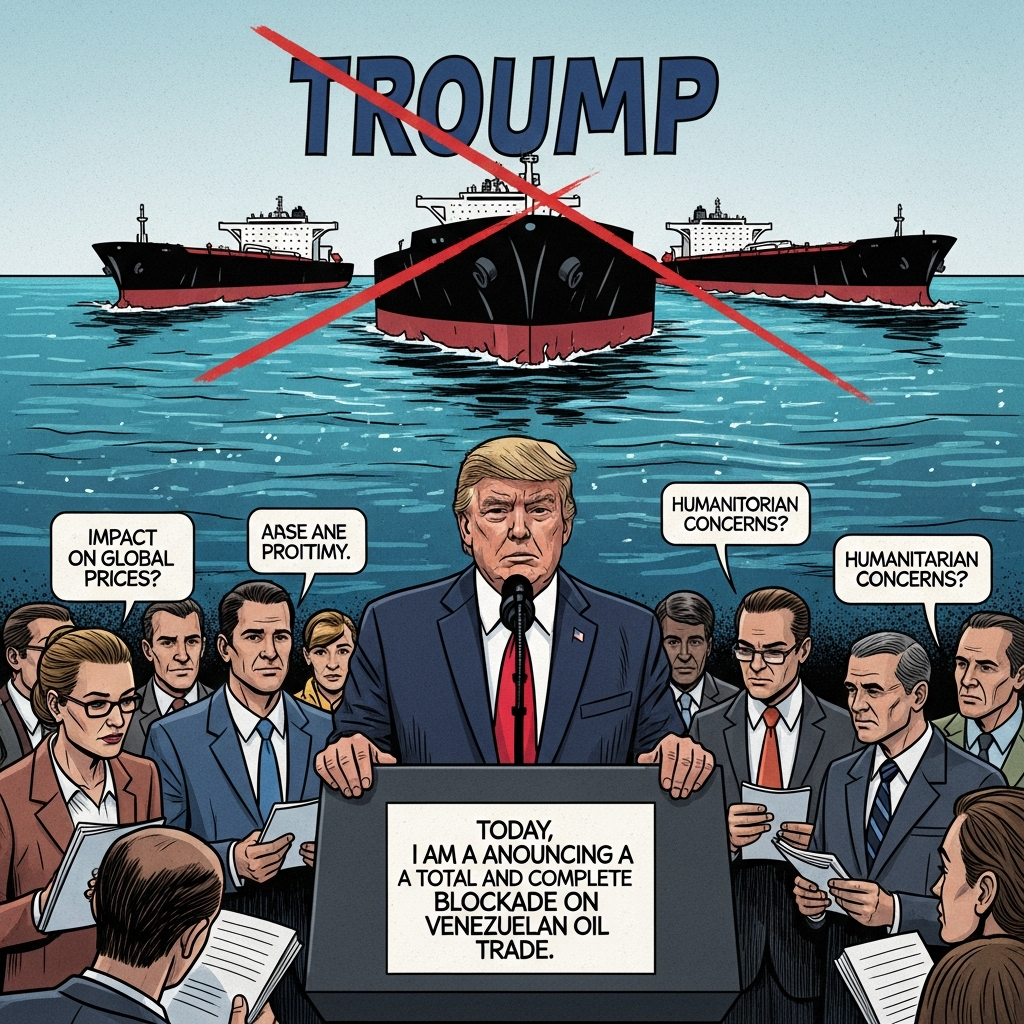
The United States dramatically escalated its pressure on Venezuela, with former President Donald Trump announcing a “total and complete blockade” targeting sanctioned oil tankers entering and leaving the South American nation. This unprecedented order, communicated via social media, signaled a significant tightening of economic sanctions and a heightened military posture in the Caribbean. Caracas swiftly condemned the move as an act of war and a blatant violation of international law.
The Blockade Order: A Major Escalation
In a series of strong declarations, Donald Trump announced a “TOTAL AND COMPLETE BLOCKADE OF ALL SANCTIONED OIL TANKERS” linked to Venezuela. He claimed the nation was “completely surrounded by the largest Armada ever assembled,” promising further military growth. The order intensified an already fraught relationship, pushing the US campaign against Nicolás Maduro’s government into new and uncertain territory. This decisive action aimed to further cripple Venezuela’s oil-dependent economy and destabilize Maduro’s rule.
Trump’s Justification and Rhetoric
Trump justified the blockade by asserting that Venezuela used its oil revenues to finance what he termed “Drug Terrorism, Human Trafficking, Murder, and Kidnapping.” He further designated the Venezuelan regime as a “FOREIGN TERRORIST ORGANIZATION,” an expansion of a previous designation of the “Cartel de los Soles.” This rhetorical escalation included demands for Venezuela to return “all of the Oil, Land, and other Assets that they previously stole from us,” referencing past expropriations of American oil company assets by the Chavez government in 2007. White House chief of staff Susie Wiles later clarified the administration’s aggressive intent, stating Trump “wants to keep on blowing boats up until Maduro cries uncle,” revealing the ultimate goal of regime change.
Venezuela’s Vehement Rejection
Venezuelan President Nicolás Maduro immediately rejected Trump’s threats. He declared that Venezuela would continue its oil trade, asserting the nation’s sovereign right over its natural wealth. Maduro denounced the declaration as a “reckless and serious threat” and an “act of international piracy,” arguing it violated international law, free trade, and freedom of navigation. The Venezuelan government accused the US of attempting to impose a naval military blockade to “steal the wealth that belongs to our homeland.” Venezuela announced plans to formally denounce this perceived violation before the United Nations, framing the US actions as an imperialistic attempt to colonize the nation and seize its vast resources.
A History of Pressure: Preceding US Actions
The blockade order was not an isolated event but the culmination of a series of aggressive actions by the Trump administration. For years, the US had employed stringent sanctions against the Maduro government, aiming for his removal amidst accusations of human rights abuses and rigged elections. The recent events brought a new level of military and economic coercion.
Tanker Seizures and Expanded Sanctions
Just a week before the blockade announcement, US forces seized the oil tanker “Skipper” off Venezuela’s coast. Officials alleged the vessel was part of an illicit network supporting terrorist organizations and illegally transporting oil between Venezuela and Iran, destined for Cuba. Venezuela labeled this seizure a “kidnapping” and “stealing” of the ship and crew. Following this, the US Treasury Department sanctioned six additional tankers (White Crane, Kiara M, H Constance, Lattafa, Tamia, Monique) and six shipping companies. These measures specifically aimed to cripple Venezuela’s oil sector, which the US claimed funded “Maduro’s illegitimate regime.” The sanctions package also extended to target Maduro family members and a business associate, broadening the net of financial pressure.
Deadly Maritime Operations
Parallel to economic sanctions, the US military had already intensified operations in the region. Since September, US forces conducted dozens of strikes on vessels allegedly carrying drugs in the Pacific and Caribbean, resulting in at least 95 fatalities. One incident involved a second strike on September 2 that reportedly killed survivors of an earlier attack, raising concerns among some US lawmakers about potential war crimes. While the Trump administration defended these strikes as successful in preventing drugs from reaching American shores, questions arose about the lack of public evidence for drug cargo and the boundaries of lawful warfare. These actions underscored the administration’s aggressive posture and willingness to employ kinetic force to achieve its policy objectives in Venezuela.
The Stakes: Venezuela’s Oil and Economy
Venezuela possesses the world’s largest known oil reserves, making oil exports the primary source of government revenue. This immense wealth lies at the heart of the geopolitical struggle. The US blockade threat, even if limited to sanctioned vessels, aimed directly at this vital lifeline.
Global Oil Market Implications
The news of the blockade sent ripples through the oil market, with prices anticipating a potential reduction in Venezuelan exports. While the global market was considered well-supplied at the time, a sustained and effective embargo could remove nearly a million barrels per day of crude supply, inevitably driving oil prices higher. Many loaded vessels carrying millions of barrels of oil remained stranded in Venezuelan waters, unwilling to risk seizure. This effectively created a de facto embargo even before explicit enforcement measures were fully clarified.
Navigating Sanctions: The “Shadowy Fleet”
Since the Trump administration imposed oil sanctions in 2017, Maduro’s government had resorted to a “shadowy fleet” of unflagged tankers. These vessels were crucial for smuggling crude into global supply chains, predominantly to China. The state-owned Petróleos de Venezuela S.A. (PDVSA) was largely locked out of conventional global markets, selling most of its exports at a steep discount on the black market. According to Francisco Monaldi, a Venezuelan oil expert, about 80% of Venezuela’s 850,000 barrels per day in exports went to China, with 15-17% to the US via Chevron Corp., and the remainder to Cuba. The blockade threatened to further isolate this already struggling system, even as Maduro reportedly offered stakes in Venezuela’s oil and mineral wealth in attempts to alleviate US pressure.
International Law and Domestic Scrutiny
The “total and complete blockade” raised significant questions about international law, sovereignty, and the legality of US actions. It prompted strong reactions both abroad and within the United States.
Legal Challenges and Sovereignty Concerns
Venezuela’s government vehemently asserted that Trump’s order violated fundamental principles of international law, free trade, and freedom of navigation. A traditional naval blockade, involving completely sealing a country’s coastline, is generally considered an act of war. While Trump’s announcement might have signaled more targeted tanker seizures rather than a full-scale naval blockade, the rhetoric alone represented a severe challenge to Venezuela’s sovereignty. The UN human rights chief, Volker Türk, had previously warned of an intensified crackdown on civic space in Venezuela, adding another layer of international concern to the volatile situation.
US Lawmakers Question Blockade Legality
Domestically, the blockade order drew criticism from some US lawmakers. Congressman Joaquin Castro, a Democrat from Texas, labeled the naval blockade “unquestionably an act of war,” arguing it was unauthorized by Congress and unwanted by the American people. Bipartisan scrutiny also emerged regarding the US military strikes, particularly after reports of civilian casualties and questions about the bounds of lawful warfare. Lawmakers called for transparency and accountability, demanding video evidence of the controversial September 2 strike. These concerns highlighted the complex legal and ethical considerations surrounding the aggressive US policy towards Venezuela.
The “Armada” and Enforcement Challenges
Trump’s dramatic claim of Venezuela being “completely surrounded by the largest Armada ever assembled in the History of South America” underscored the substantial US military buildup in the Caribbean. The US maintained a significant presence, including 11 warships, an aircraft carrier (the USS Gerald Ford), several amphibious assault ships, thousands of troops, and a wide array of aircraft. These assets provided extensive capabilities for monitoring marine traffic and conducting interdictions. While the exact method for enforcing a “total and complete blockade” was not immediately clear, the US Navy’s presence offered ample capacity for targeted operations against vessels deemed to be violating sanctions. This buildup served as a potent symbol of American resolve and its capacity to exert military pressure.
Behind the Scenes: The Real Aim
Beyond the stated justifications of combating drug trafficking and terrorism, the deeper strategic objective of the Trump administration’s actions appeared to be the ousting of Nicolás Maduro. The aggressive rhetoric, the expanded sanctions, and the military pressure collectively aimed to destabilize the Venezuelan government and force a change in leadership. The quote from Susie Wiles highlighted this explicit goal, suggesting a relentless campaign of pressure designed to make Maduro yield. This sustained pressure reflected years of US opposition to the Maduro government under both the Trump and Biden administrations, characterized by a commitment to his removal through various means.
Frequently Asked Questions
What exactly did Trump’s ‘total and complete blockade’ order entail for Venezuelan oil?
Donald Trump’s order announced a “total and complete blockade” specifically targeting sanctioned oil tankers entering or leaving Venezuela. While not necessarily a traditional full naval blockade, it aimed to prevent the movement of oil by vessels already identified as violating US sanctions. Trump justified this by alleging Venezuela’s use of oil revenue for “Drug Terrorism, Human Trafficking, Murder, and Kidnapping,” and by his administration’s expanded designation of the Venezuelan regime as a “FOREIGN TERRORIST ORGANIZATION.” This move was designed to further isolate and economically cripple the Maduro government.
What sequence of events and US actions preceded Trump’s order for a Venezuelan oil blockade?
The blockade order followed several escalating US actions. Just a week prior, US forces seized the oil tanker “Skipper” off Venezuela’s coast, claiming it was involved in illicit oil trade. This seizure was part of broader US efforts, which included expanding sanctions on numerous other ships, shipping companies, and even relatives of President Maduro. Additionally, the US military had conducted dozens of deadly strikes on alleged drug-smuggling vessels in the Caribbean and eastern Pacific since September, leading to approximately 95 fatalities and significant military buildup in the region.
How did Venezuela and the international community react to the US blockade threat?
Venezuela’s President Nicolás Maduro vehemently condemned the blockade order, rejecting it as a “reckless and serious threat,” an “act of international piracy,” and an attempt to “steal the wealth that belongs to our homeland.” Venezuela vowed to continue its oil trade and announced it would formally denounce the US actions before the United Nations. Domestically in the US, some lawmakers, like Congressman Joaquin Castro, criticized the blockade as an “unquestionably an act of war.” The oil market also reacted, with prices rising due to anticipated reductions in Venezuelan crude exports, while many loaded tankers remained in Venezuelan waters to avoid seizure.
Conclusion
The “total and complete blockade” order represented a profound escalation in the United States’ long-standing pressure campaign against Venezuela. By targeting the nation’s vital oil trade and coupling it with an aggressive military posture, the Trump administration sought to exert maximum economic and political leverage. While the immediate implementation details remained fluid, the declaration sent clear signals of intent, drawing sharp condemnation from Venezuela and raising concerns among international observers and even some US lawmakers. This pivotal moment underscored the deep complexities of international relations, economic warfare, and the contentious struggle over Venezuela’s vast natural resources.