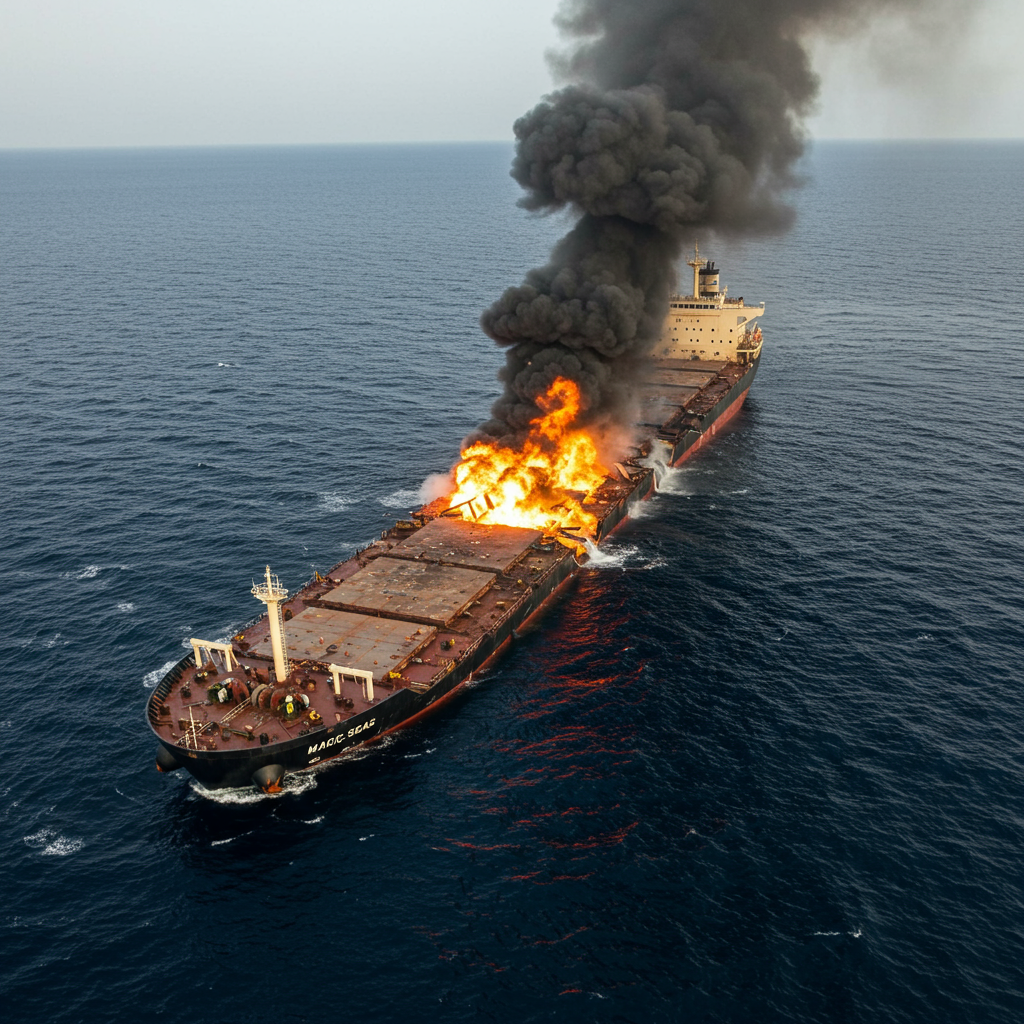
A significant incident unfolded in the vital Red Sea shipping lane this week as the crew of a Liberian-flagged bulk carrier, the Magic Seas, was forced to abandon their ship following a serious attack. The vessel, owned by Greece-based interests, suffered extensive damage, catching fire and taking on water after being struck by multiple projectiles. This assault marks a troubling return to aggressive action against commercial shipping in the area after a period of relative calm, reigniting concerns for global trade security and regional stability.
Ship Attacked Off Yemen Coast
The bulk carrier Magic Seas became the target of a complex assault while transiting northbound in the Red Sea. The attack occurred approximately 100 kilometers (about 60 miles) southwest of Hodeida, a key port city in Yemen controlled by the houthi rebels. Initial reports from maritime authorities and security firms painted a picture of a multi-stage attack.
According to the UK military’s United Kingdom Maritime Trade Operations (UKMTO) center, the situation began with gunfire targeting the vessel. An armed security team aboard the Magic Seas reportedly returned fire in an attempt to repel the attackers. Private maritime security firm Ambrey provided further detail, stating the ship was initially attacked by eight skiffs.
The assault escalated rapidly. Ambrey reported that after the initial small arms fire and rocket-propelled grenades (RPGs), the vessel was struck by bomb-carrying drone boats, technically known as Uncrewed Surface Vessels (USVs). Two USVs reportedly hit the port side of the ship, causing significant damage, including impacting the cargo area. The armed guards managed to destroy two additional drone boats, preventing further strikes.
The UKMTO later confirmed that the ship had been hit by “unknown projectiles” and was on fire. As damage mounted and the vessel began taking on water, the crew determined it was no longer safe to remain aboard. They abandoned the Magic Seas late Sunday night. Despite the severity of the incident and the need to abandon ship, initial reports indicated no injuries to the crew members.
Attribution and Geopolitical Context
Suspicion for the attack immediately fell on Yemen’s Houthi rebels. The location of the incident, near a Houthi stronghold, and the use of tactics like drone boats, which are associated with the group, strongly suggested their involvement. While Houthi-run media outlets acknowledged the attack occurred, the group did not immediately claim responsibility, a common practice where claims may follow hours or even days later.
However, officials from Yemen’s exiled government, which opposes the Houthis, were quick to assign blame. Moammar al-Eryani, the information minister, identified the attacked vessel as the Magic Seas and explicitly pointed to the Houthi rebels. Al-Eryani further alleged the attack was part of an “Iranian scheme” to destabilize the region and global economy, claiming Tehran continues to supply the Houthis with advanced military technology, including missiles and drones.
Maritime security analysts echoed the likelihood of Houthi involvement. Mohammad al-Basha, a Yemen analyst at the Basha Report risk advisory firm, suggested the attack served as a clear message. He noted it likely demonstrates the Houthis “continue to possess the capability and willingness to strike at strategic maritime targets regardless of diplomatic developments.” Ambrey also stated the targeted vessel met the “established Houthi target profile,” although specifics of this profile were not immediately detailed.
The attack on the Magic Seas unfolded at a highly sensitive time in the Middle East. Regional tensions remain elevated amid discussions for a potential ceasefire in the Israel-Hamas conflict. Additionally, Iran is reportedly considering restarting nuclear negotiations following recent U.S. airstrikes on Iranian nuclear facilities. The Houthis had previously reacted strongly to U.S. actions targeting Iran, warning of a response.
Broader Houthi Campaign Against Shipping
This incident is not isolated but falls within a sustained campaign by the Iran-aligned Houthi rebels against commercial and military shipping in the Red Sea and Gulf of Aden. The Houthis initiated these attacks in October 2023, stating their actions are in solidarity with Palestinians in Gaza during the ongoing conflict with Israel. They often claim, sometimes falsely, to target vessels linked to Israel, the U.S., or the UK.
The Houthi campaign has had a profound impact on global maritime trade. The Red Sea corridor, a crucial artery handling an estimated $1 trillion in goods annually, has seen traffic significantly reduced. Increased risks have led many shipping companies to reroute vessels around Southern Africa, drastically increasing transit times and costs by billions of dollars. This disruption affects global supply chains and the timely delivery and pricing of goods worldwide.
Between November 2023 and January 2025, the Houthis conducted over 100 documented attacks using missiles and drones. Tragically, these assaults have resulted in two ships sinking and, prior to recent events, four sailor fatalities.
The Houthis had observed a self-imposed ceasefire against shipping for a period, ending after the U.S. launched a broad assault against the rebels in mid-March. While the pause in attacks on vessels lasted for weeks, they continued occasional missile launches targeting Israel. The attack on the Magic Seas marks the first reported major assault on a commercial vessel in the Red Sea since April.
Recent Fatalities and Escalation
The Red Sea remains a dangerous zone for mariners. The attack on the Magic Seas occurred just days after another vessel, the Liberian-flagged bulk carrier Tutor, is believed to have sunk. The Tutor was struck by an explosive-laden uncrewed surface vessel (USV) approximately a week earlier. This fatal attack tragically killed one Filipino crew member who was in the engine room at the time. The remaining crew were rescued by the U.S. Navy. The sinking of the Tutor is the second loss of a vessel attributed to the Houthis since their campaign began, following the Rubymar in March.
Adding to the recent spate of attacks, a Palauan-flagged bulk carrier, the Verbena, sustained severe damage in the Gulf of Aden last Thursday. It was hit by two anti-ship cruise missiles fired from Houthi-controlled areas. The attack caused fires and serious injury to a crew member, who required medical evacuation. The remaining crew were forced to abandon the Verbena on Saturday due to uncontrollable fires, being rescued by another ship. U.S. military reports noted an Iranian warship nearby did not respond to the distress call.
These recent incidents underscore the persistent and escalating threat to innocent seafarers and commercial shipping. The use of sophisticated weapons like bomb-carrying USVs and anti-ship cruise missiles highlights the Houthis’ evolving capabilities and willingness to target vessels regardless of flag or destination.
Responses and Outlook
The international community has reacted to the Houthi aggression with a combination of military action and diplomatic efforts. The U.S. and UK have conducted repeated airstrikes on Houthi military targets in Yemen as part of an effort to degrade their capabilities. An international naval task force has been deployed to the Red Sea since December to protect commercial shipping, though the continued attacks demonstrate the challenges it faces.
In response to the attack on the Magic Seas and continued Houthi aggression, the Israeli military conducted airstrikes on Houthi targets in Yemen shortly before midnight on Sunday. Israel confirmed strikes on three Houthi-held ports – Hodeidah, Ras Isa, and Salif – as well as the Ras al-Khatib power station. The Israeli military stated these strikes were in response to “repeated Houthi attacks on Israel.” They also reportedly targeted the seized vessel Galaxy Leader, which Israel claimed the Houthis were using as a radar platform to track ships.
Other actors in the region’s waters include the Yemeni Coast Guard, loyal to the exiled government, and Somali pirates. However, neither of these groups is known to utilize advanced weaponry like bomb-carrying drone boats or anti-ship cruise missiles in the manner seen in these recent attacks, making the Houthis the primary suspects for the assault on the Magic Seas and others like the Tutor and Verbena.
The world’s leading shipping associations have issued joint statements condemning the assaults, emphasizing they violate the fundamental principle of freedom of navigation and deploring the targeting of innocent seafarers. They urge states with influence to ensure mariner safety and de-escalate the volatile situation.
The attack on the Magic Seas signals that the Red Sea crisis is far from over. The persistent threat from the Houthis, coupled with regional geopolitical tensions, ensures that this critical maritime route will remain high-risk for the foreseeable future. The economic costs and risks to human life highlight the urgent need for a resolution to the underlying conflicts driving this instability.
Frequently Asked Questions
What happened to the ship Magic Seas in the Red Sea?
The Liberian-flagged bulk carrier Magic Seas was attacked while transiting in the Red Sea off the coast of Yemen. The vessel was hit by multiple projectiles, reportedly including fire from skiffs, rocket-propelled grenades, and bomb-carrying drone boats (USVs). The attack caused a fire onboard, and the ship began taking on water, forcing the crew to abandon the vessel for safety. While the ship suffered significant damage, there were no initial reports of injuries to the crew members.
Which locations in Yemen were targeted by Israeli airstrikes after the attack?
Following the attack on the Magic Seas and citing repeated Houthi attacks on Israel, the Israeli military conducted airstrikes targeting Houthi positions in Yemen. The Israeli military confirmed strikes on three Houthi-held ports: Hodeidah, Ras Isa, and Salif. Additionally, the Ras al-Khatib power station was also targeted. These strikes occurred shortly before midnight on Sunday in Yemen.
What is the impact of Red Sea attacks on global trade and shipping?
Attacks on shipping in the Red Sea by groups like the Houthi rebels have caused significant disruption to global trade. As a critical maritime artery, the Red Sea handles approximately $1 trillion in goods annually. Increased security risks have led many shipping companies to reroute vessels around Southern Africa, substantially increasing journey times and shipping costs by billions of dollars. This impacts global supply chains, leading to delays and potentially higher prices for goods worldwide. The attacks also pose a direct threat to the safety and lives of seafarers.
Conclusion
The abandonment of the Magic Seas crew in the Red Sea is a stark reminder of the ongoing dangers in this crucial global shipping corridor. This incident, attributed by many to Yemen’s Houthi rebels, indicates a potential renewed intensity in their campaign against maritime traffic after a lull. Occurring amidst wider regional tensions and following other recent fatal attacks on vessels like the Tutor, it underscores the serious threat to international trade and the lives of seafarers. The swift Israeli military response targeting Houthi sites further illustrates the volatile nature of the situation. As shipping associations call for de-escalation and protection for mariners, the incident highlights the complex interplay of regional conflicts and their far-reaching consequences for global security and commerce. Addressing the root causes of instability in the region remains paramount to restoring safe passage through the Red Sea.
Word Count Check: 1216