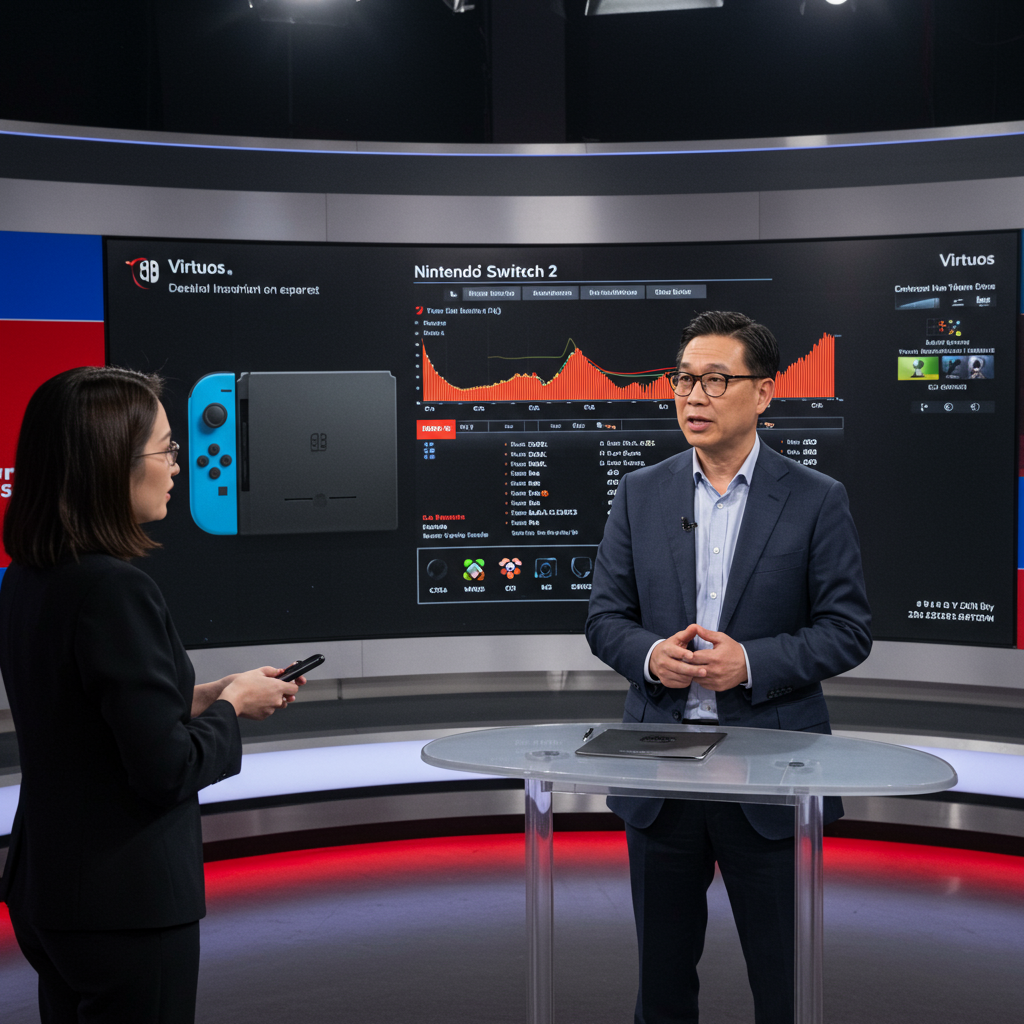
Game development experts are offering crucial insights into the potential performance of the upcoming Nintendo switch 2 console. A prominent figure from Virtuos, a studio renowned for bringing major game franchises to new platforms, suggests that developers could find it surprisingly simple to adapt titles running at 60 frames per second (FPS) on the Xbox series S for Nintendo’s next system. This assessment provides valuable context for understanding the Switch 2’s technical capabilities compared to current-generation hardware.
What a Porting Expert Says About Switch 2 Power
Virtuos is a massive name in the video game industry. Established in 2004, they are one of the world’s largest game development support studios. They specialize in co-developing triple-A games and, significantly for this discussion, porting existing titles to new consoles. Their extensive resume includes work on popular franchises like Call of Duty, Dark Souls, Battlefield, Uncharted, and Horizon. They are currently supporting Konami with the ambitious remake of Metal Gear Solid 3. This deep experience across multiple platforms lends significant weight to their technical analysis.
Eoin O’ Grady, who serves as the technical director at Virtuos subsidiary Black Shamrock, recently shared his perspective on the Nintendo Switch 2’s technical profile. Black Shamrock has worked on titles such as Grounded, Kerbal Space Program 2, and The Outer Worlds: Spacer’s Choice Edition. O’Grady offered a direct comparison between the anticipated capabilities of the Switch 2 and Microsoft’s Xbox Series S console.
Comparing Switch 2 and Xbox Series S Hardware
O’Grady noted that the graphics processing unit (GPU) capabilities of the two consoles appear “comparable overall.” He highlighted a key factor contributing to this: the Nintendo Switch 2’s expected support for DLSS (Deep Learning Super Sampling) upscaling technology. DLSS uses AI to render frames at a lower resolution and intelligently upscale them, providing a visual quality close to native high resolution but with significantly less performance cost. The Xbox Series S does not support this specific technology.
While O’Grady indicated that the Switch 2’s raw GPU power is slightly below that of the Series S, especially when in handheld mode, he believes DLSS helps bridge this gap effectively. This allows the Switch 2 to achieve comparable visual output and performance targets in many scenarios, despite potentially having less raw graphical muscle.
The central processing unit (CPU) comparison showed a clearer difference, according to O’Grady. He placed the Switch 2’s CPU performance closer to that of the PlayStation 4, describing it as “just a bit more powerful than the PS4’s.” He explained that the impact of this CPU difference varies depending on the game. Games are often more limited by GPU performance than CPU power when they are well optimized. However, CPU-intensive tasks like complex physics simulations, intricate character animations, or large numbers of on-screen entities can become bottlenecks.
Porting Games Between Series S and Switch 2
Based on this technical assessment, O’Grady expressed considerable optimism regarding the ease of porting games developed for the Xbox Series S to the Nintendo Switch 2. His most striking assertion was that “any game shipping at 60 FPS on the Series S should easily port to the Switch 2.” This suggests a strong performance baseline for Nintendo’s new console.
He further added that even 30 FPS games from the Series S should port well to the Switch 2, provided they are primarily limited by GPU performance rather than CPU power. This covers a broad range of modern titles. The primary challenges, he noted, would arise with games heavily reliant on complex CPU calculations. Titles featuring advanced physics engines, detailed AI routines, or extensive character interactions might require additional optimization effort to run smoothly on the Switch 2 at target frame rates (30 or 60 FPS).
The ease of porting 60 FPS Series S games is a significant potential advantage for the Switch 2. It implies that many graphically demanding titles designed for Microsoft’s smaller console could make their way to Nintendo’s platform relatively quickly. This could lead to a robust library of third-party games available shortly after the Switch 2 launches, addressing a desire from players for more AAA experiences on a portable device.
The Broader Picture for the Switch 2 Console
Beyond just technical comparisons, O’Grady shared a positive outlook for the Nintendo Switch 2’s potential market performance. He believes the new console could even surpass the phenomenal sales success of its predecessor, the original Switch, which has sold over 150 million units globally. Such an achievement would place the Switch 2 among the best-selling consoles ever released.
Several factors contribute to this optimistic forecast. Nintendo commands a massive, loyal fanbase eagerly awaiting the next hardware generation. Crucially, the handheld gaming market is experiencing significant growth. The original Switch played a pivotal role in revitalizing this sector, alongside the emergence of powerful handheld PCs like the Steam Deck. O’Grady sees gamers increasingly prioritizing the ability to play high-quality, ‘AAA’ games on the go. The Switch 2 is perfectly positioned to capitalize on this trend, offering a powerful handheld experience with modern graphics.
Nintendo itself has expressed confidence regarding the Switch 2’s launch and supply. Following the console’s introduction, Nintendo of America president Doug Bowser stated that the company expects to meet US demand throughout 2025. This suggests a strong production plan is in place to avoid the stock shortages that often plague new console launches.
New Features and Market Strategy
The Switch 2 isn’t just a power upgrade; it introduces new features aimed at enhancing the user experience. Bowser confirmed the console starts at a higher price point ($450), explaining that it was “built from the ground up.” Key gameplay enhancements stem from its upgraded processing power, promising “high fidelity graphics” a noticeable step up from the original model.
The new Joy-Con controllers also feature significant improvements. They now attach magnetically for easier connection and detachment. A particularly innovative feature is their ability to function as a mouse in compatible games. For social interactions, the Switch 2 includes built-in video and voice chat accessible with a simple button press, fostering a “virtual living room” feel for online play. Nintendo has noted that while the main console price remained as announced, some accessory prices did increase, reflecting economic conditions and tariff considerations.
The industry landscape is also shifting towards multiplatform releases. Square Enix, for instance, is bringing Final Fantasy 7 Remake Intergrade to the Nintendo Switch 2, following its initial exclusivity on PlayStation. While porting can present technical challenges—as seen with the Final Fantasy 16 port on Xbox Series X exhibiting resolution and detail compromises compared to the PS5 version, even while achieving a locked 60 FPS in gameplay—the strategic move to reach wider audiences is clear. Virtuos’s positive assessment of porting from Series S to Switch 2 aligns well with this trend, indicating that making modern games available on Nintendo’s new platform might be technically feasible for many titles.
The combination of increased power, new features, a growing market for handheld AAA gaming, and apparently straightforward porting paths from a current-gen console like the Xbox Series S paints a promising picture for the Nintendo Switch 2’s future. The insights from experienced porting studios like Virtuos provide tangible evidence of the console’s potential performance capabilities.
Frequently Asked Questions
What did Virtuos say about Nintendo Switch 2 power vs Xbox Series S?
A technical director from Virtuos subsidiary Black Shamrock stated that the Nintendo Switch 2’s overall GPU capabilities are comparable to the Xbox Series S. This comparison is largely due to the Switch 2’s expected use of DLSS upscaling technology, which the Series S lacks. The Switch 2’s CPU is considered closer in power to the PlayStation 4, though slightly more powerful.
How does DLSS help Switch 2 match Xbox Series S graphics power?
DLSS (Deep Learning Super Sampling) is a technology that uses artificial intelligence to boost frame rates and generate sharp images. It allows the Switch 2 to render games at a lower internal resolution but then upscale the output to a higher resolution using AI, making the visuals appear sharper and more detailed than traditional upscaling methods. This process is less demanding on the GPU than rendering natively at the higher resolution, helping the Switch 2 achieve graphical fidelity and performance comparable to the Series S in many scenarios, despite the Series S having slightly stronger raw GPU power.
Which Xbox Series S games are easiest or hardest to port to Switch 2?
According to the Virtuos technical director, any game running at a stable 60 FPS on the Xbox Series S should be “easily port[ed]” to the Nintendo Switch 2. Similarly, 30 FPS Series S games that are primarily limited by GPU performance are also expected to port well. The games that might face challenges or require extra optimization during porting are those with complex physics, elaborate animations, or other elements that heavily strain the CPU, as the Switch 2’s CPU is closer to PS4 levels than the Series S.