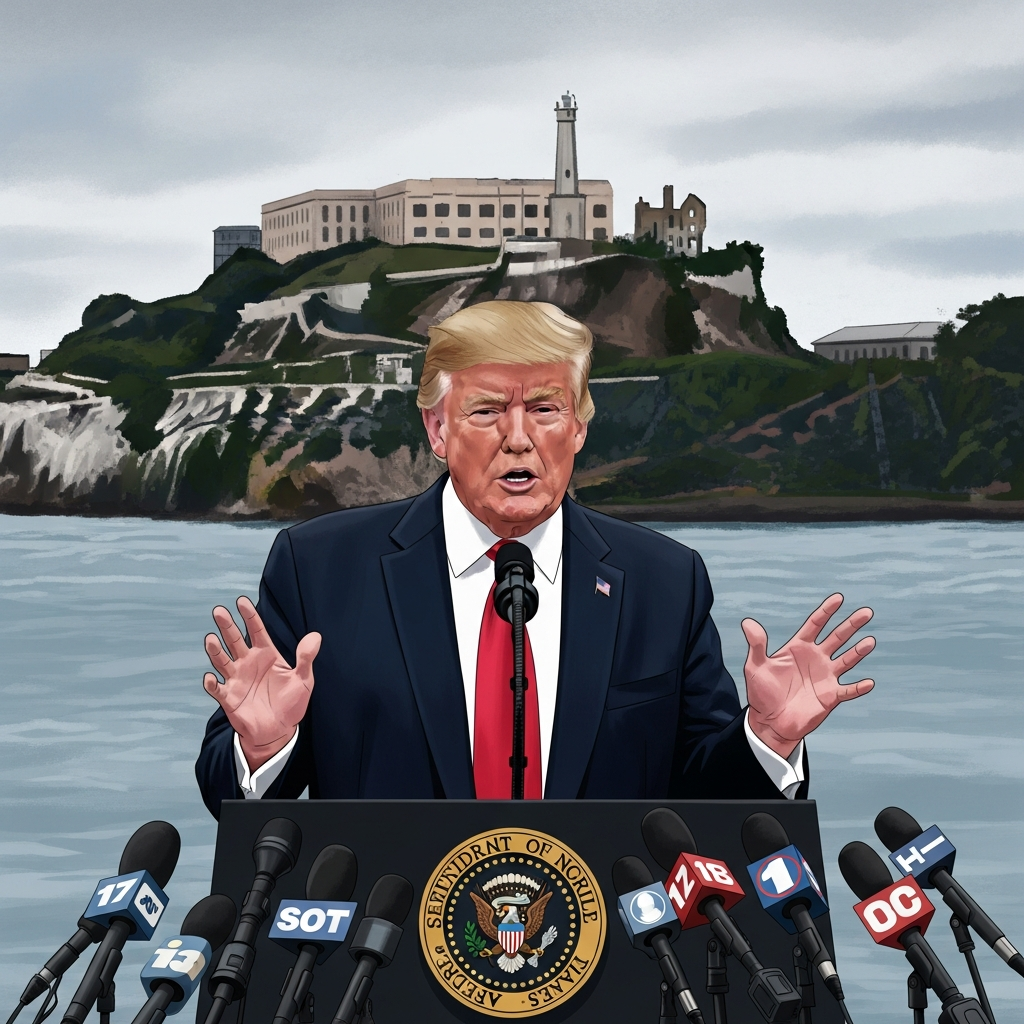
A politically charged proposal by former President Donald Trump to convert Alcatraz Island back into a functioning federal prison is gaining renewed attention. Trump’s administration recently requested $152 million from Congress for fiscal year 2027 to begin “rebuilding” the historic San Francisco Bay site. This move resurrects a polarizing concept first floated last year, aiming to transform the iconic landmark, which has served as a museum for over 60 years, into a “state-of-the-art secure prison facility.” The request has ignited fierce debate among lawmakers and local officials, many of whom are questioning the project’s financial viability, legal hurdles, and impact on a cherished national historic site.
Trump’s Resurfaced Alcatraz Vision
President Trump has consistently framed the reopening of Alcatraz as a symbol of “law and order,” envisioning it as a place to house “America’s most ruthless and violent Offenders.” He previously told reporters that the site “represents something very strong, very powerful,” despite also calling it “rusting and rotting.” The $152 million sought in the proposed budget for FY2027 is intended to cover only the initial year of costs. However, the total duration and comprehensive budget for the project remain unclear.
Despite the significant financial request, tangible progress on the initiative appears limited. The Bureau of Prisons (BOP) stated in April 2026 that it had no new information regarding the potential project. They offered no updates on assessments supposedly launched the previous year. A BOP spokesperson indicated the bureau was “moving forward, evaluating, and formulating the actions necessary.” They referenced a May 2025 statement from Director William K. Marshall, who pledged to “vigorously pursue all avenues to support and implement the President’s agenda.” Last year, then-Attorney General Pam Bondi and Interior Secretary Doug Burgum visited Alcatraz. Bondi suggested it “could hold the worst of the worst, it could hold middle-class violent prisoners, it could hold illegal aliens,” highlighting its historical impregnability.
A Political Priority Facing Practical Roadblocks
The White House’s Office of Management and Budget confirmed that “reopening Alcatraz is a Presidential priority” reflected in the budget. However, the administration’s critics, including many Democrats, argue that little groundwork has been laid. The BOP had previously stated that no final decision was made. They indicated they would determine its operational, legal, and financial feasibility, working on cost estimates and reports after site assessments with the National Park Service (NPS).
Alcatraz: From Military Fort to Federal Penitentiary
The history of Alcatraz Island dates back to 1775 when Spanish explorer Juan Manuel de Ayala named it “Isla de los Alcatraces,” or “island of the pelicans.” It served as a military fort and prisoner-of-war camp from 1850 until 1933. The Department of Justice took over the island in 1933. They transformed it into a maximum-security federal penitentiary in 1934, specifically for the nation’s most dangerous criminals. Infamous inmates like Al Capone were among those held within its walls. Several escape attempts, mostly unsuccessful, cemented its legendary status.
The federal prison closed its doors on March 21, 1963, after 29 years of operation. The primary reason for its closure was the prohibitively high operational costs and deteriorating infrastructure. Following its abandonment, a group of Native American activists occupied the island from 1969 to 1971. In 1972, Alcatraz became a national recreation area under the management of the National Park Service. It opened to the public as a national park attraction in 1973 and was later designated a National Historic Landmark.
The Costly Truth: Why Alcatraz Shut Down Originally
Operating a prison on Alcatraz Island was always a logistical nightmare and a financial drain. At the time of its closure in 1963, the Bureau of Prisons estimated that Alcatraz’s operating expenses were approximately three times higher than any other federal facility. This extreme cost was due to several critical factors:
Geographic Isolation: As an island 1.5 miles offshore in San Francisco Bay, all food, supplies, and personnel had to be transported by boat.
Lack of Fresh Water: Alcatraz lacked a natural fresh water source. This required nearly 1 million gallons to be barged in each week, adding significantly to expenses.
Crumbling Infrastructure: By 1963, the facility faced an estimated $3-5 million in restoration and maintenance costs. This was on top of its exorbitant daily operational expenses.
Limited Capacity: Even at its peak, Alcatraz housed only 260 to 275 inmates. This represented less than 1% of the federal prisoner population, making it an inefficient use of resources for such high costs.
The decision to close Alcatraz was a pragmatic one, driven by the unsustainable economic burden and the challenges of maintaining a facility in such a unique environment.
Political Firestorm: Widespread Opposition to Reopening
President Trump’s proposal has met with robust and bipartisan opposition, especially from Democratic lawmakers. Rep. Nancy Pelosi (D-San Francisco), now Speaker Emerita, quickly vowed to block the “stupid” proposal by any means possible. She called it “nothing more than a waste of taxpayer dollars” and an “insult to the intelligence of the American people.” Pelosi emphasized that Alcatraz is a “historic museum that belongs to the public” and that San Franciscans would not allow it to become a “political prop.”
Other key figures echoed these sentiments. Sen. Patty Murray (D-Washington), vice chair of the Senate appropriations committee, argued that Trump would waste taxpayer money on Alcatraz. This, she noted, would happen “while ignoring billions of dollars in repair-backlog needs for existing” federal prisons. Sen. Adam Schiff (D-Calif.) called the plan “prohibitively expensive” and a “wasteful exercise in futility.” He suggested it was part of an “attack by the Trump administration on national parks.” State Sen. Scott Wiener, a potential successor to Pelosi, labeled the plan the “epitome of waste, fraud, and abuse” and asserted that “making Alcatraz a prison again isn’t a thing.” San Francisco Mayor Daniel Lurie dismissed the idea as “not a serious proposal.”
Immense Hurdles: Financial, Logistical, and Legal Challenges
The push to reopen Alcatraz as a prison faces numerous insurmountable challenges beyond political opposition. Critics and experts point to staggering potential costs, complex logistical issues, and stringent legal protections.
Exorbitant Costs: The $152 million requested is only for the first year. Estimates for merely restoring the facility and constructing a new operational prison range from at least a quarter of a billion dollars to over $2 billion, significantly higher than Trump’s initial budget. Reopening it would mean re-establishing all utilities, including a fresh water supply, which historically required nearly 1 million gallons to be barged in weekly.
Logistical Nightmares: The island’s isolation, which once made it secure, now presents a major impediment to modern prison operations. Transporting staff, inmates, food, and supplies across the bay daily would be incredibly costly and complex. The existing infrastructure is severely dilapidated, lacking proper water supply and sewage systems.
Legal Protections: Alcatraz Island is currently administered by the Department of the Interior as part of the Golden Gate National Recreation Area. This area was established by Congress in 1972 as a federally recognized national park. Federal law mandates that the National Park Service and the Department of the Interior “preserve the recreation area, as far as possible, in its natural setting, and protect it from development and uses which would destroy the scenic beauty and natural character of the area.” The land is also protected under the Historic Preservation, National Environmental Protection, and Park Service Organic acts. These federal protections would render the operation of a prison on the site “virtually impossible.”
Economic Impact: Alcatraz currently thrives as a major tourist attraction, drawing over 1.5 million visitors annually and generating approximately $60 million in revenue for the National Park Service and tens of millions more for the regional economy. Reopening it as a prison would eliminate this significant economic benefit.
Frequently Asked Questions
What is President Trump proposing for Alcatraz Island?
President Trump is proposing to “rebuild” Alcatraz Island and return it to operational use as a federal prison. He requested $152 million from Congress in his proposed budget for fiscal year 2027 to cover initial costs. Trump has publicly stated his desire to house “America’s most ruthless and violent Offenders” there, viewing it as a symbol of “law and order” despite acknowledging its dilapidated state.
Why is there significant political opposition to reopening Alcatraz as a prison?
The proposal faces strong opposition primarily from Democratic lawmakers and local officials who deem it “absurd” and a “waste of taxpayer dollars.” Critics, including Speaker Emerita Nancy Pelosi, highlight Alcatraz’s status as a historic museum and national park. They argue that turning it into a prison again would be prohibitively expensive, logistically unfeasible, and an attack on national park lands, diverting funds from existing federal prison needs.
What are the primary historical and logistical challenges for an Alcatraz prison reopening?
Historically, Alcatraz was closed in 1963 primarily due to its exorbitant operating costs, which were three times higher than other federal prisons. The island lacks a fresh water source, requiring massive amounts to be barged in weekly, and its infrastructure is severely deteriorated. Logistically, its isolation makes transporting personnel, inmates, and supplies incredibly complex and costly. Additionally, federal laws protecting Alcatraz as a national park and historic landmark present significant legal hurdles to its conversion into a modern correctional facility.
Conclusion: A Costly Proposition with a Historic Price Tag
President Trump’s proposal to reopen Alcatraz as a federal prison is a complex issue intertwined with history, politics, and economics. While presented as a strong statement on “law and order,” the plan faces overwhelming challenges. The island’s history reveals its original closure was due to astronomical operational costs and decaying infrastructure. Modern estimates suggest restoring it would require billions, far exceeding the initial $152 million request. Furthermore, the island’s current status as a protected national park and major tourist attraction creates significant legal and economic barriers. Given the widespread political opposition and the immense practical difficulties, the prospect of “The Rock” returning to its former function seems highly improbable, destined to remain a costly political concept rather than a feasible reality.