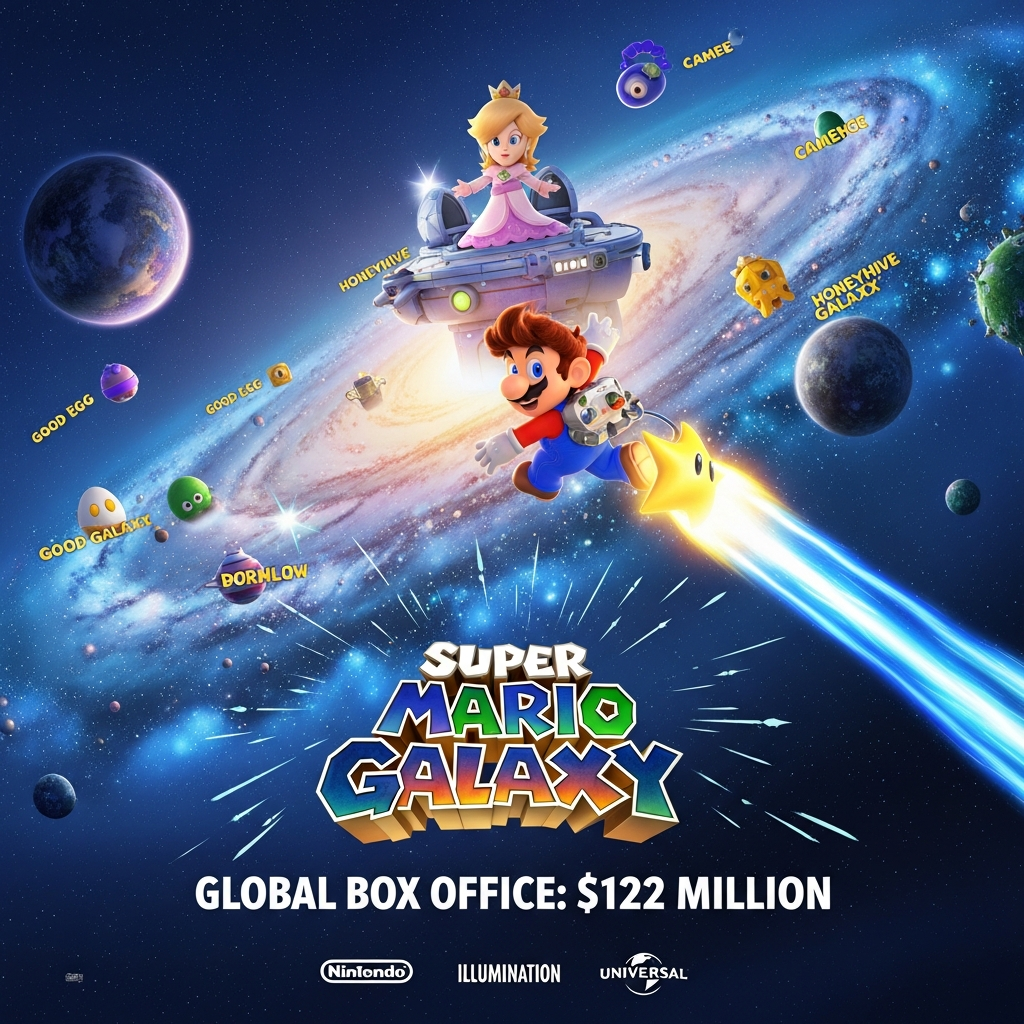
The cinematic universe of Nintendo continues its dazzling expansion with The Super Mario Galaxy Movie, an animated sequel that has rocketed to an impressive global box office haul. In just its first two days of release, the Illumination/Nintendo/Universal collaboration surpassed expectations, grossing a phenomenal $122.1 million worldwide. This stellar performance not only mirrors the success of its groundbreaking predecessor but also positions the franchise for even greater heights. Fans and critics are buzzing about Mario’s latest adventure, solidifying its place as a significant contender in the animated film landscape.
Galactic Box Office Triumph: A Stellar Opening
The highly anticipated sequel to 2023’s The Super Mario Bros. Movie has delivered a truly spectacular debut. In its initial 48 hours, The Super Mario Galaxy Movie accumulated a global total of $122.1 million. This figure subtly outperforms the first film’s $120.7 million over the same period, demonstrating a remarkable 1.1% increase. Such a strong start signals enduring global appeal for the beloved Italian plumbers and their companions.
Early Numbers Soar Past Expectations
Domestically, in the U.S. and Canada, the film captured $59.1 million during its Wednesday and Thursday run. Internationally, the Super Mario Galaxy Movie secured an additional $63 million from 78 markets. This international showing directly aligns with the first movie’s initial overseas performance. Thursday alone saw overseas markets contribute $27.9 million, slightly ahead of the original’s $27.6 million on the same day. These numbers confirm the sequel has harnessed the same “rocket fuel” that propelled the first Super Mario Bros. Movie to over $1.3 billion globally.
International Markets Lead the Charge
The film’s opening day, Wednesday, set a new benchmark, achieving a global figure of $68.4 million. Of this, $33.9 million originated from international territories. This initial global tally also outstripped the first Super Mario Bros. Movie‘s reported opening day gross of $66.4 million. Mario’s console game legacy clearly translates into robust ticket sales across the globe, especially in Europe and Latin America.
Key markets worldwide shattered records:
Mexico soared with a $6.7 million opening day, becoming Universal’s biggest opening ever and the second-largest animated debut in the country. Its two-day total reached $12.5 million, commanding an astounding 85% market share.
UK & Ireland posted a $4.3 million Wednesday preview, marking the second-highest single-day animated preview in the region’s box office history. Their two-day sum hit $7.3 million.
Germany celebrated its biggest animated opening and Universal’s biggest opening ever with $3.8 million on Wednesday. The film quickly amassed $6.6 million by Thursday, making it the biggest opening week of the year.
Spain recorded a $3 million opening day, ranking as the second-highest animated opening and third-biggest overall opening day ever. Its two-day cume stood at $5.4 million, with a dominant 57% market share.
Central America saw its second-biggest Thursday gross ever, just behind Avengers: Endgame, outperforming the first Super Mario Bros. Movie by 4%. The region’s two-day total hit $2.3 million with an impressive 94% market share.
France delivered Illumination’s second-biggest opening of all time, excluding holiday periods, with $2.9 million.
Austria broke records for both Universal and animated films with a $700,000 opening day.
Italy contributed $1.5 million on opening day, reaching a $2.7 million running cume.
In China, early estimates for the first day showed $1.58 million, placing it as the top film, though it has a shorter 3-day opening weekend compared to the original’s 5-day.
Crucially, major markets like Japan, Korea, Israel, and Poland are scheduled for later openings. This staggered release strategy ensures sustained momentum and significant future box office growth. The global performance underscores the franchise’s sustained popularity and broad appeal.
A Universe Expanded: Plot, Characters, and Fan Service
The Super Mario Galaxy Movie offers more than just impressive box office numbers; it delivers an engaging narrative filled with fan-favorite characters and stunning visuals. While some critics note its familiar structure, the shift to an outer space setting provides “eye-catching and captivating” backdrops, enhancing the overall experience.
An Epic Space Adventure Unfolds
The film’s plot expands the cinematic lore, drawing significant inspiration from the critically acclaimed 2007 Wii game, Super Mario Galaxy. The story intricately weaves two main arcs: Bowser Jr.’s (voiced by Benny Safdie) determined quest to free his shrunken father, King Bowser (Jack Black), and Princess Peach’s (Anya Taylor-Joy) journey of self-discovery. Peach seeks answers about her mysterious past in the Mushroom Kingdom, a quest accelerated by a frightened Luma needing help to rescue Princess Rosalina.
Audiences witness a profound realization as Peach discovers that she and Rosalina (Brie Larson) are long-lost sisters. This revelation is central, as their combined powers become the key to saving the universe from Bowser Jr.’s destructive plans. The climax features a thrilling battle against Dry Bones Bowser and Bowser Jr., culminating in Peach and Rosalina dismantling Bowser Jr.’s power-draining machine and transforming his malevolent Planet Bowser into a vibrant utopia. Following their victory, the community, including Mario (Chris Pratt) and Luigi (Charlie Day), rallies to rebuild Peach’s castle, symbolizing unity and triumph. The core theme of “the power of sisterhood” resonates throughout the narrative.
New Faces, Familiar Voices, and Scene-Stealers
The sequel brings back the beloved primary cast, including Chris Pratt as Mario, Charlie Day as Luigi, and Anya Taylor-Joy as Princess Peach. Keegan-Michael Key returns as Toad, and Jack Black delights as Bowser. However, Galaxy introduces a host of exciting new characters and voice talents. Brie Larson shines as Princess Rosalina, a pivotal figure in Peach’s past. Benny Safdie lends his voice to the ambitious Bowser Jr.
Adding further star power and fan appeal, Donald Glover voices the charming Yoshi, a character many reviewers highlight as “stealing the movie.” Glen Powell brings his signature swagger to Fox McCloud, the “smart-aleck” protagonist from the Star Fox games, playing a substantial role. These new additions, alongside improved visuals, elevate the sequel. While some critics found Chris Pratt’s Mario performance “bland” in the first film, they noted he appeared “more engaged” in Galaxy. Larson, Taylor-Joy, Key, and Glover all receive praise for their performances, contributing to the film’s overall charm and entertainment value.
Paving the Way for a Nintendo Cinematic Universe
The success of The Super Mario Galaxy Movie is more than just a win for a single film; it’s a powerful validation for Nintendo’s ambitious cinematic universe strategy. The filmmakers cleverly lay groundwork for future installments, building anticipation and ensuring the franchise’s longevity.
Post-Credits Teases and Inevitable Sequels
True to modern blockbusters, The Super Mario Galaxy Movie features two crucial post-credits scenes that provide tantalizing hints about what’s next. The first mid-credits sequence shows Bowser and Bowser Jr. being transported to a snow-covered prison by Fox McCloud. There, they are greeted by the nihilistic blue star, Lumalee (voiced by Juliet Jelenic), who serves as their darkly humorous prison guard, taunting them with the “drum beat of death.”
The second, and arguably more significant, end-credits scene introduces a highly anticipated character: Princess Daisy. This scene depicts a mysterious figure intervening to stop a pilfering Ukiki. The camera then reveals a grinning Princess Daisy, distinct with her brunette hair and yellow-gold dress, making her cinematic debut. Having first appeared in the 1989 Super Mario Land game, Daisy is clearly positioned to play a “major role in whatever comes next.” This direct setup strongly suggests her inclusion in future Super Mario films.
The immense financial success of the first Mario movie, a “billion-dollar juggernaut,” coupled with the strong performance of The Super Mario Galaxy Movie, makes a third film an undeniable inevitability. Jack Black, Bowser’s voice actor, even teased a potential 2029 release for a third movie, hinting at another original song to follow the viral hit “Peaches.” This strategic expansion of the character roster and narrative possibilities signals a bright and expansive future for the Nintendo cinematic universe, promising more galactic adventures for years to come.
Frequently Asked Questions
What were The Super Mario Galaxy Movie’s global box office earnings in its first two days?
In its first two days of release, The Super Mario Galaxy Movie achieved an impressive global box office total of $122.1 million. This figure included $59.1 million from domestic markets (U.S. and Canada) and $63 million from international territories across 78 markets. This strong opening surpassed the performance of the first Super Mario Bros. Movie over the same period by 1.1%, signaling a robust start for the highly anticipated sequel.
Which key new characters were introduced in The Super Mario Galaxy Movie?
The Super Mario Galaxy Movie significantly expanded its cast with several fan-favorite new characters. Princess Rosalina, voiced by Brie Larson, plays a central role as Princess Peach’s long-lost sister. Bowser Jr., voiced by Benny Safdie, drives a key part of the plot with his quest to free his father. Additionally, Donald Glover voices the popular Yoshi, and Glen Powell lends his voice to Fox McCloud from the Star Fox series. The post-credits scene also introduces Princess Daisy, setting her up for future appearances.
How does The Super Mario Galaxy Movie set up future films in the Nintendo cinematic universe?
The Super Mario Galaxy Movie strategically paves the way for future installments through its plot and post-credits scenes. The film introduces major new characters like Princess Rosalina and Princess Daisy, clearly positioning them for significant roles in subsequent movies. The narrative successfully expands the world of Mario into outer space, demonstrating the vast storytelling potential. Furthermore, the two post-credits scenes, one featuring Bowser and Bowser Jr. imprisoned with Lumalee, and the other revealing Princess Daisy, directly tease ongoing storylines and the inevitable continuation of the highly successful Nintendo cinematic universe.
In conclusion, The Super Mario Galaxy Movie* has not only dominated the early box office but also successfully deepened the lore and expanded the character roster of the Nintendo cinematic universe. Its impressive global performance, record-breaking international debuts, and strategic setup for future installments underscore the immense appeal of Mario and his friends. This sequel proves that the magic of the Mushroom Kingdom, now stretching across the galaxy, continues to captivate audiences worldwide, solidifying the franchise as a major force in animated entertainment for years to come.