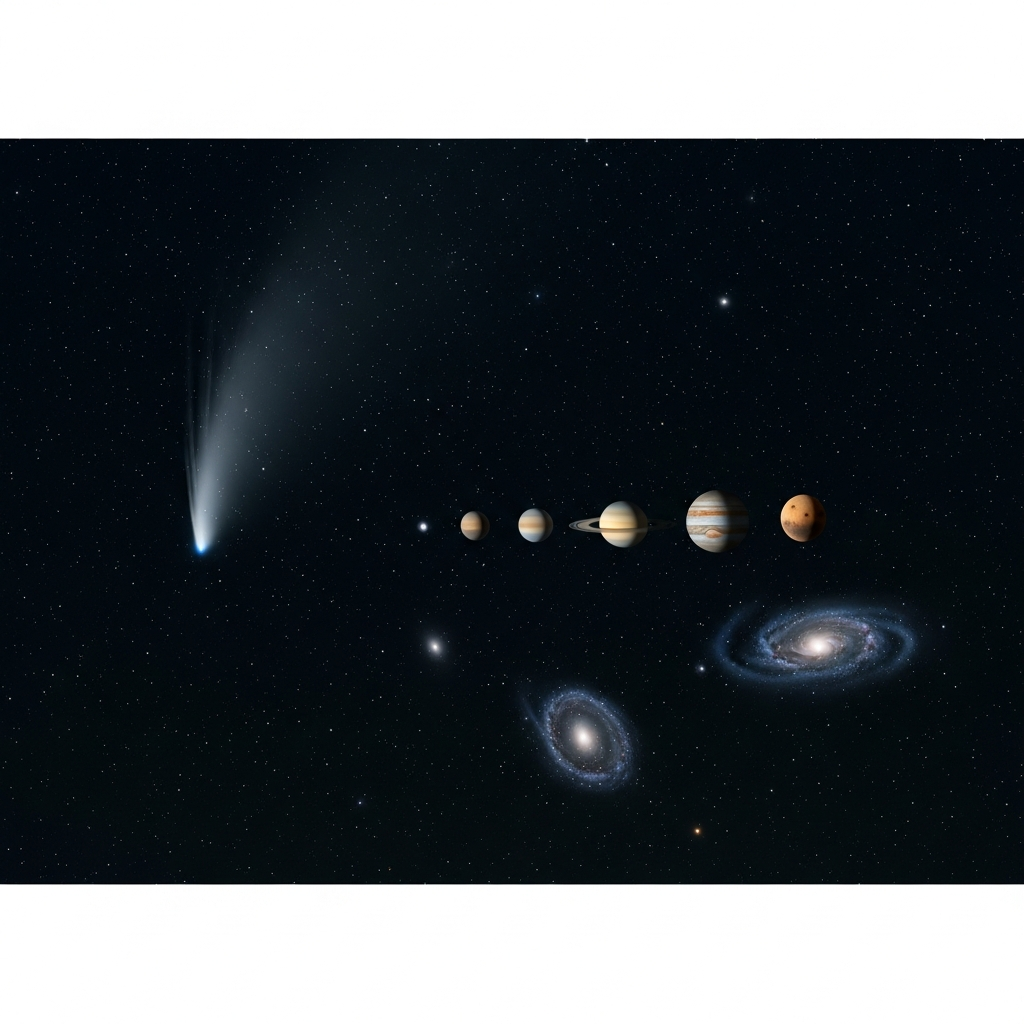
April 2026 promises a truly spectacular celestial show, offering skywatchers an unparalleled opportunity to witness breathtaking cosmic events. From a potentially naked-eye comet to a flurry of planetary alignments and distant galaxies, the night sky is set to be extraordinarily active. This comprehensive April skywatching guide will equip you with everything needed to navigate the stellar landscape, ensuring you don’t miss any of these unforgettable moments. Prepare your binoculars and telescopes, as we delve into the must-see events of the month, designed for both novice stargazers and seasoned astronomers alike.
Comet Pan-STARRS (C/2025 R3): A Potential Naked-Eye Marvel
The spotlight this April shines brightly on Comet Pan-STARRS (C/2025 R3), a celestial visitor first spotted in September 2025 by the Pan-STARRS2 telescope in Maui, Hawai’i. Since its discovery, this comet has steadily brightened, transitioning from an incredibly faint magnitude 19 speck to a more accessible magnitude 10 by late March. This means that under dark skies, a modest 6-inch telescope can already reveal its distinct nucleus and flowing tail.
Viewing Details and Tips for C/2025 R3
As April progresses, C/2025 R3 continues its brightening trend. By its closest approach to the sun, known as perihelion, on April 19, it’s projected to reach magnitude 7. At this brightness, the comet becomes an easy target for binoculars, offering a beautiful fuzzy glow. For early risers, the period from April 1-21 is prime viewing time. One hour before dawn, direct your gaze towards the eastern horizon to locate the distinctive Great Square of Pegasus. The comet will initially appear about 20 degrees above the horizon, a few degrees to the upper right of Pegasus’s box. It will then gradually descend each morning until April 10, after which it accelerates, hurtling through the Square and closer to the horizon before its “curtain call” on April 21.
Understanding Naked-Eye Potential
The true spectacle of C/2025 R3 hinges on its composition. The comet is currently positioned favorably between Earth and the sun, setting the stage for a dramatic display. If composed primarily of volatile ices and rock, it will likely remain a stunning binocular or telescopic object. However, if the comet is particularly dusty, its coma—the generated dust cloud surrounding the nucleus—could glow significantly brighter. This phenomenon, known as “forward scattering,” would direct sunlight off the dust particles towards Earth, potentially boosting its brightness to a fuzzy magnitude 3. Such an enhancement would elevate C/2025 R3 to naked-eye status, making it visible without any optical aid under sufficiently dark conditions. This prospect makes tracking Comet Pan-STARRS a truly exciting element of your April skywatching guide.
A Planetary Disco: April’s Conjunctions and Alignments
Beyond the comet, April will host a remarkable series of planetary conjunctions, with no fewer than six significant alignments occurring between April 13-23. These celestial dances offer fantastic opportunities to observe multiple planets in close proximity, creating stunning visual pairings.
Mercury’s Best Showing and Morning Encounters
Start your planetary exploration early in the month with Mercury, which reaches its greatest western elongation on April 4. At 28 degrees west of the sun, this marks its best visibility for the year in the morning twilight. The elusive planet will break above the eastern horizon just after 5:45 a.m., offering a prime viewing window approximately 45 minutes before the sun’s rising light overwhelms it. For the adventurous, a “raucous planetary disco” unfolds over the following days and weeks as Mercury, Saturn, Mars, and Neptune perform a complex celestial ballet. Binoculars are highly recommended to help distinguish these subtle pairings against the morning glow.
A more challenging, yet rewarding, conjunction takes place on April 13 at 4:40 a.m. when Neptune meets Mars. Due to the proximity to daybreak, a telescope will be necessary to clearly separate these planets from the ambient light. Crucially, exercise extreme caution during morning observations near sunrise. Never look at the sun through binoculars or a telescope without a proper solar filter, as instant and permanent eye damage will occur.
Evening Delights: Moon and Planet Pairings
The evening sky also provides its share of planetary beauty. On April 18, a two-day-old crescent moon will form a beautiful pairing with the exceptionally bright Venus (magnitude -3.9) low above the western horizon. This visual treat is easily enjoyed with the naked eye. The following night, the entrancing Pleiades open star cluster will position itself elegantly between the moon and Venus, creating a stunning cosmic triangle. To cap off the planetary action, April 23 brings a telescope-worthy Uranus-Venus conjunction in the evening. The primordial god of the sky, Uranus, will sit a cozy 0.8 degrees from the goddess of love, Venus, a tight alignment best appreciated through optical aid.
Jupiter, which has been a prominent fixture high near the zenith in Constellation Gemini for months, also offers a grand spectacle. On the night of April 22, watch for the waxing crescent moon and Jupiter to form a striking vertical pairing with Gemini’s head stars, Pollux and Castor. Seize this opportunity to observe the gas giant at its high altitude, as it will continue to set earlier each night and eventually move lower in the western sky by sunset in the coming months.
Deep-Sky Wonders: The Leo Triplet Galaxies
Beyond our solar system, the distant universe beckons. The constellations Leo and Leo Minor offer some truly spectacular deep-sky targets, culminating around 10 p.m. on April 10, when their midpoints cross the north/south meridian. While Leo itself is a compelling constellation, its true gems are the galaxies hidden within its borders.
Spotting M66, M65, and the Hamburger Galaxy
The most dramatic, accessible, and compelling of these galactic treasures is the renowned Leo Triplet. This grouping consists of three magnificent spiral galaxies: M65, M66, and the dust-lane-slashed NGC 3628, famously nicknamed the Hamburger Galaxy. In a small 3-inch telescope, these galaxies might appear as faint smudges of light. However, the larger your telescope’s mirror, the more apparent their intricate spiral structures and dusty lanes become. For a truly rewarding and impactful view, an 8-inch telescope used under dark skies is highly recommended, transforming these marginal smudges into awe-inspiring cosmic islands.
The Hubble Space Telescope has provided incredible insights into M66, the largest of the three Leo Triplet galaxies, situated approximately 35 million light-years away. M66 is classified as an interacting spiral galaxy, meaning its distinctive lopsided arms and slightly off-center core are believed to be distortions caused by the gravitational pull of its neighbors, M65 and NGC 3628. Spanning about 100,000 light-years, M66’s stunning Hubble image combines infrared, visible green light, and a special red light known as H-alpha. H-alpha is emitted by glowing hydrogen gas, beautifully revealing the bright regions where new stars are actively being born within the galaxy, offering a vivid glimpse into the lifecycle of stars and galaxies.
The Lyrid Meteor Shower: A Modest Celestial Rain
No April skywatching guide would be complete without mentioning a meteor shower. The Lyrid meteor shower, which appears to radiate from the constellation Lyra (the Greek kithara), will peak overnight on April 21-22. Astronomically, a “shower” refers to Earth passing through a debris field—in this case, Comet Thatcher’s meteoroid stream—rather than a guarantee of a high number of meteors.
What to Expect and Prime Viewing Conditions
While the Lyrids are not typically the most prolific shower, they can still provide a delightful experience. The Zenithal Hourly Rate (ZHR) for the Lyrids is expected to be between 15 and 20 meteors per hour, which is considered modest. However, viewing conditions this year are “close to ideal.” The moon will be slightly younger than first quarter and will set around midnight, minimizing its light pollution for the peak viewing hours. To maximize your chances, find a location far from city lights, lie back comfortably, and allow your eyes about 20-30 minutes to adapt to the darkness. Look towards the constellation Lyra, but keep your gaze wide, as meteors can appear anywhere in the sky.
The Pink Moon: April’s Full Moon
Rounding out the month’s celestial offerings is April’s full moon, occurring at 8:11 p.m. on a Wednesday. This full moon is traditionally known as the “Pink Moon.” This charming name does not refer to the moon’s actual color, but rather to the “moss pink” flower, Phlox subulata, a vibrant wild ground phlox that typically blooms around this time of year in North America. Take a moment to appreciate this luminous lunar display, a beautiful punctuation mark to a month packed with astronomical wonders.
Frequently Asked Questions
What makes Comet Pan-STARRS (C/2025 R3) potentially visible to the naked eye?
Comet Pan-STARRS (C/2025 R3) could become a naked-eye object due to its composition and favorable viewing geometry. If the comet is particularly dusty, its coma—the cloud of gas and dust surrounding its nucleus—can significantly brighten. This is enhanced by “forward scattering,” where sunlight reflecting off the dust particles is directed towards Earth, considerably boosting its luminosity. This effect, combined with its opportune position between Earth and the sun, could elevate its brightness to magnitude 3, making it observable without optical aid under dark skies.
Which planetary conjunctions are easiest to spot in April 2026?
For easy viewing, the conjunction between the two-day-old crescent moon and brilliant Venus on April 18 is highly recommended and easily visible to the naked eye low above the western horizon. Another great target is the vertical pairing of the waxing crescent moon and Jupiter with Gemini’s head stars Pollux and Castor on the night of April 22. While other conjunctions like Mercury with Saturn, Mars, and Neptune are occurring, they often require binoculars or telescopes and must be observed in the morning twilight, making them more challenging for casual observers.
What equipment is essential for viewing April’s deep-sky objects like the Leo Triplet?
To truly appreciate deep-sky objects such as the Leo Triplet galaxies, a telescope is essential. While they may appear as faint smudges in a 3-inch scope, their structures become much more apparent with larger mirrors. An 8-inch telescope is highly recommended under dark sky conditions for a “worthwhile rather than marginal” view, allowing you to discern the distinct spiral arms of M65 and M66, and the dust lane of NGC 3628. Binoculars are useful for wider fields of view and locating constellations but won’t resolve galaxy details.
Conclusion
April 2026 presents an extraordinary canvas of the cosmos, from the potential naked-eye brilliance of Comet Pan-STARRS to the intricate dances of planets and the majestic, distant swirl of galaxies. This April skywatching guide has highlighted the key dates and objects, offering practical advice to enhance your viewing experience. Whether you’re an experienced astronomer or a curious beginner, this month offers a unique opportunity to connect with the universe. So, check your local weather, find a spot away from light pollution, and look up! The wonders of the night sky await, ready to inspire and amaze.