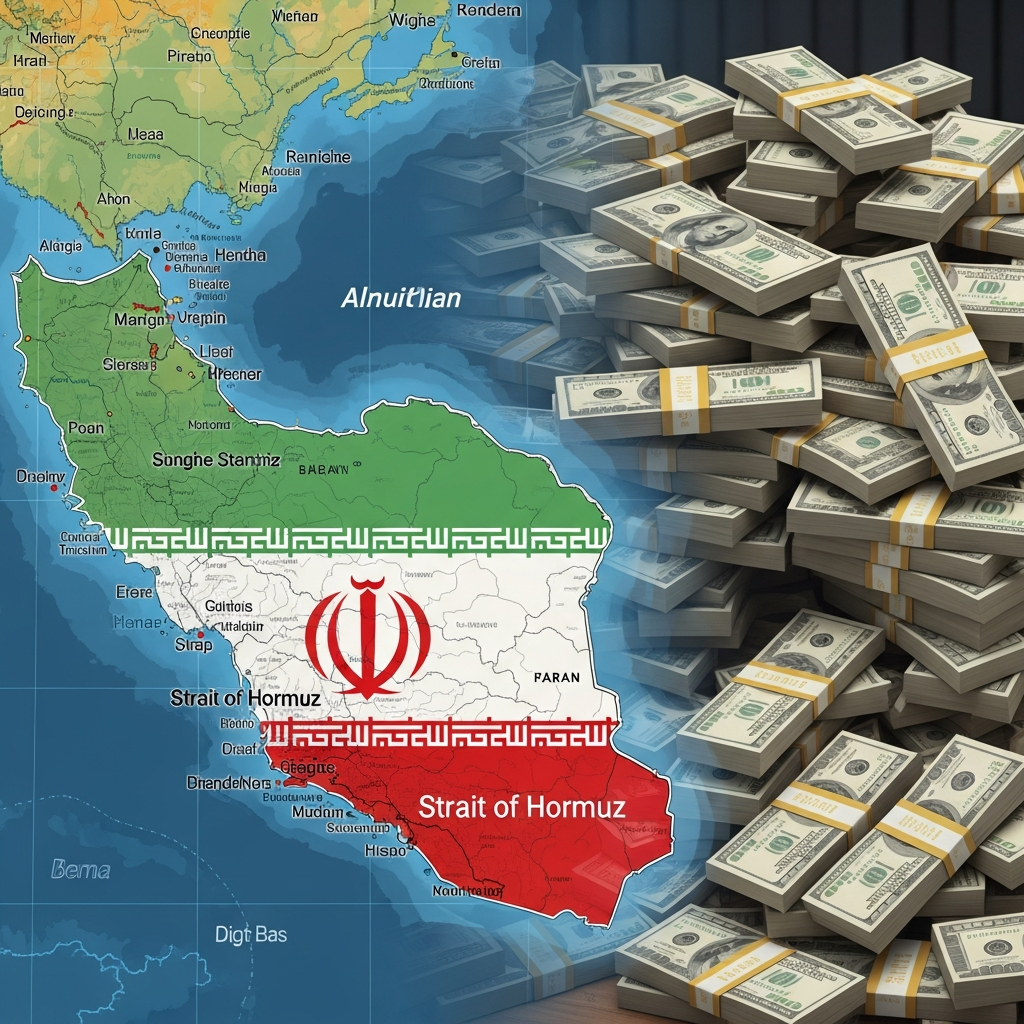
A new, audacious demand from Iran could fundamentally reshape global energy markets and bring billions into Tehran’s coffers. Amidst the ongoing conflict with the United States and Israel, an Iranian official recently unveiled a list of conditions for peace. Strikingly, this list included a novel item: official recognition of Iran’s sovereignty over the Strait of Hormuz, a critical maritime chokepoint. This strategic waterway, typically traversed by a fifth of the world’s oil and liquefied natural gas (LNG), has become Iran’s most formidable bargaining chip. Tehran now seeks to formalize its control, transforming this vital passage into a lucrative revenue stream and a potent pressure point on the global economy.
The Strategic Value of the Strait of Hormuz
The Strait of Hormuz, a narrow passage between the Persian Gulf and the Arabian Sea, holds immense geopolitical significance. For decades, Iran has periodically threatened to close it in response to perceived aggressions. However, few anticipated the sheer effectiveness of its current strategy in disrupting global trade flows. The scale of this disruption appears to have emboldened Tehran, pushing its ambitions beyond temporary blockades to a more permanent form of leverage.
Shipping through the strait has faced significant challenges, including Iranian attacks, pushing global energy markets into turmoil. Countries worldwide, far beyond the Persian Gulf, have been forced to implement emergency measures to secure vital fuel supplies. Experts like Dina Esfandiary, Middle East lead at Bloomberg Economics, note that Iran seems “a little taken aback by how successful its (Hormuz) strategy has been.” She adds, “One of the lessons learned in the war is that it has discovered this new leverage, and it’s likely to use it again in the future. And I think monetizing it is part of discovering that it has this leverage.”
Iran’s Conditions for Peace and the Toll Demand
Iran’s demand for Hormuz sovereignty is just one facet of its broader peace proposal. Tehran recently rejected a U.S. ceasefire plan, instead presenting its own five conditions for a comprehensive resolution to the escalating conflict. These include: an end to enemy aggression, concrete guarantees preventing future wars, a clear determination for peace, guaranteed payment of war damages and compensation, and a comprehensive end to the war across all fronts, including against all resistance groups. Critically, recognition of Iranian sovereignty over the Strait of Hormuz is integrated into this demand for a comprehensive end to the war.
Iranian officials, including Foreign Minister Abbas Araghchi, have emphasized that they are not directly negotiating with the U.S. but exchanging messages through intermediaries like Pakistan. They stated, “We do not want a ceasefire,” but an end to the war on Iran’s terms with reparations for damages. This firm stance is mirrored by Mojtaba Khamenei, Iran’s new supreme leader, who in his first purported address, stressed that the leverage of blocking the waterway “must continue to be used.”
The Quest for Billions: A Rival to the Suez Canal?
The financial implications of Iran’s proposed toll system are staggering. Iranian lawmakers are actively considering a bill that would require countries using the strait for shipping fuel and goods to pay transit fees. An adviser to the supreme leader has even spoken of a “new regime for the Strait of Hormuz” post-war. This system could allow Tehran to impose maritime restrictions on adversaries, effectively tying access to a crucial shipping lane to its geopolitical disputes.
While experts question the international acceptance of such a system, the potential revenues are immense. CNN calculations suggest that if successful, these revenues could rival those generated by Egypt’s Suez Canal. With approximately 20 million barrels of crude oil and oil products (roughly 10 very large crude carriers) passing through the strait daily, a reported fee of $2 million per tanker could translate to around $20 million a day, or $600 million a month, from oil alone. Including LNG shipments could push this figure to over $800 million a month, potentially accounting for 15-20% of Iran’s monthly oil export revenue. For context, the Suez Canal, an artificial, government-controlled waterway, typically earns Egypt $700-800 million monthly.
Legal Challenges and International Condemnation
The concept of a Strait of Hormuz toll faces significant legal hurdles under international law. James Kraska, a professor of international maritime law at the US Naval War College, clarifies that imposing transit fees is a “violation of the rules of transit passage.” He explains that there is “no legal basis under international law for a coastal state to charge fees in an international strait like Hormuz.”
The rules are primarily set out in the UN Convention on the Law of the Sea (UNCLOS). Although neither Iran nor the United States is a party to UNCLOS, many of its core principles are widely accepted as customary international law. Kraska notes that Iran might attempt to use its non-membership to bolster its case, but precedent offers little support. In the 19th century, Denmark charged fees through the Danish Straits but abolished them permanently after international protests led to the Copenhagen Convention of 1857.
Washington has vehemently rejected Iran’s demands. US Secretary of State Marco Rubio warned that a tolling system at Hormuz would be “illegal, it’s unacceptable, it’s dangerous to the world.” Following a G7 meeting in France, foreign ministers from the group emphasized “the absolute necessity” to restore “safe and toll-free freedom of navigation.” Internationally, a 47-member council, including several Persian Gulf states, condemned Iran’s “unprovoked and deliberate” attacks, demanding their cessation and reparations.
The Broader War and Economic Fallout
Iran’s drive to monetize Hormuz is also fueled by severe economic pressures. As one of the world’s most heavily sanctioned countries, second only to Russia, Tehran views charging for passage as an “easy” and “low-cost” mechanism to compensate for restricted access to global markets and “make up for some of its economic shortfalls,” according to Esfandiary.
The wider conflict has already inflicted a heavy toll. The U.N. human rights chief reported an estimated $63 billion in economic losses across the Arab region due to the war. The US, too, is feeling significant financial strain. President Donald Trump’s ongoing war with Iran is exacerbating the U.S. debt situation, with the Pentagon seeking an additional $200 billion from Congress. Weak demand for U.S. debt in recent Treasury auctions, coupled with soaring oil prices, is elevating inflation expectations and putting potential Federal Reserve rate cuts on hold.
The human cost is also immense. The U.S.-based Human Rights Activists News Agency reported over 1,300 Iranian civilian deaths, while over 1,000 have died in Lebanon from Israeli airstrikes. Civilian casualties have also occurred in Israel, Iraq, and Gulf states. Protests in the U.S., like one in Philadelphia, have highlighted public concern over the war’s financial drain on domestic needs and its human toll.
Testing the Waters: De Facto Control
Despite international condemnations, Iran appears to be testing a controlled system of passage in practice. While Tehran officially states the Strait of Hormuz remains open for “non-hostile” vessels coordinating with Iranian authorities, ship-tracking data reveals some tankers using routes closer to Iran’s coast. There are reports that certain operators may have paid for safe passage.
Shipping intelligence firm Lloyd’s List reported that over 20 vessels have used a new corridor through the strait, with at least two ships understood to have paid, one reportedly around $2 million. Iran’s Islamic Revolutionary Guard Corps (IRGC) has also established a registration system for approved vessels. Some governments are reportedly engaging directly with Tehran to secure transit for their tankers. Richard Meade, editor-in-chief of Lloyd’s List, stated, “This is happening. And I suspect it’s going to happen slightly more frequently if we don’t see some progress in terms of the negotiations.”
Frequently Asked Questions
What exactly is Iran demanding regarding the Strait of Hormuz?
Iran is demanding formal recognition of its sovereignty over the Strait of Hormuz as part of a comprehensive peace settlement to the ongoing conflict. This new demand includes the right to establish a tolling system, requiring vessels using the waterway to pay transit fees. This would effectively monetize the strait, potentially generating billions in annual revenue for Iran, and grant Tehran significant leverage over global shipping and energy markets.
How would a Strait of Hormuz toll system impact global energy markets and trade?
A toll system in the Strait of Hormuz would significantly impact global energy markets by increasing shipping costs for oil and LNG, which account for a fifth of global supply passing through the strait. This would likely lead to higher energy prices, impacting consumers and industries worldwide. Furthermore, Iran’s ability to impose maritime restrictions based on geopolitical disputes could disrupt supply chains, heighten global economic uncertainty, and force countries to seek alternative, potentially more costly, energy routes or sources.
What is the international legal stance on Iran’s demand for a Strait of Hormuz toll?
Under customary international law, as reflected in the UN Convention on the Law of the Sea (UNCLOS), the Strait of Hormuz is considered an international strait where the right of transit passage applies, permitting unimpeded, toll-free navigation for all states. Legal experts like James Kraska affirm there is “no legal basis” for a coastal state to charge fees in such a strait. The United States and other G7 nations have strongly condemned Iran’s proposal, asserting the “absolute necessity” for safe and toll-free freedom of navigation.
The new demand for control over the Strait of Hormuz represents a significant escalation in Iran’s geopolitical strategy. While facing severe international condemnation and legal challenges, Tehran is clearly attempting to solidify its leverage over a vital global chokepoint. The outcome of this audacious bid could redefine international maritime law, reshape global energy economics, and profoundly influence the future course of the ongoing conflict in the Middle East.