The stock market today is a whirlwind of geopolitical influence. Global financial markets recently surged, then pulled back. Hopes of US-Iran talks fueled a Monday rally across the Dow, S&P 500, and Nasdaq. This optimism also sent crude oil prices dramatically lower. Yet, investor sentiment remains fragile. Rapid shifts in news headlines are now dictating market direction. This article dives into the recent market volatility, unpacking how Middle East tensions are shaping global economic outlooks.
The Initial Spark: Hopes for Diplomacy Ignite Markets
Global financial markets experienced a significant jolt of optimism early this week. This surge was directly tied to statements from US President Donald Trump, who announced “very good and productive conversations” with Iran. These talks aimed at a “complete and total resolution of our hostilities in the Middle East.” As a tangible sign of de-escalation, Trump instructed a five-day postponement of military strikes against Iranian power plants and energy infrastructure. This news, delivered on March 23, instantly resonated with investors worldwide.
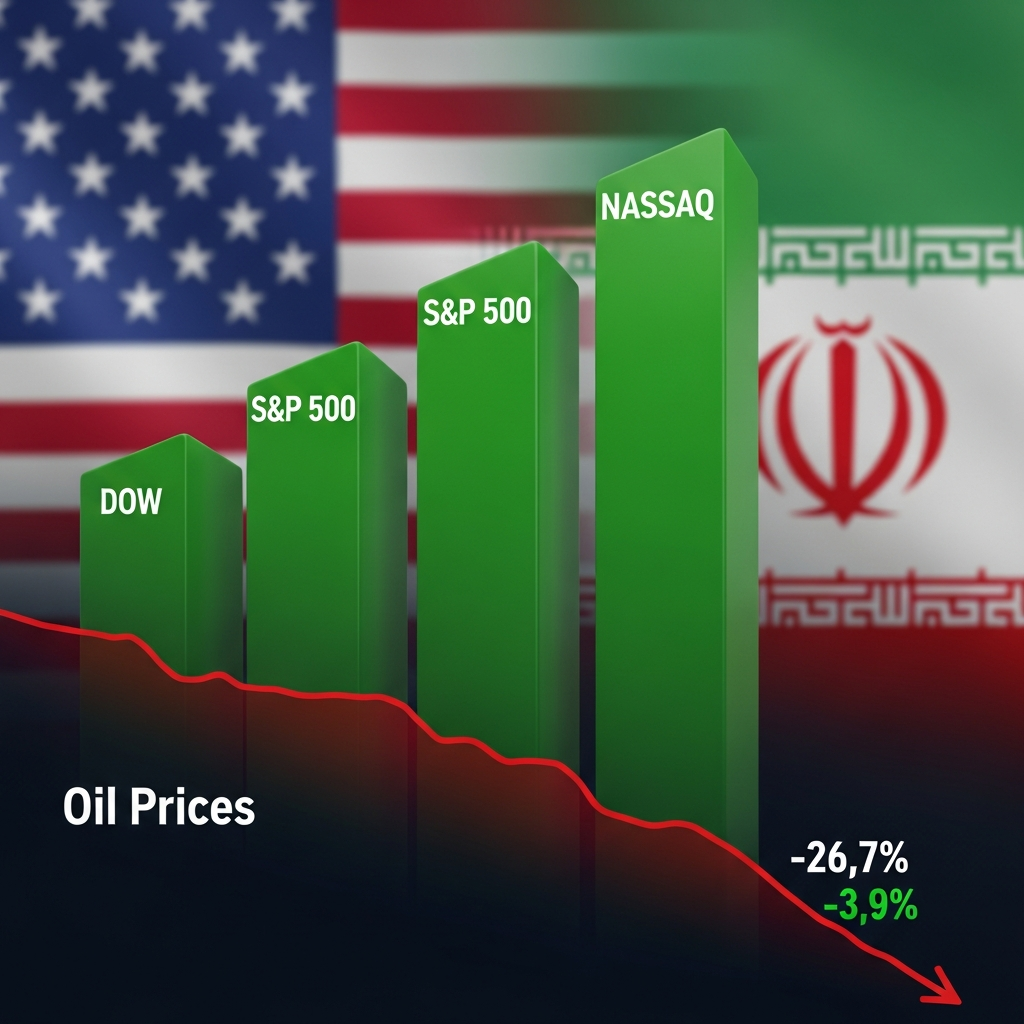
The market reaction was swift and overwhelmingly positive. US stock market futures signaled a sharp open, with major indexes jumping. Futures for the Dow Jones Industrial Average surged by 2.6%. The S&P 500 futures climbed 2.7%, and Nasdaq futures advanced by 2.5%. This broad-based rally showcased a collective relief among investors. Many had been bracing for further conflict in the Middle East.
Crucially, crude oil prices experienced a dramatic decline. Brent crude futures, a key international benchmark, plummeted over 14.3%. It hit a day’s low of $96 per barrel. This drop signaled easing concerns over potential prolonged energy supply disruptions. Oil had been trading well above $100 for weeks. Precious metals, often seen as safe-haven assets during uncertainty, also recovered. Comex gold rebounded significantly, while Comex silver erased most of its earlier losses. The market was clearly pricing in a potential path to peace.
A Fragile Rally: Uncertainty Returns, Oil Rebounds
The market’s newfound optimism proved to be short-lived. Just hours after President Trump’s statements, Iranian state media denied that any direct negotiations had taken place. This contradiction introduced significant doubt. Investors quickly questioned if the market had priced in peace too prematurely. The initial surge gave way to a palpable sense of renewed uncertainty.
As a result, Tuesday saw a slight pullback in market performance. Both Dow Jones and Nasdaq 100 futures edged lower, pulling back after Monday’s strong rally. This shift highlighted the extreme sensitivity of the markets to geopolitical headlines. The back-and-forth communication created a highly volatile trading environment.
Alongside the market pullback, oil prices rebounded sharply. West Texas Intermediate (WTI) crude climbed back above $90 per barrel. Brent crude, which had dipped below $100, surged past $101. This immediate reversal in oil prices underscored the ongoing fragility of the situation. It also showed how quickly supply concerns can re-enter the market narrative. The geopolitical chessboard remains complex.
Why Oil Is Central to Market Stability
The price of crude oil plays an exceptionally critical role in global market stability. Rising oil prices fuel inflation concerns across economies. They increase pressure on central banks to tighten monetary policy. This can lead to higher interest rates and slower economic growth. High oil prices also squeeze corporate profit margins, impacting earnings and stock valuations.
The Strait of Hormuz is at the heart of this volatility. This narrow passage in the Persian Gulf is a vital geopolitical flashpoint. Nearly a fifth of the world’s oil, along with other key commodities, passes through it daily. Any disruption there poses a severe threat to global oil supply. This directly hinders market stability and can send shockwaves through economies worldwide. Iran’s previous threats to close the Strait have consistently triggered global market jitters.
Geopolitics Over Economic Fundamentals
The current market landscape is almost entirely driven by headlines from the Middle East. Traditional economic data, usually significant market catalysts, are taking a back seat. The constant back-and-forth—from weekend escalations and threats of retaliation to fleeting diplomatic optimism, and then back to mixed signals—creates an exceptionally volatile environment. Traders are forced to react rapidly, often within hours. This dynamic leads many analysts to conclude that the market is currently led by headlines rather than underlying economic fundamentals.
Some analysts express caution regarding the sustainability of recent rallies. Jim Cramer, host of CNBC’s “Mad Money,” notably described Monday’s rebound as “driven by fear rather than confidence.” He warned that such a rebound might not last. It requires on-the-ground actions to align with optimistic rhetoric. This raises an important question about the market’s resilience. Especially if tensions were to escalate again, the gains could easily evaporate. The Dow, for instance, had been close to a 10% correction from its highs before Monday’s rally. This indicates existing market weakness that adds pressure on any rebound to prove its longevity.
Even strong corporate earnings results are unlikely to significantly move markets if oil prices and war headlines remain the dominant, attention-grabbing factors. This highlights a challenging period for investors. The usual benchmarks for market health are being overshadowed by external geopolitical forces.
The Wider Economic Repercussions
The impact of previously elevated crude prices was substantial. Persistent high oil prices had prompted several major global central banks to revise their inflation forecasts upward. The US Federal Reserve, the Bank of Japan, and the Bank of England had all paused any planned interest rate cuts. This move aimed to combat rising costs.
Furthermore, these high oil prices led financial markets to scale back their expectations for US Federal Reserve rate cuts in the future. Earlier projections had anticipated up to three cuts. The current de-escalation of tensions and the subsequent drop in oil prices are expected to alleviate some inflationary pressures. This could potentially lead to a recalibration of central bank monetary policy expectations. However, the quick rebound of oil prices quickly reintroduced these concerns. The market’s dance with inflation and interest rates is far from over.
Navigating Volatile Waters: Investor Takeaways
In such a volatile and headline-driven market, investors must prioritize informed decision-making. Relying solely on immediate reactions to news flashes can be perilous. A strategic approach involves several key considerations:
Stay Informed, Not Reactive: Follow developments closely but avoid making impulsive trading decisions based on hourly news cycles. Understand the underlying factors, like the importance of the Strait of Hormuz.
Diversification Remains Key: A well-diversified portfolio can help cushion against sector-specific or market-wide shocks. Don’t put all your eggs in one basket, especially during geopolitical uncertainty.
Focus on Long-Term Strategy: While short-term swings are dramatic, a long-term investment horizon can help weather the storm. Resist the urge to panic sell or buy into fleeting rallies.
Assess Risk Tolerance: Understand your personal risk appetite. Adjust your portfolio to match your comfort level with market fluctuations. This is crucial in unpredictable environments.
- Consider Hedging Strategies: For some, exploring hedging options against potential oil price spikes or market downturns might be prudent.
- coinpaper.com
- www.livemint.com
The interplay between geopolitics and financial markets is complex. Understanding this dynamic is essential for sound investment decisions.
Frequently Asked Questions
What specifically caused the recent stock market rally and subsequent pullback?
The initial stock market rally was triggered by President Trump’s announcement of “very good and productive conversations” with Iran, leading to a temporary pause in military strikes. This sparked hopes of de-escalation in the Middle East, causing the Dow, S&P 500, and Nasdaq to surge. However, this optimism quickly faded when Iranian state media denied direct talks, reintroducing uncertainty. This led to a market pullback and a rebound in oil prices as investors re-evaluated the situation.
How does the Strait of Hormuz impact global oil prices and market stability?
The Strait of Hormuz is a crucial shipping lane in the Persian Gulf, through which approximately one-fifth of the world’s oil supply passes daily. Any threat or disruption to this choke point, such as a closure or military action, immediately triggers fears of global energy supply shortages. These fears cause oil prices to spike dramatically, leading to inflation concerns, pressure on central banks to revise monetary policy, and overall market instability. Its geopolitical significance makes it a key determinant of energy market volatility.
Should investors adjust their portfolios based on Middle East tensions?
While immediate, drastic portfolio adjustments based on every news headline are generally ill-advised due to market volatility, investors should certainly be aware of and factor Middle East tensions into their broader strategy. Geopolitical events can significantly influence oil prices, inflation, and global economic growth. A well-diversified portfolio, a long-term investment horizon, and a clear understanding of your personal risk tolerance are crucial. Prioritize staying informed and making strategic, rather than reactive, decisions in such an environment.
Conclusion
The recent market movements serve as a stark reminder of how deeply intertwined global financial markets are with geopolitical developments. The fleeting optimism surrounding potential US-Iran talks, followed by rapid reversals due to conflicting reports, showcases a market led by headlines. As investors navigate these turbulent waters, understanding the critical role of oil prices, the strategic importance of regions like the Strait of Hormuz, and the broader economic repercussions of conflict is paramount. Staying informed, maintaining a diversified portfolio, and adhering to a long-term investment strategy are key to managing the inherent volatility in today’s global market.