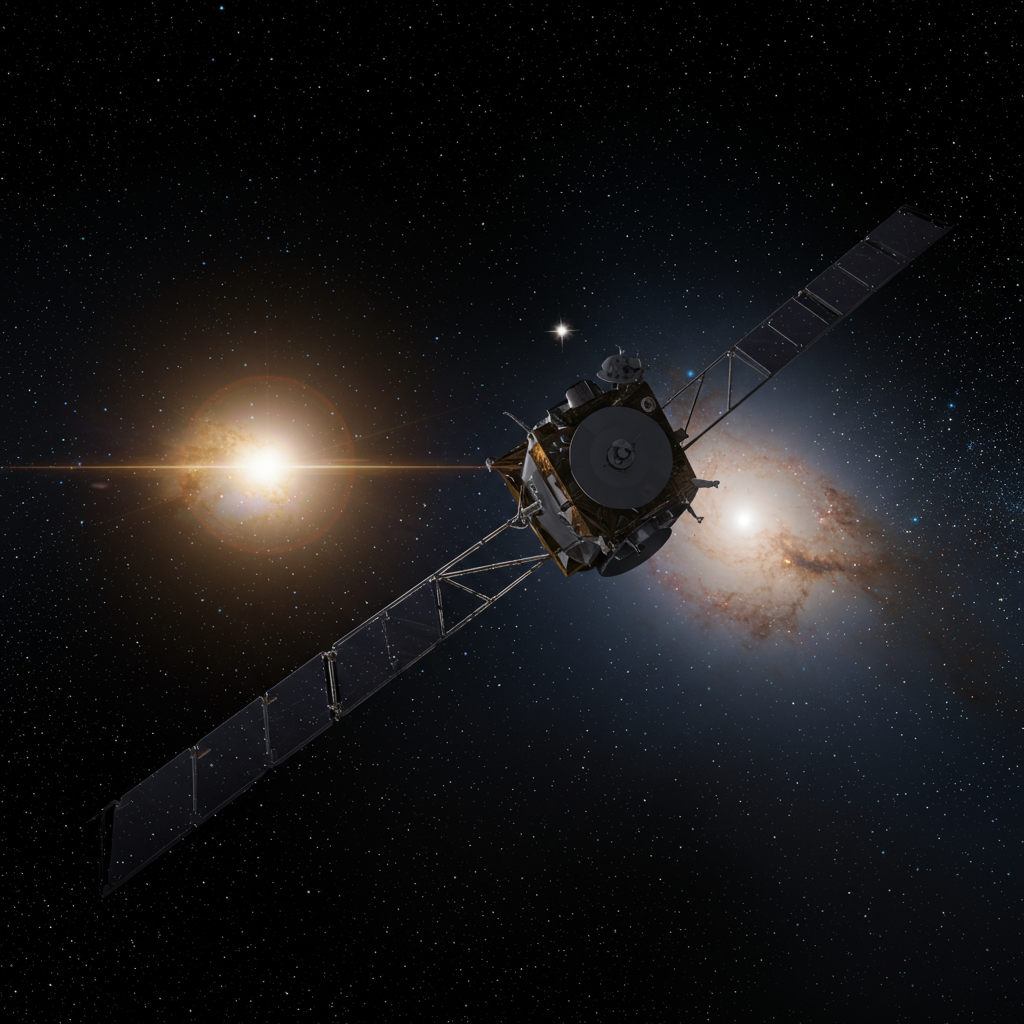
The cosmos frequently surprises us, but few events captivate astronomers more than catching a celestial body in the act of transformation. Recently, the NASA/ESA Hubble Space Telescope achieved an “extraordinarily minuscule” stroke of luck, unexpectedly witnessing Comet C/2025 K1 (ATLAS)—simply known as K1—shatter into multiple pieces. This dramatic Hubble comet breakup offers unprecedented insights into the life and death of these icy wanderers, potentially unlocking secrets about our solar system’s earliest days. Published in the prestigious journal Icarus, these findings provide a rare, intimate look at cometary fragmentation, an event scientists have long sought to observe with such clarity.
A Serendipitous Glimpse: Hubble’s Cosmic Twist of Fate
The observation of Comet K1’s disintegration was far from planned. The research team, led by Principal Investigator Dennis Bodewits and Co-investigator John Noonan of Auburn University, faced technical challenges that prevented them from observing their original target. Forced to select a new comet, they unwittingly chose K1. “Sometimes the best science happens by accident,” remarked Noonan, highlighting the sheer improbability of their discovery. When Noonan reviewed the images, he was astonished to see not one, but four distinct comets where only one should have been. This “slim chance” discovery became a goldmine for planetary science, especially after numerous previous proposals to capture a comet breaking up had failed due to intricate scheduling difficulties.
Comets are often described as “leftovers” from our solar system’s formation, essentially pristine time capsules of primordial material. However, they are not entirely untouched; millennia of exposure to solar radiation and cosmic rays alter their composition. A cometary fragmentation event, therefore, offers a unique opportunity to peer into the inner, “ancient material that has not been processed,” helping researchers distinguish original properties from evolutionary changes.
Unpacking K1’s Dramatic Demise
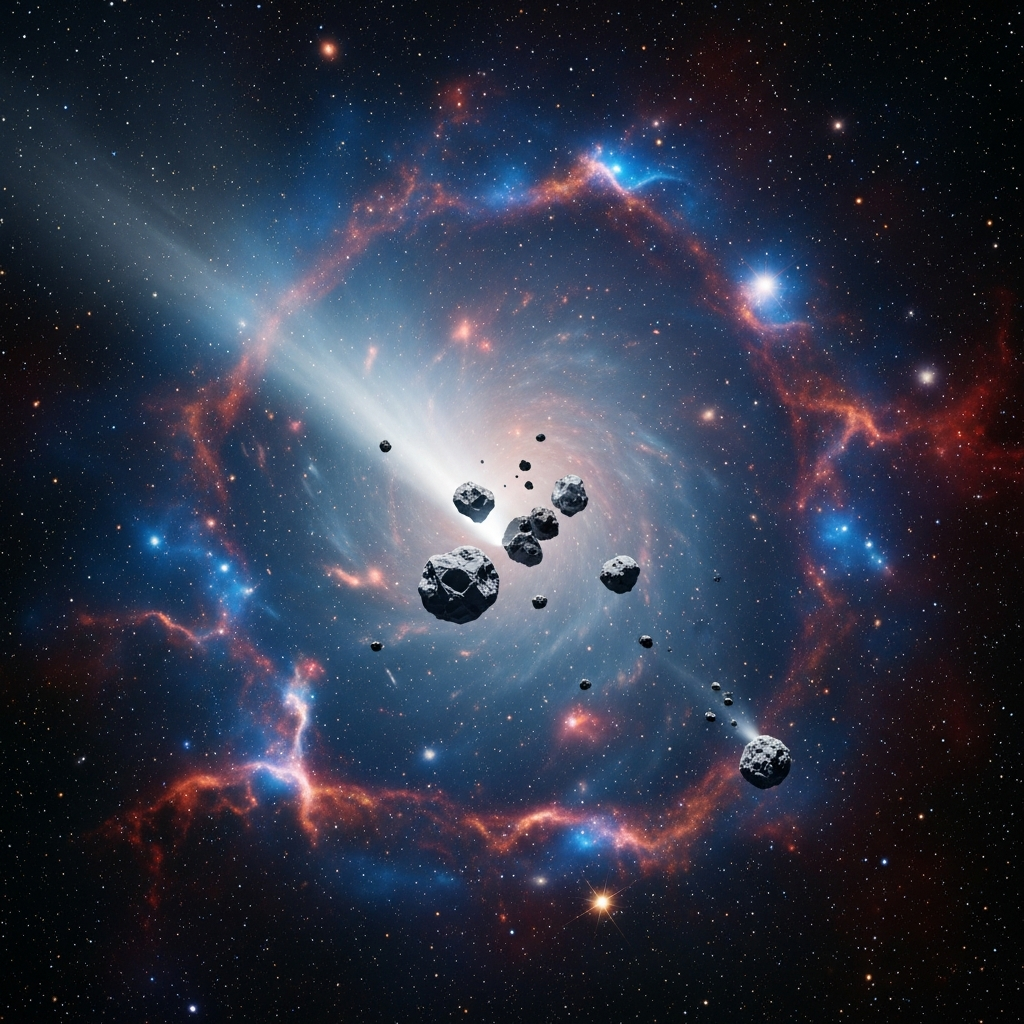
Hubble’s sharp vision recorded K1 fragmenting into at least four distinct pieces between November 8 and 10, 2025. Each fragment sported its own fuzzy envelope of gas and dust, known as a coma. This level of detail surpassed anything ground-based telescopes could achieve at the time, which could only discern the fragments as “barely distinguishable blobs.” The event unfolded roughly one month after K1’s closest approach to the Sun, or perihelion. This perihelion brought K1 well within Mercury’s orbit, subjecting it to immense thermal stress and gravitational forces—conditions under which many long-period comets like K1 are prone to fall apart.
Before its breakup, scientists estimate K1 was a bit larger than an average comet, spanning approximately 8 kilometers (about 5 miles) across. The team meticulously reconstructed the timeline, estimating the comet began to disintegrate roughly eight days before Hubble’s initial observations. Remarkably, during Hubble’s three-day monitoring, one of K1’s smaller fragments was also observed breaking apart, offering a cascading view of destruction.
The Enigma of Delayed Brightening
A significant mystery emerged from the detailed observations: a noticeable delay between K1’s physical breakup, which would expose fresh ice, and the subsequent bright outbursts observed from Earth. Why didn’t the comet brighten almost instantly? The research team has put forth several intriguing theories. One theory suggests that a layer of dry dust needs to form over the newly exposed pure ice before it can be effectively blown off by solar radiation. Another possibility is that heat must penetrate below the surface, build up significant pressure, and then violently eject an expanding shell of dust.
Noonan emphasized the significance of catching the fragmentation just days after it occurred, a rare feat compared to typical observations made weeks or months later. This close-up, timely data provides crucial clues about the physics governing a comet’s surface and the precise timescale required for a substantial dust layer to form and be expelled by gas. Understanding this process is vital for accurately modeling cometary evolution.
A Chemically Strange Visitor and its Far-Reaching Implications
Beyond its dramatic breakup, Comet K1 revealed another surprising characteristic: its chemical composition. Preliminary ground-based analysis has shown K1 to be “chemically very strange,” exhibiting a significant depletion of carbon compared to other known comets. Future spectroscopic analysis using Hubble’s STIS (Space Telescope Imaging Spectrograph) and COS (Cosmic Origins Spectrograph) instruments is expected to provide even more profound insights. Such detailed analysis could reveal critical information about K1’s makeup and, by extension, shed light on the very origins of our solar system.
This kind of detailed compositional data from a newly fragmented comet is invaluable. It helps astronomers build a clearer picture of the different kinds of primordial materials that existed in the early solar nebula and how they were distributed. The unexpected composition of K1 might hint at specific formation environments or processes that differ from those of other comets we have studied.
Multi-Mission Insights: IMAP’s Unexpected Glimpse
In a fascinating cross-mission revelation, NASA’s Interstellar Mapping and Acceleration Probe (IMAP) mission also played an unexpected role in observing Comet K1. As IMAP’s GLOWS (GLObal Solar Wind Structure) instrument conducted its “first light” observations, intended to image ultraviolet light (helioglow) and distant stars, it serendipitously captured the signature of Comet C/2025 K1 (ATLAS). This unexpected detection by a mission focused on mapping the heliosphere’s boundaries highlights the interconnectedness of astronomical observations and underscores how multiple instruments can provide complementary data on single events. While IMAP’s primary mission focuses on the solar wind and interstellar space, its accidental glimpse of K1 adds another layer to our understanding of this unique long-period comet.
Looking Ahead: Guiding Future Comet Interceptors
Currently, Comet K1 exists as a collection of fragments, approximately 400 million kilometers (about 250 million miles) from Earth, located in the constellation Pisces. It is now on a trajectory out of the solar system, unlikely to ever return. Astronomers have noted that long-period comets like K1 are more prone to fragmentation than their short-period cousins, such as 67P/Churyumov-Gerasimenko, famously visited by ESA’s Rosetta mission. However, the exact reasons for this differential susceptibility remain a mystery.
This unexpected Hubble observation holds significant implications for future space missions. Prof. Colin Snodgrass of the University of Edinburgh, an Interdisciplinary Scientist for ESA’s upcoming Comet Interceptor mission, confirmed the value of these findings. Launching towards the end of the decade, Comet Interceptor will be the first mission specifically designed to visit a long-period comet. Snodgrass stated that Hubble’s data from K1 will “help us understand why some long-period comets split apart and give us a first view of their interiors.” This crucial information will both complement the detailed view provided by Comet Interceptor and aid astronomers in selecting the mission’s ultimate target.
—
Frequently Asked Questions
What makes Comet K1’s breakup so significant for scientific understanding?
Comet K1’s fragmentation is profoundly significant because Hubble observed it just days after the event, offering an unprecedented, early-stage view. This rare timing allows scientists to study newly exposed primordial material directly, helping differentiate between a comet’s original properties and changes caused by its journey through space. The detailed observations help unravel mysteries like the delay between fragmentation and brightening, providing critical data on the physics governing cometary surfaces and the formation of dust layers.
What other space missions are impacted by the study of Comet K1?
The study of Comet K1 has implications for several missions. Beyond the Hubble Space Telescope’s primary observations, NASA’s IMAP mission unexpectedly captured K1’s signature, highlighting multi-instrument, multi-mission observation potential. Critically, these findings will directly benefit ESA’s upcoming Comet Interceptor mission. Data from K1 will help scientists understand why some long-period comets fragment, offer insights into their interiors, and assist in selecting a target for the Interceptor, which will be the first mission to visit a long-period comet.
How does Comet K1’s unique chemical composition affect our understanding of comet evolution?
Comet K1’s unique chemical composition, particularly its significant depletion in carbon compared to other comets, provides vital clues about the diversity of primordial materials in the early solar system. This “chemically strange” nature suggests that comets might have formed in different regions or under varied conditions, affecting their elemental makeup. Analyzing K1’s composition helps distinguish between original properties and evolutionary changes, enhancing our models of how comets form and evolve, and ultimately contributing to our understanding of the solar system’s origins.
—
Conclusion
The accidental observation of Comet K1’s dramatic Hubble comet breakup stands as a testament to the enduring power and serendipitous nature of scientific discovery. From revealing the “extraordinarily minuscule” odds of such a sighting to offering a unique window into primordial materials, this event has significantly advanced our understanding of cometary mechanics and the early solar system. The insights gleaned from K1, including its puzzling delayed brightening and peculiar chemical composition, not only expand our current knowledge but also directly inform future endeavors like the ESA’s Comet Interceptor mission. As the fragments of K1 journey into the cosmic distance, the data collected by Hubble ensures that its dramatic demise will continue to illuminate the origins of our universe for years to come.