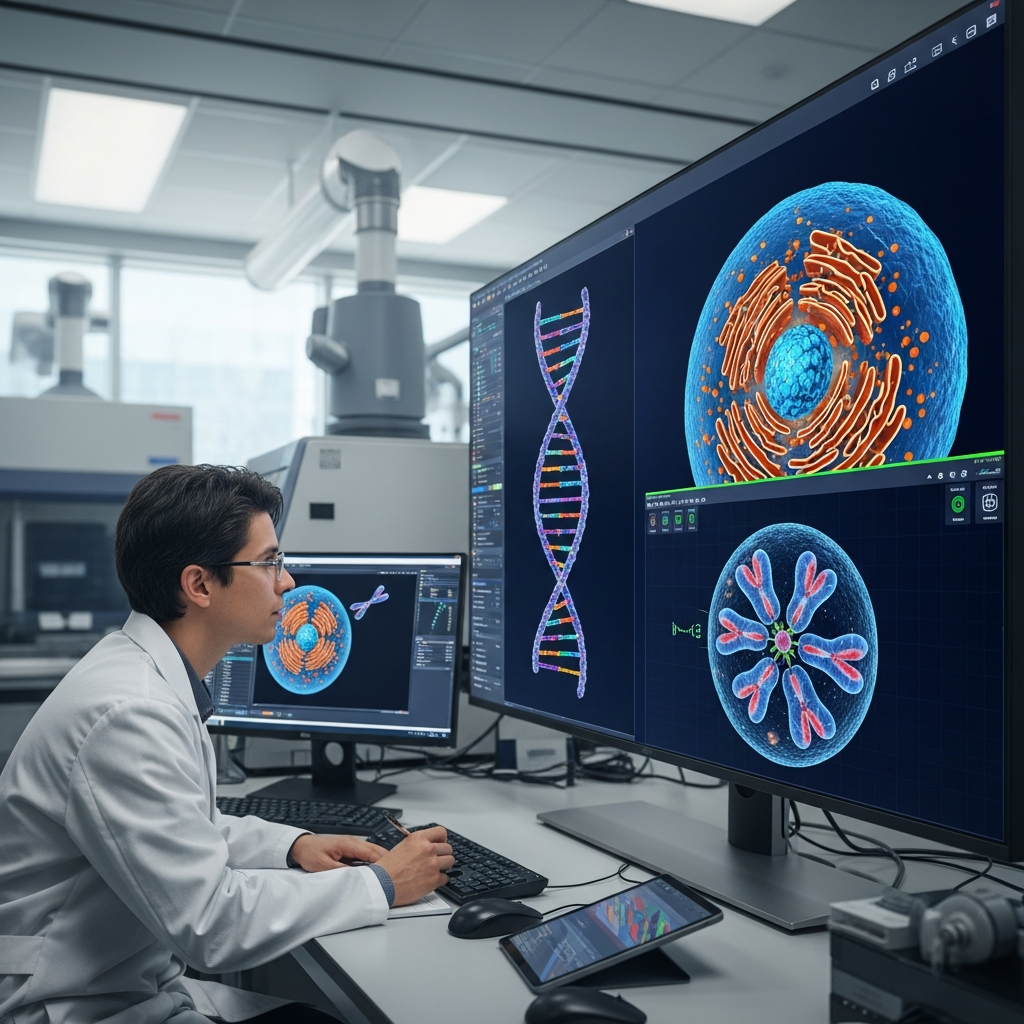
The intricate dance of life within a cell, once a microscopic mystery, is rapidly becoming a vibrant, visible narrative thanks to groundbreaking computer simulations. Researchers are leveraging advanced computational power to construct detailed, dynamic models that map every molecular interaction, from DNA replication to cell division. These digital replicas of living cells are not just marvels of technology; they are powerful tools. They are unlocking fundamental biological secrets, driving forward synthetic biology, and even accelerating the quest for new disease treatments. This article delves into the latest advancements in simulating cell life, exploring the innovative techniques and profound discoveries shaping our understanding of life itself.
Why Simulate the Cell Life Cycle?
Understanding the precise mechanisms governing cellular growth, division, and function has long been a monumental challenge for biologists. Traditional experimental methods offer snapshots, but struggle to capture the simultaneous, dynamic interactions of billions of molecules in real-time. This is where computer simulations become indispensable. They offer a unique “virtual microscope” that can:
Visualize the Invisible: Peer into the crowded, dynamic intracellular environment.
Test Hypotheses Rapidly: Conduct “virtual experiments” that are impossible or too costly in a lab.
Integrate Multiscale Data: Combine genetic, biochemical, and biophysical information into a holistic model.
Predict Behavior: Forecast how cells might react to genetic changes or external stimuli.
By providing a comprehensive, time-resolved view of cellular processes, these simulations transform biology from descriptive observation to predictive science.
Pioneering 4D Simulations: The Minimal Cell Unveiled
A landmark achievement in computational biology comes from the University of Illinois Urbana-Champaign. Researchers developed an unprecedented computer model. It simulates the entire life cycle of a genetically minimal bacterial cell, JCVI-syn3A, in astounding nanoscale detail. This revolutionary work, published in Cell, offers a four-dimensional visualization – 3D space plus time. It illuminates the complex internal choreography of cellular components. This includes DNA replication, protein synthesis, metabolism, and ultimately, cell division.
The team specifically chose JCVI-syn3A for its elegant simplicity. Engineered by the J. Craig Venter Institute, this bacterium possesses fewer than 500 genes. Each gene is absolutely essential for survival and replication. This pared-down genetic makeup significantly reduced modeling complexity. Yet, it still encompassed all critical processes governing cellular life. The primary goal was to simulate how this “Genetically Minimal Cell” orchestrates its molecular machinery. The model covered its full 105-minute cell cycle. It revealed previously inaccessible insights into physical interactions and temporal dynamics.
Methodology & Computational Prowess
Creating such an extraordinarily detailed and dynamic model demanded extensive experimental datasets. It also required cutting-edge computational methods. Researchers meticulously represented the behavior and interactions of every molecule. This included genes, proteins, RNA molecules, membranes, ribosomes, and metabolic intermediates. Each was governed by complex kinetics and biophysical constraints. Their approach involved assembling mechanistic descriptions of gene expression, mRNA degradation, protein synthesis, and DNA replication. They seamlessly linked these subcellular processes into a time-resolved simulation.
A significant technical marvel involved handling simultaneous, multiscale phenomena. All this happened within the confined bacterial cytoplasm. The team employed a dual-GPU strategy. One dedicated GPU efficiently executed detailed chromosome replication. Another handled concurrent activities like metabolism and ribosome assembly. This parallel processing vastly accelerated the simulation. What would have been an overwhelming computational challenge became feasible. It completed in a six-day run on advanced supercomputing infrastructure like Delta at the National Center for Supercomputing Applications.
Key Discoveries & Visualizations
The simulation yielded crucial findings. It offered quantitative validation for existing experimental observations and provided novel insights. It accurately captured the tightly regulated timing of DNA replication and the symmetrical division of Syn3A. This fidelity provided significant understanding of the fundamental requirements for cellular life. Beyond confirming known phenomena, the model allowed researchers to peer into the crowded molecular milieu. By selectively rendering components, they visualized the cell’s lone chromosome threading through a densely packed cytoplasm. This offered unprecedented intuition into intracellular crowding effects and molecular organization.
One surprising discovery involved JCVI-syn3A’s unusually rapid growth. The simulation pointed to an enzyme called transaldolase as crucial for this speed. However, experimental evidence suggests this enzyme is absent. This discrepancy raises fascinating questions for future research. It also demonstrated the model’s predictive power. It successfully confirmed that adding genes for two nonessential enzymes can shorten cell division time. This pioneering work fundamentally reframes how scientists conceptualize living cells. They are not static collections of molecules, but orchestrated, highly dynamic entities, now made visible at the nanoscale.
Decoding Tissue Organization: The “Tissue Code”
While the Illinois team focused on single-cell dynamics, another collaborative study unveiled fundamental rules governing multicellular organization. Researchers from ChristianaCare and the University of Delaware discovered a “tissue code.” This surprisingly simple set of five fundamental rules dictates how organs maintain their intricate structure. This occurs despite constant cellular renewal. Published in Biology of the Cell, this research suggests these rules choreograph cell division, movement, and death. Tissues like the colon, which replaces its cells every few days, remain flawlessly structured.
The central question was how the body replaces billions of cells daily while preserving tissue integrity. Dr. Bruce Boman, a senior research scientist at ChristianaCare, likens this discovery to a “biological blueprint.” It draws a parallel to the genetic code.
Mathematical Modeling for Biological Rules
To unravel this mystery, researchers employed mathematical modeling and computer simulations. They focused on the colon lining due to its rapid cellular turnover and stable overall shape. Through iterative simulations, they identified five core biological rules:
- Timing of cell division: When cells initiate their division process.
- Order in which cells divide: The sequence of division among a group of cells.
- Direction cells divide and move: The orientation and trajectory of division and subsequent migration.
- How many times cells divide: The proliferative capacity of individual cells.
- How long a cell lives before it dies: The lifespan and turnover rate of cells.
These rules operate in concert “like choreography,” explains Dr. Gilberto Schleiniger. They control the spatial distribution, division timing, and longevity of cells. This ensures tissues function and appear as they should.
Universal Implications for Health
A significant implication of this “tissue code” is its potential universality. Researchers believe it may apply to many tissues throughout the body, including skin, liver, and brain. If validated, this code could profoundly enhance our understanding of:
Tissue healing after injury.
Mechanisms underlying birth defects.
Development of diseases like cancer when rules are disrupted.
This research also holds significant implications for initiatives like the Human Cell Atlas. It provides a dynamic framework, transforming static cell maps into predictive models of cell organization and behavior.
Accelerating Discovery: Atomic-Resolution Simulations
Further advancing the field is a novel computer modeling technique from the University of Kansas. Published in the Proceedings of the National Academy of Sciences, this method simulates molecular cell life at atomic resolution. It marks a significant step toward creating a comprehensive, working simulation of a living cell at an unprecedented scale. Ilya Vakser led this research, promising profound insights into fundamental cellular biology. It also facilitates faster, more precise treatments for human diseases.
The primary challenge in modeling cells computationally has been representing proteins and their intricate interactions. These are central to all cellular processes. Existing techniques, “protein docking” and “molecular simulation,” each have limitations. Docking excels spatially but lacks dynamic time. Molecular simulations model dynamics but are often too slow.
Bridging Methodologies for Unprecedented Speed
The new methodology developed by Vakser’s team uniquely bridges these two approaches. It combines their strengths to achieve unprecedented simulation timescales. Crucially, it maintains all-atom resolution. The core innovation lies in an algorithm that significantly enhances computational speed. Traditional methods spend vast amounts of time traversing “low-probability” or “high-energy” areas. The KU team’s breakthrough samples only “high-probability,” low-energy areas. It then estimates transition rates between these states. This effectively skips computationally intensive regions.
This targeted sampling strategy results in a dramatic increase in calculation speed. It is “tens or hundreds of thousands of times faster” than current atomic resolution methods. Crucially, this speed gain comes without any apparent loss of accuracy. In fact, Vakser suggests accuracy may even be improved. This is because the protocol integrates principles from docking techniques.
Impact on Disease & Drug Design
This advanced cell-simulation method holds immense potential for human health. It can be utilized to:
Determine detrimental effects of genetic mutations: Observe altered protein association patterns.
Identify critical elements in protein-association patterns: Pinpoint novel targets for drug design with greater precision.
Characterize physiological mechanisms: Model processes previously beyond computational reach.
This breakthrough opens “unprecedented opportunities” to enhance our understanding of cellular processes. It will significantly improve therapeutic strategies for various diseases.
The Future of Cellular Modeling
These advancements represent a pivotal moment in computational biology. The future promises even more sophisticated computer simulation of cell life cycle dynamics. Integrating these different approaches could lead to models that combine the global cell cycle accuracy of the UIUC minimal cell with the atomic-level detail and speed of the KU method. Imagine simulating an entire human cell, tracking disease progression at a molecular level, or designing new synthetic organisms with precise functions.
Ongoing research aims to:
Refine existing models with even more experimental data.
Incorporate biophysical forces and interactions at atomic levels.
Adapt techniques to model protein interactions with nucleic acids.
Apply these simulations to complex human diseases like cancer.
This integrative insight is poised to accelerate research into minimal life forms and synthetic biology. It could fundamentally guide the engineering of synthetic cells with novel functions.
Challenges & Limitations
Despite their extraordinary fidelity, current simulations have acknowledged limitations. Not all simulated data perfectly align with experimental results. The 94 genes with unknown functions in JCVI-syn3A still represent a significant gap. Furthermore, current models are primarily biochemical. A truly comprehensive understanding requires modeling all biophysical forces and interactions. The immense computational power required remains a hurdle, though advancements like KU’s fast algorithm are addressing this. Researchers are continually working to balance computational feasibility with biological realism.
Frequently Asked Questions
What groundbreaking insights have minimal cell simulations revealed about basic life processes?
Pioneering simulations of the minimal bacterial cell JCVI-syn3A by the University of Illinois Urbana-Champaign team have revealed unprecedented insights into fundamental life processes. The model accurately captured the tightly regulated timing of DNA replication and symmetrical cell division, even with a reduced gene set. It allowed researchers to visualize how the cell’s single chromosome navigates a densely packed cytoplasm, offering new intuition into intracellular crowding. Crucially, it also identified discrepancies, like the suspected absence of the transaldolase enzyme for rapid growth, prompting new experimental investigations into unknown essential cellular functions.
Which institutions are leading the development of advanced cell simulation techniques?
Several leading institutions are at the forefront of developing advanced cell simulation techniques. The University of Illinois Urbana-Champaign is renowned for its 4D whole-cell simulation of minimal bacteria. ChristianaCare and the University of Delaware collaborate on mathematical modeling to uncover the “tissue code” governing organ structure and cell dynamics. Furthermore, the University of Kansas, led by Ilya Vakser, has introduced game-changing computer modeling capable of atomic-resolution simulations at unprecedented speeds. These institutions, along with others like the J. Craig Venter Institute and Harvard Medical School, are collectively pushing the boundaries of computational biology.
How will advanced computer simulations of cells accelerate drug discovery and disease treatment?
Advanced computer simulations of cells, particularly those capable of atomic resolution like the technique developed at the University of Kansas, will significantly accelerate drug discovery and disease treatment. These models can precisely determine the detrimental effects of genetic mutations by observing altered patterns of protein associations. By identifying critical elements in protein-association patterns, they can pinpoint novel and highly specific targets for drug design. This ability to conduct “virtual experiments” and analyze molecular interactions with unmatched speed and accuracy will lead to faster development of more effective and targeted therapies for complex diseases.
Conclusion
The era of digital biology is upon us, with computer simulation of cell life cycle models rapidly transforming our understanding of the fundamental units of life. From the detailed 4D mapping of minimal cells to the discovery of universal “tissue codes” and the development of atomic-resolution simulation techniques, these advancements are not just theoretical breakthroughs. They are practical tools. They promise to revolutionize fields ranging from synthetic biology to personalized medicine. As computational power continues to grow, our ability to virtually explore, understand, and even engineer life will expand exponentially. This truly marks an exciting frontier in scientific discovery.