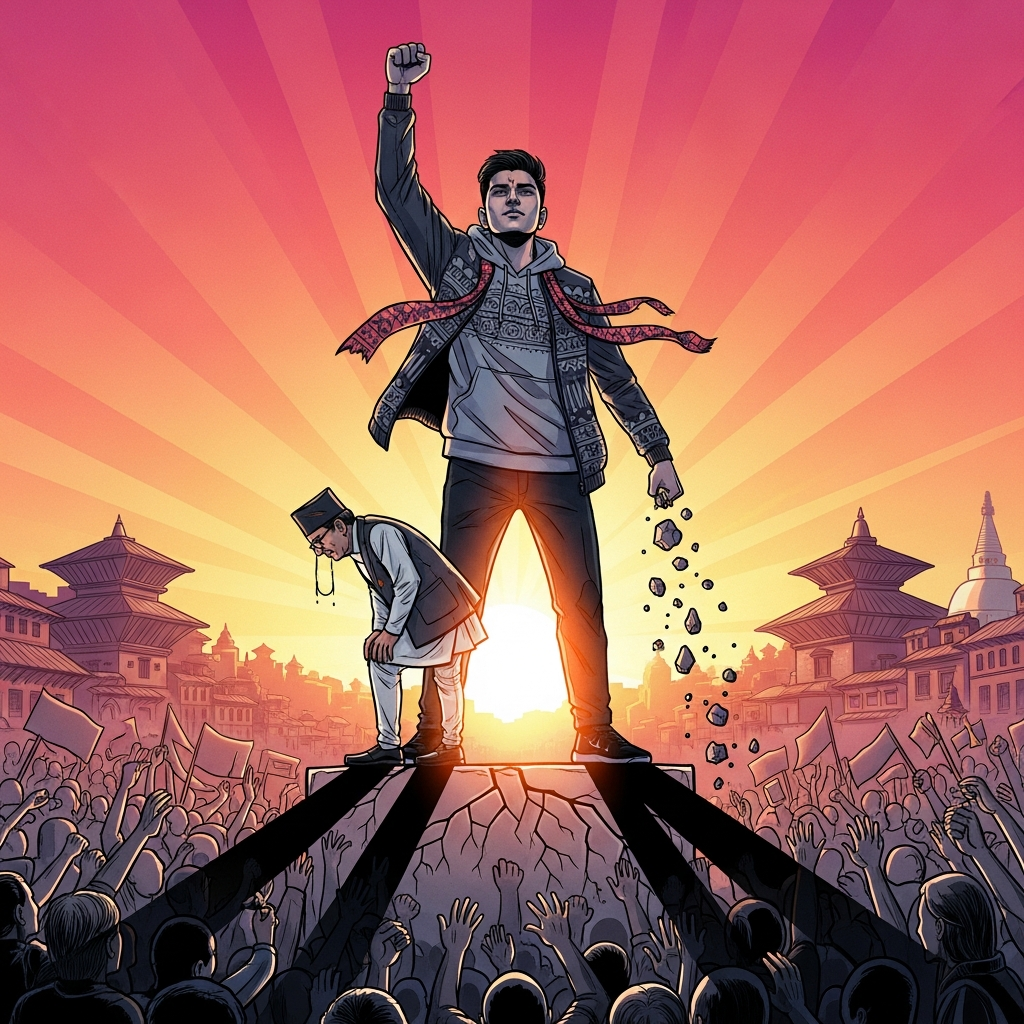
Nepal is witnessing an unprecedented political transformation. Rapper-turned-politician Balendra Shah has achieved a seismic victory, effectively unseating four-time former Prime Minister KP Sharma Oli. This isn’t just an election win; it’s a powerful statement from a nation hungry for change. Shah’s triumph signals a dramatic shift, challenging decades of entrenched political power and ushering in a new era potentially defined by youth voices and fresh perspectives. His Rastriya Swatantra Party (RSP) appears poised for a landslide, reflecting widespread public disillusionment with the traditional political establishment. This article delves into the significance of Shah’s rise, the underlying currents of discontent, and what his potential leadership means for Nepal’s future.
The Ascendance of Balendra Shah: From Hip-Hop to High Office
Balendra Shah, popularly known as “Balen,” is more than a politician. He is a cultural phenomenon turned political force. At 35, Shah represents a vibrant new generation. His journey from the Nepali hip-hop scene to national prominence is remarkable.
From Hip-Hop Star to Political Force
Shah first gained widespread recognition through his music. His song “Balidan” (sacrifice), delivered in Nepali, garnered millions of views on YouTube. This deep connection with youth culture and a growing digital audience became a powerful asset. It allowed him to bypass traditional media. Instead, he communicated directly with voters through social media, crafting an image as an outsider. This approach resonated deeply. It helped him connect with a frustrated electorate. His campaign rallies often featured rap music. An AI-generated campaign song with lyrics like “Time’s up, Fake leaders, Game Over” became an anthem. Shah’s signature black sunglasses added to his unique persona.
Kathmandu Mayor to National Contender
Shah’s political trajectory accelerated with his election as the independent Mayor of Kathmandu in 2022. This role served as a crucial proving ground. It demonstrated his ability to secure votes outside the established party system. While his mayoral tenure drew some criticism for heavy-handed tactics against street vendors, it also showcased his willingness to challenge norms. His experience in municipal governance provided a platform. It allowed him to articulate a broader vision for Nepal. Now, he stands on the cusp of national leadership. This marks a swift ascent for the rapper-turned-politician.
Unseating the Veteran: Oli’s Decisive Defeat
The general election, held recently, was more than a contest for votes. It was a generational battle for Nepal’s soul. Balendra Shah’s victory over former Prime Minister KP Sharma Oli is historic. It highlights a profound shift in voter sentiment.
The Vote Count: A Decisive Mandate
In a stunning upset, Shah decisively unseated four-time former Prime Minister KP Sharma Oli. This happened in Oli’s own parliamentary constituency of Jhapa-5. Shah secured an overwhelming 68,348 votes. Oli managed only 18,734 votes. This significant margin confirms a clear public mandate. The result was confirmed by Nepal’s Election Commission. It underscores the depth of public desire for new leadership. This victory is a direct challenge to the political old guard.
A Generational Clash at the Polls
Political analysts describe this election as a “generational contest.” It pitted Nepal’s long-established political elite against a new wave of leaders. Young voters, especially “Gen Z,” played a crucial role. They represented a significant bloc of over 915,000 first-time voters. For decades, Nepal’s politics have been dominated by three major parties. Two of these are communist. These parties have often formed fragile coalition governments. These governments rarely completed their full terms. Public fatigue with the “same old faces” was palpable. Chandra Dev Bhatta called Shah’s success “the people’s revolt against the established political parties.” Kunda Dixit, of the Nepali Times, termed it an “even bigger upset than expected.” He cited “public disenchantment” and “anger over the events of September.”
The Rastriya Swatantra Party (RSP) on the Rise
Balendra Shah’s victory is not an isolated event. It is part of a broader surge for his Rastriya Swatantra Party (RSP). The party is a centrist force. It is challenging the traditional political landscape. Early results indicate a strong performance.
RSP’s Ambitious Vision for Nepal
The RSP released an ambitious manifesto in February. It directly addresses key frustrations among Nepalis. Unemployment and low wages have driven millions overseas. The party pledges to tackle these issues head-on. Key promises include:
Creating 1.2 million jobs to retain talent within Nepal.
Significantly reducing forced migration by improving domestic opportunities.
Raising Nepal’s per capita income from $1,447 to $3,000 within five years.
More than doubling the country’s economy to a $100 billion GDP within five years.
- Providing comprehensive safety nets, including healthcare insurance, for the entire population.
- www.bbc.com
- www.themountaineer.com
- www.arise.tv
- www.bbc.com
These pledges resonate with a populace tired of unfulfilled promises. They offer a tangible vision for economic betterment.
Challenging Decades of Traditional Rule
The RSP’s strong performance marks a potential end to a long-standing cycle. For over two decades, Nepal has seen a revolving door of coalition governments. These were largely dominated by a few established parties. The current election tested whether Gen Z voters could convince the country to embrace new, untested leadership. Early trends from the Election Commission show RSP’s dominance. Out of 76 declared results, RSP secured 61 seats. They were also leading in direct elections in 61 of 89 constituencies. Furthermore, they comfortably secured more than half of the proportional representation votes. This system determines an additional 110 seats. This indicates a profound rejection of the status quo. It signals a desire for systemic change.
The Spark of Change: Gen Z Protests and Public Discontent
The backdrop to Balendra Shah’s rise is a nation in turmoil. Violent youth-led protests significantly influenced this election. These demonstrations served as a powerful catalyst for political change.
The September 2025 Uprising: Roots of Rebellion
The recent general election is the first since violent youth-led protests toppled the previous government in September 2025. These demonstrations, primarily driven by a loose “Gen Z” movement, began over a social media ban imposed by Oli. However, they quickly escalated. Protesters voiced deeper grievances. They criticized rampant corruption, political instability, and a struggling economy. The unrest resulted in tragic consequences. A total of 77 people were killed. A BBC investigation revealed the country’s police chief issued an order for lethal fire. This was directed against thousands of unarmed protesters. The burnt-out ruins of Oli’s home served as a stark reminder of public anger. Balendra Shah vocally supported these protesters. He even called Oli a “terrorist” who had betrayed the country.
Addressing Corruption and “Nepo Babies”
A key focus of the protests was class inequality. This was symbolized by “nepo babies.” This term refers to the children of the country’s politicians. They are often perceived as benefiting from nepotism and privilege. Young Nepalis expressed deep frustration with these systemic issues. Voters like 20-year-old student Ispa Sapkota voiced a common sentiment: “We don’t want the same old parties to rule our country.” This widespread desire for accountability and meritocracy fueled Shah’s campaign. His message of change resonated powerfully. It tapped into a pervasive feeling that the old guard had failed its citizens.
What Does Shah’s Victory Mean for Nepal’s Future?
Balendra Shah’s potential leadership signals a pivotal moment for Nepal. His victory could usher in significant changes. These changes span governance, economy, and youth engagement.
A New Era of Governance?
A victory for a newcomer like Balendra Shah over a political veteran like Oli would indeed be a “seismic moment.” It could signify the end of a long-standing cycle. This cycle involved familiar faces and political bargaining among an entrenched elite. Shah’s leadership could potentially lead to Nepal’s first government in many years without a communist party. Nishchal N Pandey, director of the Centre for South Asian Studies, noted that people are “tired of the same old faces.” They desire a “generational contest.” This election tests whether a new generation can shape Nepal’s future. It challenges the assumption that veteran heavyweights will always hold power.
Economic Hopes and Policy Challenges
The RSP’s ambitious economic agenda offers hope. It promises a significant boost to the economy and job creation. Achieving these goals will require robust policy implementation. It will also demand sustained political stability. Shah has stated his intent to be “the candidate for all of Nepal.” This suggests a unifying approach. His focus on economic reform aims to address the root causes of public discontent. Success in these areas could transform the lives of millions. It could curb forced migration and provide better opportunities at home. However, navigating a complex political landscape with high expectations will be challenging. The coming years will reveal whether this new generation of leadership can deliver on its promises.
Frequently Asked Questions
Why is Balendra Shah’s election victory considered a historic moment for Nepal?
Balendra Shah’s victory is historic because it marks a significant generational and political shift in Nepal. A rapper-turned-politician, Shah, 35, unseated four-time former Prime Minister KP Sharma Oli in his constituency. This represents a powerful rejection of the long-entrenched political establishment by Nepali voters, particularly Gen Z. It’s the first election since violent youth-led protests toppled the previous government, symbolizing a desire for new leadership focused on economic reform and accountability, rather than the traditional parties that have dominated for decades.
What are the key policy promises of Balendra Shah’s Rastriya Swatantra Party (RSP)?
The Rastriya Swatantra Party (RSP), led by Balendra Shah, has outlined an ambitious manifesto. Key promises include creating 1.2 million jobs to reduce forced migration and brain drain. The party also pledges to raise Nepal’s per capita income from $1,447 to $3,000 within five years. Furthermore, they aim to more than double the country’s economy to a $100 billion GDP within the same timeframe. Providing comprehensive safety nets, such as healthcare insurance for the entire population, is another central commitment. These policies directly address widespread public frustration over unemployment and low wages.
How might Balendra Shah’s rise influence Nepal’s economic future and youth engagement?
Balendra Shah’s rise could significantly influence Nepal’s economic future by prioritizing job creation and wealth generation. His party’s promises of 1.2 million jobs, reduced migration, and a doubled GDP aim to invigorate the economy and provide opportunities for young Nepalis at home. For youth engagement, Shah’s background as a rapper and his use of social media create a direct connection. His victory validates the power of Gen Z voters and their demand for change. This could inspire greater political participation and accountability from future leaders, fostering a more dynamic and responsive political environment.
This groundbreaking election could redefine Nepal’s political trajectory. It represents a powerful mandate for change. The world watches as Balendra Shah and the RSP embark on this new chapter. Their success or failure will have profound implications for the future of Nepal.