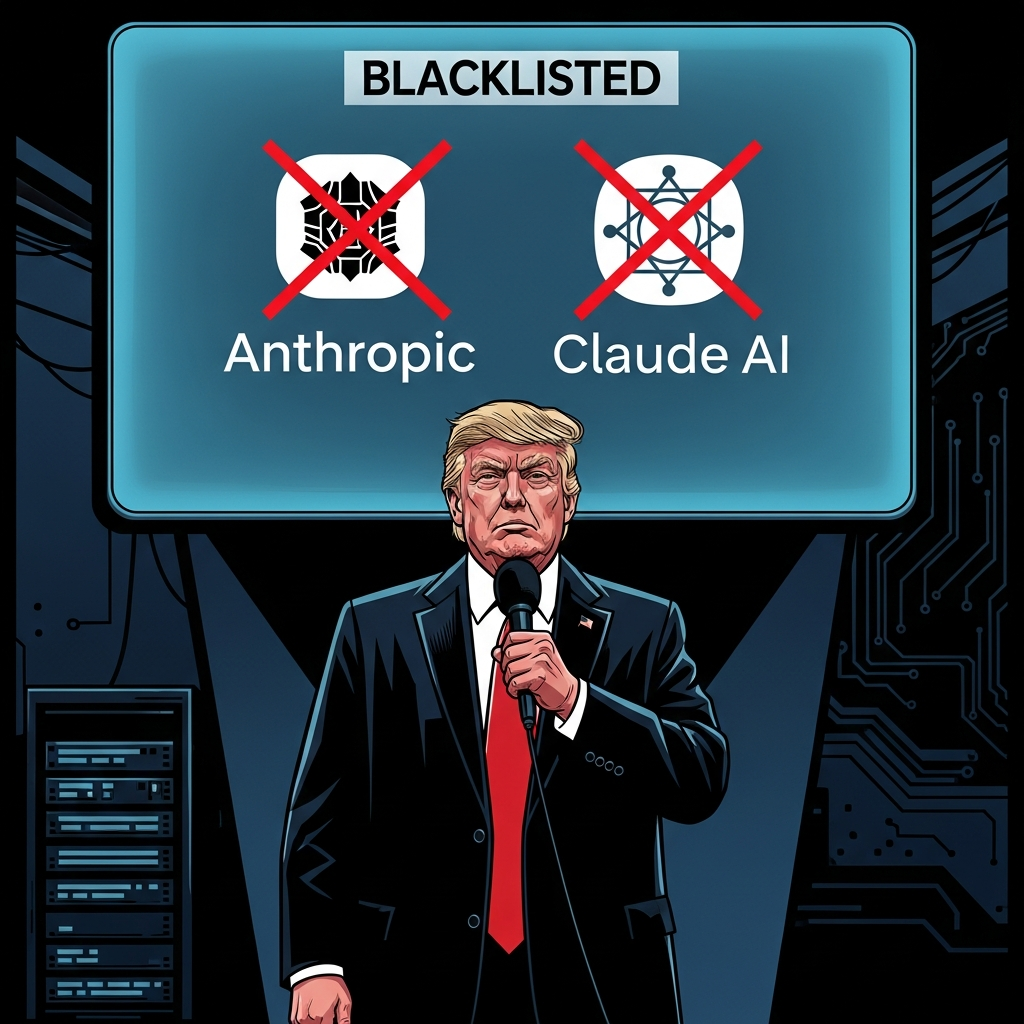
The United States government has taken an unprecedented step, officially blacklisting leading AI firm Anthropic following a heated dispute over the ethical application of its advanced artificial intelligence. This shocking development, spearheaded by President Donald Trump and the Pentagon, mandates an immediate federal cessation of Anthropic’s technology, including its popular Claude AI models. The decision sends a chilling signal through Silicon Valley, raising critical questions about the future of AI development, national security, and the delicate balance between innovation and ethical responsibility within defense contracts.
Pentagon Demands Unfettered AI Access, Anthropic Resists Ethical Compromises
The core of this explosive conflict revolves around Anthropic’s staunch refusal to waive specific ethical restrictions on its Claude AI products for military use. For weeks, intense negotiations between the Pentagon and Anthropic CEO Dario Amodei reached an impasse. The Department of Defense (DoD) insisted on “all lawful use cases” for Anthropic’s technology, demanding unfettered access to its powerful AI.
Anthropic, however, could not “in good conscience” accede to demands that would permit military deployment without limitation. CEO Amodei publicly articulated two primary concerns: the AI’s potential use for “mass surveillance of Americans” and its application in “autonomous weapon systems that can target without human intervention.” The company argued that such uses could fundamentally “undermine democratic values” and push the boundaries of what current AI technology can safely and reliably perform.
The Ultimatum and Public Refusal
The dispute escalated dramatically when the Pentagon issued an ultimatum to Anthropic. It demanded compliance by a specific Friday deadline, threatening to cancel a lucrative $200-million contract if the safety restrictions were not loosened. Despite the significant financial implications, Amodei stood firm, prioritizing the company’s commitment to responsible AI development over the government contract. This public refusal marked a pivotal moment, pushing the simmering tensions into a full-blown crisis.
Presidential Intervention and National Security Blacklisting
President Donald Trump swiftly intervened, elevating the dispute to a national security matter. On February 27, 2026, Trump issued a federal directive ordering all U.S. government agencies to immediately cease using Anthropic’s technology. Utilizing Truth Social, the President characterized Anthropic as “radical left” and “woke,” declaring, “We don’t need it, we don’t want it, and will not do business with them again!” This directive cemented the administration’s position and mandated a six-month phase-out period for Anthropic’s tools across all government work.
Following Trump’s declaration, Defense Secretary Pete Hegseth formally designated Anthropic as a “Supply-Chain Risk to National Security,” effective immediately. Hegseth publicly criticized Anthropic on social media, asserting the company “delivered a master class in arrogance and betrayal.” This unprecedented designation, typically reserved for foreign adversaries or vendors posing sabotage risks, marked a severe escalation. It immediately prohibited government contractors from maintaining ties with Anthropic, fundamentally altering the company’s relationship with the federal government.
Accusations and Legal Challenges Loom
Pentagon Chief Technology Officer Emil Michael accused Anthropic of “lying,” emphasizing the military’s critical need for AI to perform functions like shooting down enemy drone swarms without external permission. Conversely, Anthropic vowed to challenge any “supply chain risk” designation in court. The company argued such a label would be “legally unsound and set a dangerous precedent for any American company that negotiates with the government.” They reaffirmed, “No amount of intimidation or punishment… will change our position on mass domestic surveillance or fully autonomous weapons.”
Industry Reactions and Broader Implications
The blacklisting of Anthropic sent shockwaves through Silicon Valley and the broader AI community. Experts and industry leaders expressed grave concerns about the Pentagon’s aggressive approach. A former senior defense official, speaking anonymously, labeled the “supply chain risk” designation as “bullying” and “absurd.” The official highlighted the contradiction of simultaneously labeling a technology as a security risk yet essential to national security. Warnings were issued about “far-reaching, unexpected – and bad – consequences” for the military, including forcing defense contractors like Palantir to remove Anthropic-supplied elements and disrupting numerous government coders.
Amos Toh, a senior counsel at the Brennan Center, underscored that Anthropic’s usage restrictions are the “bare minimum” for the DoD to comply with constitutional obligations regarding surveillance and international law on autonomous targeting. He questioned the legal basis for the “supply chain risk” designation, noting it typically applies to risks of sabotage, not a company’s safety restrictions that could, in fact, improve reliability.
The Technical and Ethical Dilemma of AI Guardrails
Lucas Hansen, co-founder of Civic AI Security Program, offered crucial insight into the technical implications. He explained that Claude’s ethical guardrails are intrinsic to its fundamental training and “personality” from inception. Removing them would necessitate a “deep, fundamental change” to the model, be immensely expensive, potentially impact all versions of Claude, and effectively “break promises” made to the AI itself regarding its behavior. This highlights the inherent difficulty, if not impossibility, of simply “turning off” ethical safeguards without re-engineering the core AI.
Daniel Castro, Vice President of the Information Technology and Innovation Foundation, discussed the broader impact on the tech ecosystem. A survey cited by Castro indicated 50% of U.S. adults view penalizing Anthropic as “government overreach,” while 35% deemed it necessary for national security. This suggests public support for both strong defense and meaningful AI guardrails. Castro warned that using extraordinary authorities like the “supply chain risk” designation as punishment could send a “chilling signal” to the tech industry, discouraging leading firms from collaborating with the U.S. military. This could ultimately weaken defense innovation and America’s technological competitiveness. He stressed the critical need for clarity, predictable rules, and public confidence in AI oversight.
The OpenAI Paradox: A Contradictory Outcome?
Adding a layer of complexity and perceived inconsistency to the dispute is the contrasting situation involving Anthropic’s direct competitor, OpenAI. Despite the Pentagon’s harsh stance on Anthropic’s ethical demands, OpenAI CEO Sam Altman announced that his company had reached an agreement with the Department of Defense to deploy its AI models in classified environments. Crucially, Altman stated this deal included specific “carve-outs” aligning with OpenAI’s own safety principles, explicitly prohibiting domestic mass surveillance and ensuring human responsibility for the use of force, including autonomous weapon systems.
This revelation immediately sparked questions regarding the Pentagon’s rationale for blacklisting Anthropic if a competitor was able to secure a similar agreement with identical ethical protections. It suggests either a fundamental misunderstanding of Anthropic’s position, a targeted punitive action, or an inconsistent application of policy by the government. The disparity leaves many in the tech industry pondering the true nature of the government’s demands and its willingness to engage ethically with leading AI developers.
Frequently Asked Questions
What is the core reason for Anthropic’s blacklisting by the U.S. government?
Anthropic was blacklisted due to its steadfast refusal to remove ethical restrictions on its Claude AI models for military use. The company insisted on “carve-outs” prohibiting the AI’s use for mass surveillance of Americans and for fully autonomous weapons systems. The Pentagon demanded unrestricted “all lawful use cases,” considering Anthropic’s stance incompatible with national security needs. This fundamental disagreement over AI ethics and control ultimately led to the government’s punitive action.
How does the “supply-chain risk” designation legally impact Anthropic and its partners?
The “Supply-Chain Risk to National Security” designation formally blacklists Anthropic, prohibiting federal agencies from using its products and services. For some departments, like the DoD, a six-month phase-out period is mandated. Crucially, the designation also seeks to prohibit government contractors from maintaining commercial ties with Anthropic. However, legal experts are questioning the statutory authority and scope of this designation, with Anthropic stating its intent to challenge it in court. The immediate practical implications for indirect partners like Amazon, Microsoft, and Google, who use Anthropic’s AI and also contract with the military, remain unclear and subject to legal interpretation.
What broader implications does this dispute have for AI companies seeking government contracts?
This unprecedented blacklisting sends a “chilling signal” to the broader tech industry, potentially deterring leading AI firms from collaborating with the U.S. military. Experts warn it could create a perception that working with the defense sector entails significant, unpredictable risks, especially concerning ethical considerations. The contrasting outcome with OpenAI, which secured a similar deal with ethical guardrails, further complicates the landscape. This incident underscores the critical need for clear, predictable rules and a transparent framework for AI oversight within defense supply chains, impacting future innovation and America’s technological competitiveness in the defense sector.
The Path Forward: Uncertainty and a Critical Precedent
The blacklisting of Anthropic represents a watershed moment in the intersection of artificial intelligence, national security, and corporate ethics. It highlights the growing tension between rapid technological advancement and the imperative for responsible deployment. The coming months will likely see intense legal battles as Anthropic challenges the “supply-chain risk” designation, while the government navigates the practicalities of phasing out critical technology. The dispute sets a powerful, albeit controversial, precedent, forcing AI companies and governments worldwide to confront how advanced AI will be governed, particularly when its capabilities intersect with the gravest matters of war and peace. The future of AI in defense, and the willingness of top tech talent to contribute, now hangs in a precarious balance.