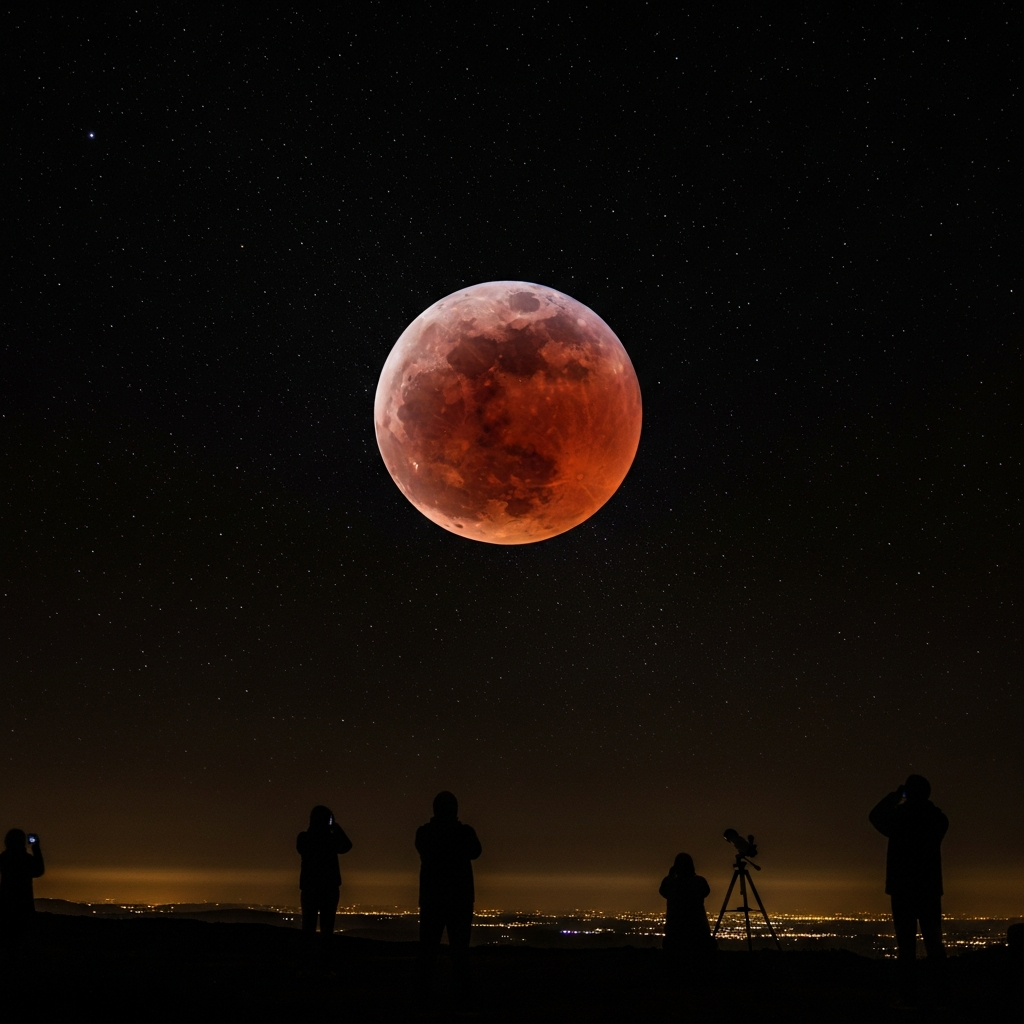
Prepare for a breathtaking celestial spectacle! In the early hours of March 3, 2026, a magnificent Total Lunar Eclipse will transform the moon into a dramatic, coppery-red “Blood Moon.” This rare astronomical event, the first of its kind for 2026, promises a captivating display for billions of skywatchers across vast regions of the globe. Whether you’re in North America, Australia, or eastern Asia, understanding the precise timings and optimal viewing conditions is key to witnessing this stunning cosmic dance.
What is a “Blood Moon” Total Lunar Eclipse?
A total lunar eclipse, popularly dubbed a “Blood Moon,” occurs when our Earth perfectly aligns between the sun and a full moon. During this alignment, the moon passes completely into Earth’s darkest shadow, known as the umbra. Instead of vanishing from sight, the moon takes on an astonishing reddish hue.
Why red? It’s a fascinating atmospheric phenomenon. Sunlight, before it reaches the moon, must first filter through Earth’s atmosphere. Our atmosphere acts like a prism, scattering shorter blue and violet wavelengths of light. However, longer red and orange wavelengths are bent or refracted around Earth and continue their journey to illuminate the lunar surface. The precise shade of red can vary, from a faint coppery glow to a deep, rusty crimson, influenced by factors such as dust and clouds in Earth’s atmosphere—even volcanic eruptions can play a role! Ancient Greek astronomers, as far back as the 5th century BC, used these curved shadows on the moon to prove Earth’s spherical shape. Imagine, during totality, an observer on the moon would witness every sunrise and sunset on Earth simultaneously!
The Dance of Shadows: Umbra and Penumbra
Before the dramatic “Blood Moon” phase, the moon first enters Earth’s fainter outer shadow, the penumbra. This stage often goes unnoticed by the casual observer. As the moon then begins to touch the umbra, a noticeable “bite” appears, marking the start of the partial eclipse. It’s during totality, when the moon is fully engulfed in the umbra, that its characteristic red glow is revealed. This mesmerizing transformation is completely safe to observe with the naked eye, no special equipment needed.
When and Where to Witness This Rare Celestial Event
The March 2026 Total Lunar Eclipse is a significant event, notably because it will be the last total lunar eclipse widely visible from the contiguous United States until June 26, 2029, and from anywhere globally until December 31, 2028. This makes setting your alarm for the early hours of March 3, 2026, an absolute must for stargazers!
This impressive “Blood Moon” will sweep primarily across the Pacific Ocean, offering prime viewing conditions for observers in the western half of North America, Australia, New Zealand, and eastern Asia.
Global Visibility Breakdown:
Optimal Views: Japan, New Zealand, and most of Australia will witness the entire eclipse from start to finish. In eastern Asia, the Blood Moon will appear high in the sky during the evening of March 3.
North America: This will be an early morning event on March 3. Hawaii will experience the eclipse beginning on the evening of March 2. For the rest of North America, the moon will descend in the west before dawn during the eclipse. Those in the western half of North America, particularly the Pacific region, will enjoy the best totality views, with the moon higher in the sky.
Central Asia: Observers here will see the moon rising with the eclipse already underway.
Limited Visibility: Skywatchers in eastern North America, including the Eastern Time Zone, may find their view of totality partially obscured as the moon sets before the eclipse concludes.
No Visibility: Unfortunately, regions including eastern Europe, Africa, and western Asia will not have any visibility of this particular total lunar eclipse.
Precision Timings for the March 2026 Lunar Eclipse
The full moon officially crests at 11:38 UTC (5:38 a.m. CST) on March 3, 2026. The period of totality, when the moon is fully immersed in Earth’s shadow, is projected to last approximately 59 minutes. This is your prime window to see the iconic Blood Moon!
Here’s a detailed breakdown of the eclipse phases in Universal Time Coordinated (UTC) and key North American time zones:
Universal Time Coordinated (UTC) Timings, March 3, 2026:
Penumbral Eclipse Begins: 08:43:58 UTC
Partial Eclipse Begins: 09:49:37 UTC
Totality Begins: 11:03:54 UTC
Maximum Eclipse: 11:33:40 UTC
Totality Ends: 12:02:53 UTC
Partial Eclipse Ends: 13:17:26 UTC
Penumbral Eclipse Ends: 14:23:19 UTC
North American Local Timings (March 3, 2026):
Eastern Time (EST):
Totality: 6:04 a.m. – 7:02 a.m. EST (Note: Moon will set during totality in much of this zone.)
Partial Eclipse Begins: 4:50 a.m. EST
Eclipse Begins (Penumbral): 3:44 a.m. EST
Eclipse Ends: 9:23 a.m. EST
Central Time (CST):
Totality: 5:04 a.m. – 6:02 a.m. CST
Maximum Eclipse: 5:33 a.m. CST
Partial Eclipse Begins: 3:50 a.m. CST
Eclipse Begins (Penumbral): 2:43 a.m. CST
Eclipse Ends: 8:23 a.m. CST
Mountain Time (MST):
Totality: 4:04 a.m. – 5:02 a.m. MST
Pacific Time (PST):
Totality: 3:04 a.m. – 4:02 a.m. PST
Partial Eclipse Begins: 1:50 a.m. PST
Eclipse Begins (Penumbral): 12:44 a.m. PST
Eclipse Ends: 6:23 a.m. PST
Alaska Time (AKST):
Totality: 2:04 a.m. – 3:02 a.m. AKST
Hawaii Time (HST):
Totality: 1:04 a.m. – 2:02 a.m. HST (Note: This is on March 2 for Hawaii.)
For Hyper-Local Timings: To ascertain the exact visibility and timings for your specific city, trusted astronomical resources like Time and Date allow you to input your location for precise details. For example, observers in New York will see the moon enter totality and turn red, but the maximum eclipse will occur after moonset, limiting the full experience.
Optimizing Your Blood Moon Viewing Experience
Watching a total lunar eclipse is a profoundly rewarding experience, offering a unique connection to the cosmos. Here’s how to make the most of the March 2026 Blood Moon:
Safety and Equipment
Naked Eye Viewing: Lunar eclipses are entirely safe to view directly. Unlike solar eclipses, you don’t need any special protective eyewear.
Enhanced Viewing: While your unaided eyes will enjoy the spectacle, a pair of binoculars or a small telescope can dramatically enhance the experience. These tools will bring out the moon’s subtle reddish hues and reveal surface details that are otherwise invisible.
Choosing Your Viewing Spot
Dark Skies: The darker your location, the more vivid the Blood Moon will appear. Try to get away from city lights and light pollution.
Clear Horizon: Ensure you have an unobstructed view of the western horizon, as the moon will be descending in North America during the eclipse.
- Weather Conditions: Cloud cover is the ultimate arbiter of visibility. Keep an eye on local forecasts closer to March 3, 2026. A chief meteorologist, Anthony Yanez, emphasized that optimal viewing depends heavily on clear skies.
- earthsky.org
- www.space.com
- www.livenowfox.com
- wlos.com
- www.click2houston.com
What to Expect During the Show
As the eclipse progresses, you’ll observe a gradual shift. The bright silver full moon will slowly dim as Earth’s penumbra first kisses its edge. Then, as it enters the umbra, a noticeable “bite” will appear, growing larger until the entire lunar disc is immersed. This is when the moon will transform into its iconic coppery red. Anthony Yanez noted that this particular eclipse won’t be perfectly centered, suggesting the moon’s southern portion might appear slightly brighter during totality. The lack of recent major volcanic eruptions suggests a “moderately bright rather than super dark” blood moon for this event.
Keep an eye out for the bright star Regulus, which will be visible near the moon during the eclipse. The moon will be situated in the constellation Leo the Lion, adding another layer of astronomical context to your viewing. This eclipse also occurs approximately 6.5 days after the moon reaches perigee, its closest point to Earth for the month.
Beyond the Blood Moon: Other Eclipses in 2026 & Future Events
The cosmos offers a continuous parade of wonders. The March 2026 Total Lunar Eclipse is part of an “eclipse season” – a period of about 35 days where multiple eclipses can occur. This particular event follows an annular solar eclipse on February 17, 2026. Later in 2026, another eclipse season will feature a total solar eclipse on August 12 and a partial lunar eclipse on August 28.
As for future total lunar eclipses, mark your calendars! After the March 2026 event, the next total lunar eclipse globally won’t occur until New Year’s Eve on December 31, 2028. Following that, a sequence of three consecutive total lunar eclipses will take place on June 26, 2029, and December 20, 2029.
March Full Moon Traditions: The “Worm Moon”
The full moon in March is traditionally known by several evocative nicknames, including the “Worm Moon,” “Crow Moon,” and “Sap Moon.” The most popular, “Worm Moon,” refers to the time of year when the ground thaws, and earthworms and insect larvae begin to emerge, signaling the approach of spring. Experiencing this ancient tradition combined with the celestial marvel of a Blood Moon adds a unique cultural layer to your stargazing.
Frequently Asked Questions
What makes the March 2026 Total Lunar Eclipse a ‘Blood Moon’?
The March 2026 Total Lunar Eclipse is termed a “Blood Moon” because the moon takes on a distinct reddish or coppery hue during its totality phase. This phenomenon occurs when Earth positions itself directly between the sun and the moon, casting its shadow. Sunlight then filters through Earth’s atmosphere, scattering blue light and allowing only longer red and orange wavelengths to reach and illuminate the lunar surface. The intensity of this red color can vary depending on atmospheric conditions like dust or volcanic aerosols.
How can I find the exact local timings for the March 2026 Blood Moon eclipse in my city?
To find the precise local timings and visibility details for the March 2026 Blood Moon eclipse in your specific city, it is recommended to use reliable astronomical websites such as Time and Date. These platforms allow you to enter your location and will provide tailored information, including the start and end times for the penumbral, partial, and total phases, as well as whether the moon will set or rise during any part of the eclipse for your area.
Is special equipment or eye protection needed to safely view the March 2026 Total Lunar Eclipse?
No, special equipment or eye protection is not necessary to safely view the March 2026 Total Lunar Eclipse. Lunar eclipses are completely safe to observe with the naked eye because you are simply looking at the moon, which is illuminated by filtered sunlight, not directly at the sun. However, using binoculars or a small telescope can significantly enhance the viewing experience, allowing you to appreciate the intricate details of the moon’s surface and the subtle variations in its reddish coloration more clearly.
Don’t Miss This Stunning Blood Moon!
The Total Lunar Eclipse of March 2026 is more than just an astronomical event; it’s a profound reminder of our place in the cosmic ballet. With its dramatic “Blood Moon” transformation and its relative rarity, this is a night sky spectacle you won’t want to miss. Double-check the timings for your location, find a spot with clear, dark skies, and set your alarm. Be ready to look up in the early hours of March 3, 2026, and witness Earth’s shadow paint the moon in an unforgettable canvas of coppery red. Share this incredible experience with friends and family, and join billions across the globe in marveling at the beauty of our universe.