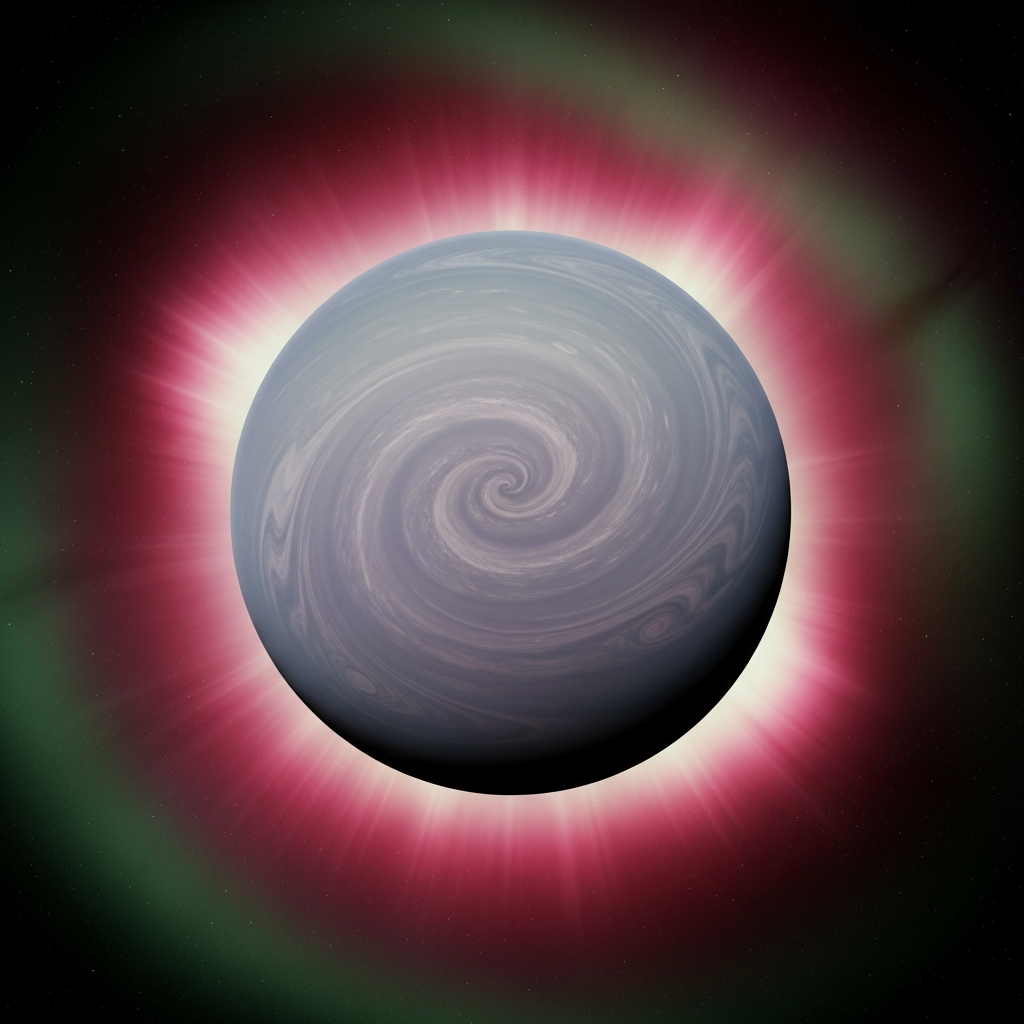
The James Webb Space Telescope (JWST) is once again delivering breathtaking insights, this time focusing on the enigmatic ice giant, Uranus. New observations reveal a mesmerizing “rosy glow” from its auroras, offering an unprecedented three-dimensional map of its upper atmosphere. These groundbreaking findings are not just beautiful images; they are pivotal for understanding our own solar system and the countless similar exoplanets across the galaxy. Get ready to dive into the mysteries of Uranus, from its bizarre tilt to its unexpected cooling trend, and discover how these distant observations hold clues to planetary evolution.
Unveiling Uranus’s Enigmatic Auroras
Recent data from the JWST have provided the best-yet three-dimensional glimpse into Uranus’s upper atmosphere, specifically mapping its ionosphere where dazzling auroras form. An international team, spearheaded by Paola Tiranti, a planetary science Ph.D. student at Northumbria University, published these significant findings in Geophysical Research Letters on February 19. Utilizing JWST’s highly sensitive NIRSpec instrument, researchers observed Uranus for over 15 hours in late January 2025.
These detailed observations captured faint glows emanating from molecules as high as 5,000 kilometers above the planet’s cloud tops. This isn’t just about pretty pictures; it’s about tracing energy. “With Webb’s sensitivity, we can trace how energy moves upward through the planet’s atmosphere and even see the influence of its lopsided magnetic field,” Tiranti explained. The auroras, appearing as rosy, glowing patches, extend above the visible atmospheric edges, providing a direct window into the planet’s internal dynamics.
A Glimpse into the Ice Giant’s Ionosphere
The 3D mapping by JWST focuses on tracing the abundance of H3+, an ion composed of three hydrogen nuclei. This ion is crucial for understanding the temperature and density of charged particles moving through Uranus’s ionosphere. The analysis unveiled significant structural and thermal characteristics. Temperatures in the upper atmosphere peaked between 3,000 and 4,000 kilometers, reaching approximately 153°C. Ion densities, meanwhile, hit their maximum closer to 1,000 kilometers.
Crucially, these temperature and ion density profiles showed clear longitudinal variations. Scientists directly attribute these variations to Uranus’s uniquely tilted and offset magnetic field. The observations also identified two bright auroral bands near the magnetic poles, separated by a depleted emission zone. This configuration strikingly mirrors features observed at Jupiter, where a strong magnetic geometry channels charged particles. Uranus’s magnetosphere, tilted at an extreme 98 degrees relative to its rotation axis, truly sculpts its atmosphere with these sweeping auroras.
Uranus: The Solar System’s Overlooked Oddball
Among our solar system’s planets, Uranus has often been criminally overlooked. Located far from the Sun, this “ice giant” world is so visually bland that only a single spacecraft, NASA’s Voyager 2, has ever visited it. That lone flyby occurred in late January 1986, more than 40 years ago, and provided limited data due to a solar storm squashing Uranus’s magnetic field at the time. This left many of its secrets untouched, making the new JWST observations incredibly vital.
Uranus is one of only two major planets with a retrograde (clockwise) rotation. Even stranger, it is the only one with such an extreme axial tilt, where its axis of rotation is almost perpendicular to its orbital motion. Imagine a spinning top tilted completely over and twirling backward around a star – that’s Uranus. Scientists believe this celestial skew likely resulted from a colossal planetary collision early in the solar system’s history. This tilt gives Uranus bizarre seasons, each spanning an astonishing 42 Earth years. It may also contribute to its lopsided, chaotic magnetic field, which is misaligned with the planet’s center and spin axis.
Why Uranus Matters: A Window to Exoplanets
Despite its peculiarities, Uranus holds keys to solving multiple planetary puzzles. In many planetary systems astronomers have discovered around other stars, worlds resembling Uranus in size and mass are incredibly common. This “ice giant” category of planet is likely the most prevalent in the Milky Way. Therefore, if we want to comprehend how planets form and evolve, both in our own solar system and throughout the galaxy, understanding Uranus is absolutely crucial.
As Heidi Hammel, a JWST interdisciplinary scientist, eloquently puts it, “These auroral detections are hugely important because they are a direct manifestation of the planet’s internal magnetic field.” She emphasizes that, without an in-situ spacecraft, there’s currently no other remote way to probe Uranus’s planetary magnetic field. The detailed vertical structure revealed by JWST is a critical step towards characterizing giant planets beyond our solar system, refining models for countless distant exoplanets.
Decoding Uranus’s Cooling Mystery
One enduring mystery that the JWST observations confirmed, though did not solve, concerns Uranus’s peculiarly plummeting temperature. For decades, scientists have observed an unexpected cooling trend in the ice giant’s upper atmosphere. The latest JWST measurements confirm this trend is ongoing. The telescope recorded an average temperature of about 150 degrees Celsius in Uranus’s upper atmosphere, a value lower than those seen in previous observations.
This continuous cooling trend, first noted in the 1990s, provides crucial insights into the energy loss dynamics unique to ice giants. While JWST has now shown how deeply these effects reach into the atmosphere, the underlying cause of this dramatic temperature drop remains an intriguing scientific puzzle. Understanding this energy balance is essential for forming a complete picture of these colossal worlds.
Catching a Glimpse: How to Spot Uranus in Your Night Sky
While the James Webb Space Telescope offers unparalleled close-ups, you can also spot Uranus from Earth! For stargazers in the United States, 2025 and 2026 offer prime viewing opportunities. Uranus reaches opposition annually, appearing brightest and largest in our night sky. For instance, in November 2025, Uranus reaches opposition on November 21st, appearing as a magnitude +5.6 object in the constellation Aries. In February 2026, Uranus will complete its retrograde motion on February 4th and will be visible from twilight to midnight in western Taurus, near the famous Pleiades star cluster, shining at magnitude +5.7.
To maximize your chances of seeing this distant ice giant:
Dark Skies are Key: Seek out rural areas far from city lights. Look for locations classified as Bortle 5 or darker on the Bortle scale of sky brightness. States known for their dark skies include Arizona, California, Colorado, Idaho, Nevada, New Mexico, Oregon, Texas, and Utah.
Allow Eye Adjustment: Give your eyes at least 15-20 minutes to adapt to the darkness.
Naked Eye (Challenging): Under exceptionally dark, clear skies, Uranus might appear as a faint, star-like point. It’s often easier to locate if you know its proximity to a brighter star cluster like the Pleiades. For example, on November 21, 2025, it will be just 4.5 degrees south of the Pleiades.
Binoculars (Recommended): A small pair of binoculars will make Uranus fairly easy to spot, even under moderately light-polluted skies. It will appear as a sixth-magnitude star, though its characteristic blue-green hue might be barely discernible.
- Telescope (Best View): For a more detailed view, including the planet’s tiny disk, a small telescope is advised. You’ll likely need at least 100x magnification to discern its disc. However, manage your expectations; you won’t see surface details like with Jupiter or Saturn. Larger apertures combined with steady seeing conditions might show subtle brightness variations across the disk.
- www.scientificamerican.com
- www.indiatoday.in
- www.space.com
- www.nationalgeographic.com
- www.unilad.com
Future Missions and the Webb Legacy
While the current JWST data provides revolutionary insights, scientists still hope to send another dedicated spacecraft to Uranus in the coming years. An in-situ mission would offer direct measurements and a much closer look at its unique environment. However, tight federal budgets and the complex timing required for an energy-efficient interplanetary voyage mean such a mission remains a distant prospect.
For now, scientists must rely on JWST’s stunning, remote views. The telescope has proven indispensable, already unveiling a new moon, charting subtle rings, and now, providing the best three-dimensional map of Uranus’s upper atmosphere. The ability to combine real-time spectroscopy with detailed 3D mapping truly opens new avenues for future discoveries in planetary science, solidifying Webb’s legacy in understanding our solar system’s most mysterious ice giant.
Frequently Asked Questions
How do JWST’s observations of Uranus’s auroras reveal its internal magnetic field?
The James Webb Space Telescope’s observations of Uranus’s auroras are a direct manifestation of its internal magnetic field. The JWST traces the abundance of H3+ ions in the ionosphere, where auroras form, to create a 3D map of the upper atmosphere’s temperature and particle density. The data showed clear longitudinal variations in these profiles, directly attributed to Uranus’s uniquely tilted and offset magnetic field. This allows scientists, like Heidi Hammel, to remotely study the planet’s magnetic field without needing an in-situ spacecraft. The presence of two bright auroral bands near the magnetic poles, mirroring features seen on Jupiter, further emphasizes the magnetic field’s role in sculpting the atmosphere.
Which unique characteristics make Uranus a crucial planet for understanding exoplanets?
Uranus is crucial for understanding exoplanets due to its unique characteristics and its prevalence as a planet type in the Milky Way. It possesses an extreme axial tilt, making it orbit like a spinning top, and rotates in a retrograde (clockwise) motion, likely from an early planetary collision. Its chaotic magnetic field is also highly unusual. Despite these oddities, planets of similar size and mass to Uranus are the most common type discovered around other stars. By studying Uranus, scientists gain vital insights into how these “ice giant” exoplanets form, evolve, and maintain their energy balance throughout the galaxy, making it a critical analogue for broader planetary science.
When is the best time to observe Uranus, and what equipment is recommended for viewing?
The best time to observe Uranus is during its annual opposition, when it appears brightest and largest in the night sky. For example, it was at opposition in November 2025 and will complete retrograde motion in February 2026. For optimal viewing, seek out dark skies away from light pollution (Bortle 5 or darker areas, common in many U.S. rural states). While it can occasionally be seen with the naked eye under perfect conditions, it will appear as a faint star-like point. Binoculars are highly recommended as they make Uranus fairly easy to spot, though its blue-green color might be subtle. For a clearer view of its tiny disk, a small telescope with at least 100x magnification is advised, but don’t expect to see intricate surface details.