The British Academy Film Awards (BAFTAs) are meant to celebrate cinematic achievement, but this year, a single edited speech ignited a firestorm of controversy. British-Nigerian filmmaker Akinola Davies Jr.’s powerful acceptance speech for his film My Father’s Shadow included a dedication to those “under occupation… and experiencing genocide,” culminating in the phrase “free Palestine.” However, when the BBC aired its delayed broadcast, this crucial segment was conspicuously absent, fueling widespread criticism and raising serious questions about editorial integrity.
This incident has amplified ongoing debates surrounding media impartiality, particularly regarding sensitive geopolitical issues. The BBC’s decision has drawn scrutiny not only for what it removed but also for what it chose to broadcast.
The BAFTA Stage: A Moment of Dedication and Disruption
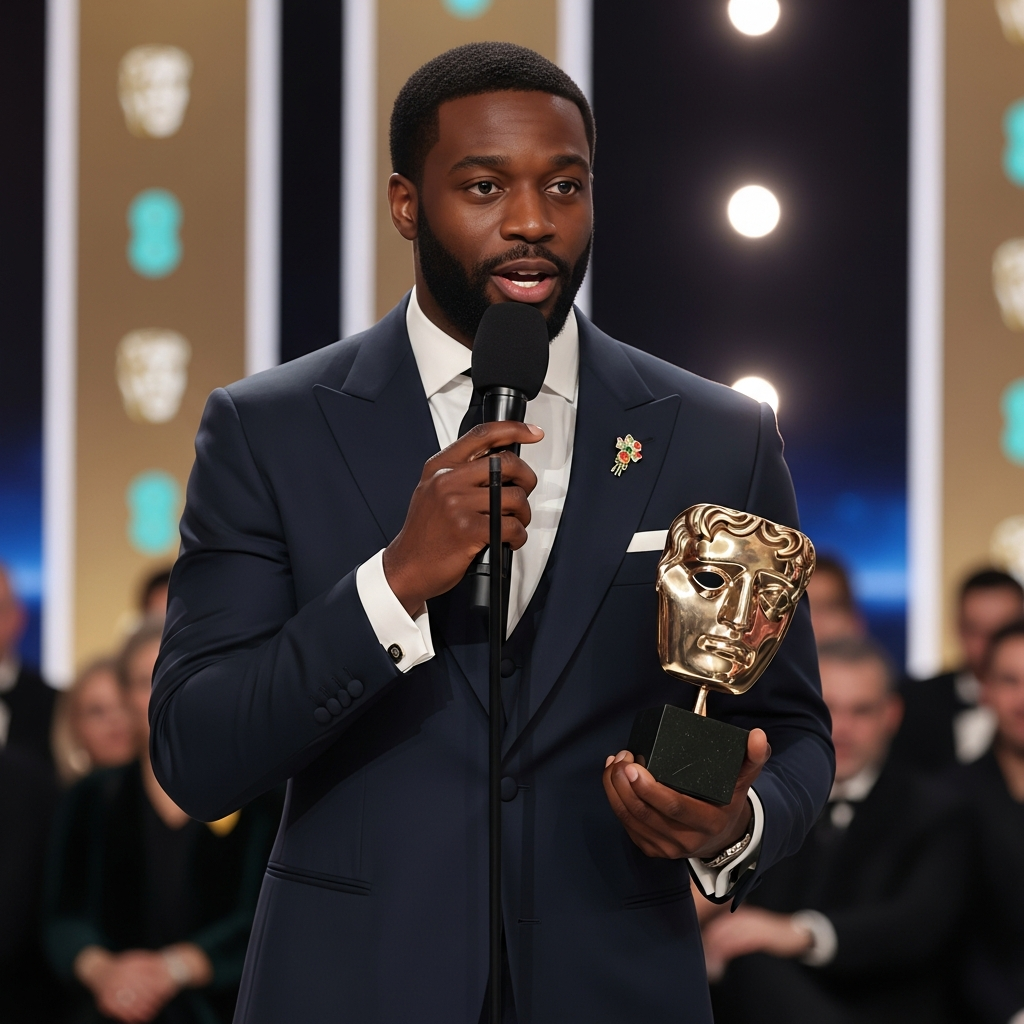
Akinola Davies Jr., alongside Wale Davies, received the prestigious BAFTA Film Award for Outstanding British Debut. Their film, My Father’s Shadow, resonated deeply with audiences, exploring themes of family, migration, and identity. When Davies Jr. took the stage to accept the accolade, his speech transcended typical thank-yous, evolving into a poignant dedication.
He spoke movingly about dedicating the award to “all those whose parents migrated to obtain a better life for their children.” Davies Jr. elaborated, acknowledging “the economic migrant, the conflict migrant. Those under occupation, dictatorship, persecution, and those experiencing genocide.” He stressed the profound importance of their stories, declaring, “You matter. Your stories matter more than ever. Your dreams are an act of resistance.” The speech concluded with a fervent call: “Archive your loved ones. Archive your stories yesterday, today, and forever. For Nigeria, for London, the Congo, Sudan, free Palestine.”
The Edited Broadcast: What Viewers Missed
While the live audience in London heard Davies Jr.’s full, impassioned statement, BBC viewers at home experienced a different version. The publicly broadcast edit on BBC One and iPlayer significantly truncated the speech. The entire segment dedicating the award to migrants and referencing geopolitical conflicts, including the “free Palestine” declaration, was removed. Instead, the edited version jumped directly to Davies Jr. thanking his family and his brother, Wale, for “nurturing this spark.”
The two-hour delay between the live ceremony and the BBC’s broadcast allowed ample time for editorial review, making the omission a deliberate choice rather than a live oversight. This specific editorial decision became a focal point of public outrage, especially when contrasted with other elements of the broadcast.
The BBC’s Justification and Brewing Controversies
A BBC spokesperson swiftly responded to queries about the edit, attributing it to time constraints. They stated that the three-hour live event needed to be reduced to a two-hour slot for broadcast, and similar edits were made to other speeches to meet the schedule. The spokesperson added that all winners’ full speeches would be available on BAFTA’s YouTube channel.
However, this explanation failed to quell criticism, particularly given a significant context. Reports had previously surfaced indicating that the BBC had made pre-emptive preparations for potentially politically charged speeches at the BAFTAs. This measure was reportedly designed to avoid a repeat of a “national scandal” from the previous year when the broadcaster aired a Glastonbury Festival performance featuring the act Bob Vylan chanting “death to the IDF.” This background suggests that the BBC’s actions, despite the official explanation of time management, might be intrinsically linked to a broader strategy to manage politically sensitive content and avert potential fallout.
The Contrast: Racial Slur vs. Political Statement
Adding further fuel to the fire, the same BBC broadcast that omitted “free Palestine” notably included an audible racial slur. During the ceremony, John Davidson, a Tourette’s advocate whose life inspired a BAFTA-winning film, shouted the N-word while actors Michael B. Jordan and Delroy Lindo were on stage. Although host Alan Cumming addressed the outburst, explaining Davidson’s involuntary tics due to Tourette’s syndrome, the decision to air the slur while cutting a political statement provoked intense public backlash.
Critics questioned the BBC’s editorial priorities, highlighting the inconsistency of censoring a widely recognized political slogan, which is not profanity or hate speech under UK law, while allowing a racial epithet to be broadcast. The BBC later offered an apology regarding the racial slur, citing “production constraints” for its inclusion, an explanation many found unconvincing given the two-hour broadcast delay.
A National Broadcaster Under Scrutiny: Broader Implications
The BAFTA editing controversy is not an isolated incident but rather another flashpoint in an ongoing period of intense scrutiny for the BBC. The broadcaster has faced significant criticism over its coverage of the war in Gaza, with concerns raised about perceived imbalanced reporting and an alleged excessive caution regarding Israel’s military actions. Over 100 BBC journalists and staff reportedly signed a letter to Director-General Tim Davie, expressing concerns about reporting impartiality.
Furthermore, the UK media regulatory agency Ofcom previously found a BBC documentary, “Gaza: How to Survive a Warzone,” to be “materially misleading” for failing to disclose the protagonist was the son of a Hamas official. Such findings, deemed “among the most serious that can be committed by a broadcaster,” underscore a deepening crisis of trust and accountability.
This public dissatisfaction is also playing out amid debates about the future of the BBC licence fee, with calls for boycotts emerging in response to dissatisfaction with its Gaza coverage. The BAFTA incident has become symbolic of a larger struggle for the BBC to navigate its role as a public service broadcaster during times of intense political polarization, balancing impartiality with freedom of expression. The absence of the full broadcast on BBC iPlayer for public review has further complicated accountability.
The Future of Live vs. Delayed Broadcasts
The selective editing has sparked broader discussions about the nature of awards ceremonies and the choices broadcasters make. Some argue that such events, especially those pre-recorded, often sacrifice authenticity for polished, time-constrained programming. Critics, including those from The Guardian, contend that a live broadcast, with all its unpredictable moments, would inject much-needed vitality and honesty into awards shows. They suggest that viewers are capable of handling unscripted political statements or even occasional profanity, much like audiences for other live events. The Oscars’ rumoured shift towards YouTube by 2029 highlights an industry trend away from traditional broadcast constraints.
For the BBC, the BAFTA controversy underscores the delicate balance it must strike between its public service remit for impartiality, the commercial realities of television scheduling, and the growing demand for transparent, unedited content in a digital age. The debate over who authorized the specific cut, and the underlying rationale beyond mere timekeeping, remains a crucial unanswered question, leaving many to wonder about the true editorial line being drawn.
Frequently Asked Questions
What specific part of Akinola Davies Jr.’s BAFTA speech did the BBC edit out?
The BBC edited out a significant portion of Akinola Davies Jr.’s BAFTA acceptance speech. This included his dedication of the award to “all those whose parents migrated to obtain a better life for their children,” specifically mentioning “the economic migrant, the conflict migrant. Those under occupation, dictatorship, persecution, and those experiencing genocide.” Crucially, the final phrase, “For Nigeria, for London, the Congo, Sudan, free Palestine,” was entirely removed from the BBC’s delayed broadcast.
What other controversies surrounded the BBC’s BAFTA broadcast that night?
Beyond the edited “free Palestine” speech, the BBC’s BAFTA broadcast drew additional controversy for including an audible racial slur. John Davidson, a Tourette’s advocate whose condition causes involuntary verbal tics, shouted the N-word during the ceremony. The BBC chose to broadcast this incident, later attributing its inclusion to “production constraints,” while simultaneously omitting Davies Jr.’s political statement. This juxtaposition sparked widespread criticism regarding the broadcaster’s editorial judgment and perceived inconsistencies.
Why has the BBC’s editing of the BAFTA speech drawn so much criticism regarding impartiality?
The BBC’s decision has drawn significant criticism for several reasons. Firstly, the two-hour delay before broadcast indicates a deliberate editorial choice rather than a live reaction, suggesting a conscious removal of a political statement. Secondly, this occurred against a backdrop of extensive public debate and internal dissent within the BBC concerning its coverage of the Gaza conflict. Critics argue that censoring “free Palestine,” a widely used political slogan, while broadcasting a racial slur, demonstrates a biased application of editorial standards and undermines the BBC’s claim to impartiality, particularly for its licence fee payers.
Conclusion
The BBC’s decision to edit Akinola Davies Jr.’s BAFTA acceptance speech, removing his powerful “free Palestine” dedication, has ignited a profound debate far beyond the glitz of an awards ceremony. It spotlights the complex ethical landscape faced by national broadcasters in an era of heightened political sensitivity and public scrutiny. This incident, especially when viewed alongside the broadcasting of a racial slur and the ongoing controversies surrounding the BBC’s Gaza coverage, underscores a pressing need for greater transparency and consistency in editorial decision-making. As public trust in media remains fragile, the choices made in these moments resonate deeply, shaping public discourse and influencing perceptions of media impartiality.