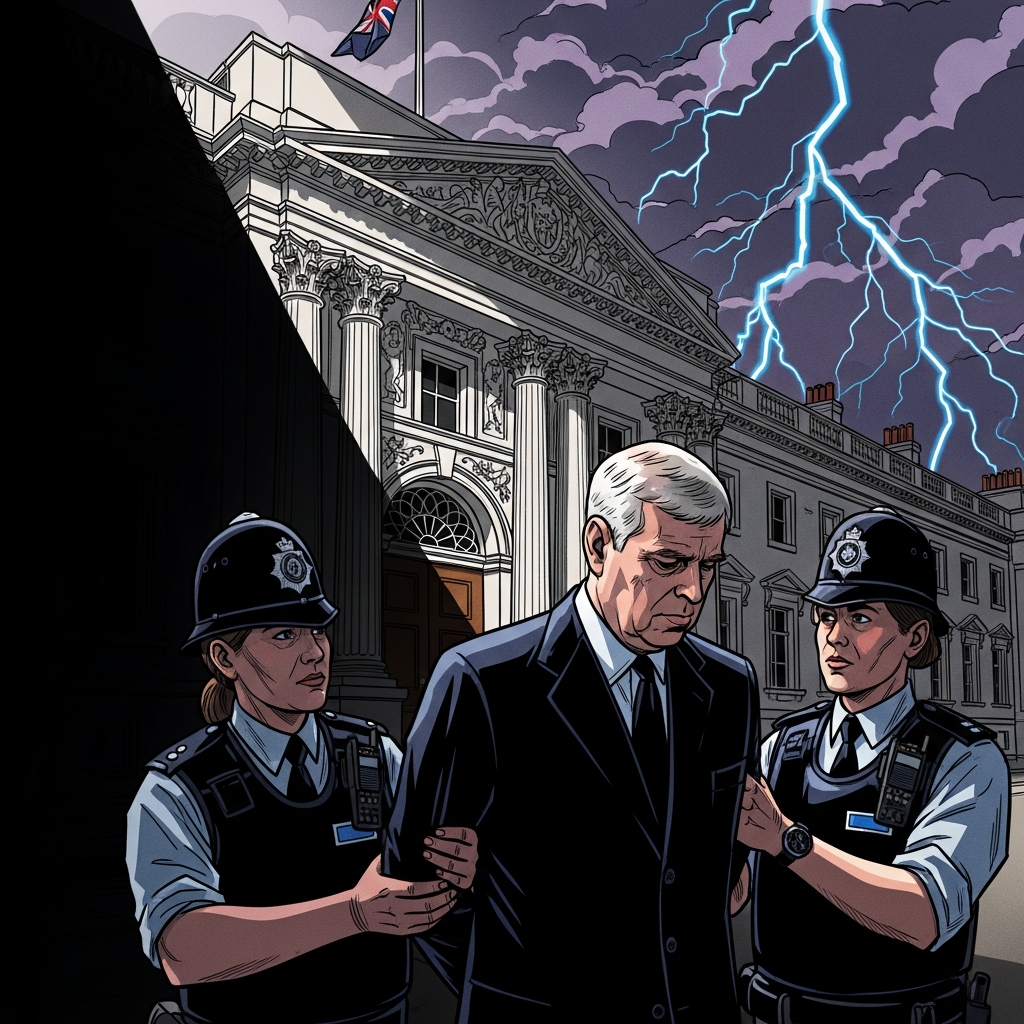
A seismic event has sent shockwaves through the British establishment, as Andrew Mountbatten-Windsor, formerly known as Prince Andrew, was arrested on suspicion of misconduct in public office. This unprecedented development, occurring on his 66th birthday, marks the first time a senior member of the Royal Family has faced arrest in nearly four centuries, underscoring a profound shift in accountability and public deference. The arrest, and subsequent release under investigation, has ignited a fresh wave of scrutiny into his long-standing association with convicted sex offender Jeffrey Epstein, prompting an immediate and firm response from King Charles III who declared, “the law must take its course.”
Unprecedented Royal Arrest: A Historic Day for the Monarchy
Thursday, February 19, 2026, dawned as a day etched into the annals of royal history. Andrew Mountbatten-Windsor was taken into custody by Thames Valley Police around 08:00 GMT at the Sandringham Estate in Norfolk. The arrest followed a “thorough assessment” by the police force, supported by Norfolk Constabulary, into serious allegations. After approximately eleven hours of questioning, he was released under investigation around 19:00 GMT, returning to his residence at Wood Farm. This Andrew Mountbatten-Windsor arrest signifies a remarkable erosion of traditional royal immunity and has been described by experts as a “spectacular fall from grace.”
The sheer rarity of such an event cannot be overstated. With no senior royal having been arrested in almost 400 years, this incident immediately captured global attention. Police searches were conducted not only at Wood Farm, his current home on the Sandringham Estate, but also at Royal Lodge in Berkshire, his former residence. Crucially, authorities emphasized that this formal investigation is not in relation to any allegations of sexual offenses, a point of clarification that attempts to distinguish it from past controversies.
The Allegations: Misconduct in Public Office Explained
At the heart of this royal scandal lies the complex offense of misconduct in public office. This charge essentially alleges that a public officer committed a serious wrongdoing, knowing it to be wrong, while performing duties on behalf of the British public. The police investigation is meticulously focusing on four key elements to establish the veracity of the claims against Andrew Mountbatten-Windsor:
Public Officer Status: Establishing if he was indeed a “public officer” and if the alleged incidents were plausibly part of his duties. The arrest is understood to be linked to his activities as the UK’s trade envoy between 2001 and 2011.
Wilful Misconduct: Determining if he “wilfully” neglected his duty or misconducted himself, a legal definition that has historically been subject to intense debate.
Abuse of Trust: Assessing if his actions constituted “an abuse of the public’s trust,” leveraging his privileged position.
Lack of Justification: Examining if he acted “without reasonable excuse or justification,” allowing for his defense to present his side of the story.
The specific allegations stem from recently released documents by the US justice department as part of the wider Jeffrey Epstein investigation. These files appear to show that in 2010, Andrew forwarded confidential government reports from official visits to Vietnam, Singapore, and China to Epstein. There are also indications that he shared information on investment opportunities, including in gold and uranium, in Afghanistan with Epstein. Official guidance for trade envoys strictly mandates a duty of confidentiality regarding sensitive commercial or political information acquired during official visits, making these allegations particularly severe. The accusation highlights a potential breach of trust and duty during his tenure as a trade representative, drawing a clear line between his official capacity and his controversial personal associations.
Royal Reaction: King Charles III’s Firm Stance
The response from Buckingham Palace was swift and unequivocal. King Charles III expressed his “deepest concern” over his brother’s arrest, issuing an unprecedented public statement that diverged from the traditional royal approach of “never complain, never explain.” He stated unequivocally, “the law must take its course,” pledging “full and wholehearted support and co-operation” to the authorities. It was understood that the King was not informed about the arrest in advance, yet his decisive reaction has been praised by royal observers like former press secretary Ailsa Anderson, who noted his access to information from the recently published Epstein files.
While the King took a firm stance, other senior members of the Royal Family continued with their scheduled engagements, maintaining a public appearance of normalcy amidst the crisis. Prince William and Catherine reportedly support the King’s remarks, echoing the sentiment that no one is above the law. However, experts like Ailsa Anderson commented that the events would undoubtedly leave the Royal Family feeling “bruised” and “shattered,” despite their outward composure. This King Charles III statement reflects a broader strategy to insulate the monarchy from the fallout and uphold public trust.
International Impact and Public Scrutiny
The Andrew Mountbatten-Windsor arrest has resonated far beyond British borders, attracting significant international attention. US President Donald Trump described the situation as “very sad” and “a shame” for the Royal Family, while Democratic Congressman Suhas Subramanyam, a vocal advocate for the release of the Epstein files, stated the situation is being “watched closely in Washington.” Subramanyam suggested that the UK is demonstrating “real accountability” for figures like Andrew Mountbatten-Windsor, contrasting it with a perceived “lack of accountability” in the US. He believes the arrest should “increase the pressure” for Andrew to cooperate, reiterating that the US door remains open for discussions, even offering to travel to the UK.
In the UK, Prime Minister Keir Starmer affirmed that “No one is above the law,” urging cooperation with US authorities. The family of the late Virginia Giuffre, a key accuser of Epstein who died by suicide last year, expressed a mixed sense of joy and bittersweet vindication. Her siblings hailed the arrest as a “win for survivors,” asserting that “no one is above the law, not even royalty.” Policing commentator Danny Shaw clarified that Mountbatten-Windsor would face “no special treatment,” being placed in a standard police cell during his interview. The National Police Chiefs’ Council (NPCC) also confirmed giving the Home Office 30 minutes’ advance notice of the arrest, highlighting the sensitivity and high-level coordination involved.
Andrew Mountbatten-Windsor’s Tumultuous Past
This latest chapter in Andrew Mountbatten-Windsor’s life adds to a long history of controversy surrounding his Jeffrey Epstein ties. Despite consistently denying any wrongdoing in his associations with Epstein and specific allegations from the released Epstein files, his public image has been severely damaged. The image of him, “shell-shocked” and “slouched” in the back of a car after his release, is poised to become a lasting visual memory of this arrest.
His connection to Epstein first led to his stepping back from royal duties in 2019 following a controversial BBC interview. By 2022, he had lost his military titles and royal patronages. He previously faced allegations from Virginia Giuffre, which were settled out of court for a multi-million-pound sum, though he made no admission of guilt. More recently, further details from a book and the Epstein documents led King Charles III to strip him of the right to be called a prince and order him to vacate his long-time residence, Royal Lodge. While he retains his place as 8th in the line of succession and technically as a counsellor of state, changes to these statuses would involve complex legislation requiring support from Commonwealth countries, further complicating the UK monarchy’s ongoing efforts to manage this significant public relations crisis.
The Road Ahead: What Happens Next in the Investigation?
Following his release under investigation, Andrew Mountbatten-Windsor is not currently subject to bail conditions, meaning he has no specific restrictions but can be rearrested or called for further interviews at any time. There is no statutory time limit for charges to be brought in a case of this nature. Given the complexity of misconduct in public office allegations and the high-profile individuals involved, a decision from the Crown Prosecution Service, following police assessment, could take a considerable period.
Police searches at Royal Lodge were reported to be ongoing even after his release, indicating the thoroughness of the investigation. This legal process is expected to be protracted, and the long-term implications for Andrew Mountbatten-Windsor and the Royal Family remain uncertain. The emphasis on “real accountability” both domestically and internationally suggests that this investigation will be watched closely, with pressure mounting for full cooperation and transparency.
Frequently Asked Questions
What is Misconduct in Public Office, and why was Andrew Mountbatten-Windsor arrested for it?
Misconduct in Public Office is a common law offense that applies when a public officer, in the course of their duties, commits a serious wrongdoing, knowing it to be wrong, and abuses the public’s trust without reasonable excuse. Andrew Mountbatten-Windsor was arrested on suspicion of this offense, specifically linked to allegations that during his tenure as a UK trade envoy (2001-2011), he shared confidential government documents and investment information from official visits with convicted sex offender Jeffrey Epstein in 2010, thereby allegedly breaching his duty of confidentiality and public trust.
What are the next steps in the police investigation following Andrew Mountbatten-Windsor’s release?
After his release under investigation, Andrew Mountbatten-Windsor is not on bail and thus not subject to specific conditions. However, the police investigation, led by Thames Valley Police, remains active. Authorities can call him for further interviews or even rearrest him if new evidence emerges or is assessed. There is no time limit for charges to be brought in this complex case, meaning the Crown Prosecution Service will take a significant period to review all evidence before deciding whether to press charges. Searches at his former and current residences were also part of the initial phase.
How has the Royal Family, particularly King Charles III, responded to Andrew Mountbatten-Windsor’s arrest?
King Charles III responded swiftly, expressing “deepest concern” and stating firmly that “the law must take its course,” pledging “full and wholehearted support and co-operation” to the authorities. The King was not given advance notice of the arrest, but his public statement demonstrated a clear effort to distance the monarchy from the controversy and emphasize accountability. While Prince William and Catherine reportedly support the King’s stance, other senior royals continued with their public engagements, aiming to project an image of normalcy amidst the significant royal crisis.
Conclusion: A Defining Moment for the Monarchy
The Andrew Mountbatten-Windsor arrest marks a watershed moment for the British monarchy, challenging traditional notions of royal privilege and demonstrating an unwavering commitment to the rule of law. The allegations of misconduct in public office, tied directly to his association with Jeffrey Epstein, highlight the long-term repercussions of controversial personal ties on public service. King Charles III’s resolute stance, coupled with significant international and domestic scrutiny, indicates that this investigation is not just a legal matter, but a profound test of the Royal Family’s integrity and its ability to adapt to a demand for greater transparency. As the investigation continues, the world watches to see how this unprecedented crisis will further shape the future of the UK monarchy.