By QuantoSei Technology Solutions | February 2026 | Identity Verification · Compliance · Fraud Prevention
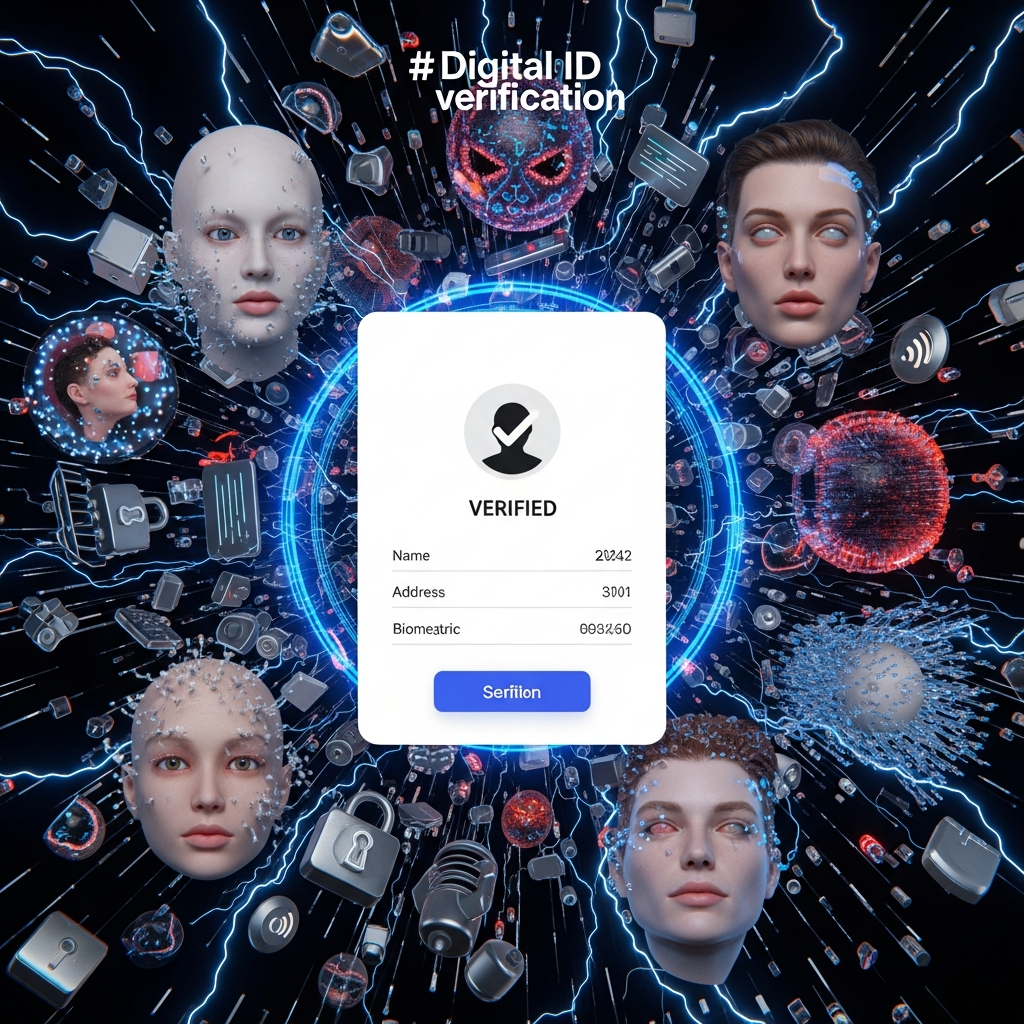
Deepfake fraud is up 3,000%. Global KYC fines hit $6.6 billion in 2023. And 1 in every 20 identity verification attempts today is fraudulent. If your business onboards customers digitally, what’s standing between you and the next breach?
The digital economy runs on trust. And trust, increasingly, is being attacked.
Across banking, fintech, healthcare, e-commerce, crypto, and government services, organizations are onboarding users faster than ever — and fraudsters are keeping pace. Synthetic identities, AI-generated fake documents, and real-time deepfake video attacks have turned customer onboarding from a routine process into a high-stakes security perimeter. The companies that recognize this first — and act — will be the ones that survive and scale.
This article breaks down what’s happening in the identity verification landscape in 2025–2026, why KYC is now a strategic necessity rather than a regulatory checkbox, and what to look for when choosing the right system for your business.
The Numbers Are Impossible to Ignore
The global identity verification market was valued at $14.19 billion in 2025 and is forecast to reach $26.8 billion by 2031, growing at a CAGR of over 11%. That growth is not speculative — it’s being driven by real, measurable pressure from all sides.
On the fraud side, the FBI’s Internet Crime Complaint Centre reported $16.6 billion in losses from online crime in 2024 alone. Consumer fraud losses reached $12.5 billion in the same year, and the share of fraud reporters who actually lost money jumped from 27% in 2023 to 38% in 2024. Account takeover losses now approach $13 billion annually, and synthetic identity fraud — where real and fabricated data are blended to create entirely fictitious people — accounts for 80% of new-account fraud and is projected to cause at least $23 billion in losses by 2030.
On the regulatory side, global financial institutions paid $6.6 billion in KYC-related penalties in 2023. TD Bank’s $3 billion anti-money-laundering fine and Binance’s $4.3 billion settlement have reset the risk calculus for compliance teams everywhere. Non-compliance is no longer an operational cost — it has become an existential threat.
The message is clear: the cost of not having a KYC system now exceeds the cost of having one.
The Deepfake Problem: A Threat Most Businesses Are Underestimating
If synthetic identity fraud is the war, deepfakes are its most powerful weapon — and they are evolving fast.
Deepfake attacks designed to bypass biometric authentication increased by 704% in 2023. The World Economic Forum reported a staggering 1,740% increase in deepfake incidents in North America alone between 2022 and 2023. Companies lost over $200 million to deepfake scams in just the first quarter of 2025, according to the Wall Street Journal. And Veriff’s 2025 Identity Fraud Report found that 1 in every 20 identity verification attempts is now fraudulent, with global fraud attempts growing 21% year-over-year.
Perhaps most striking: 78.65% of global respondents reported being targeted by deepfake or AI-generated fraud at least once in the past 12 months. This is no longer a niche threat affecting only large banks.
Fraudsters are using generative AI tools to:
- Create hyper-realistic fake ID documents (passports, driver’s licenses, residency cards) in seconds
- Perform real-time face swaps during live video verification sessions
- Inject synthetic biometric data directly into verification pipelines, bypassing cameras entirely
That last method — known as an injection attack — is particularly dangerous because it defeats traditional liveness detection by never using the camera at all. It feeds manipulated data directly to the software layer, appearing authentic at the system level.
This is precisely why modern KYC systems need both active and passive liveness detection modes, document forensics, and biometric binding — not just a basic selfie check.
What KYC Actually Needs to Do in 2026
Regulatory requirements, fraud vectors, and user expectations have all evolved. A KYC system deployed today needs to go well beyond scanning a passport photo. Here is what a complete, enterprise-grade KYC solution must include:
1. Document OCR with Fraud Detection
Optical Character Recognition (OCR) extracts data from identity documents in real time — but the better systems go further. They validate document authenticity by analyzing fonts, layouts, barcode consistency, and whether extracted data matches expected templates for that specific document type across hundreds of countries.
2. Liveness Detection (Active + Passive)
Liveness detection answers the most fundamental question in digital identity: is there a real, live human being on the other end of this verification, right now?
- Passive liveness works invisibly, analyzing micro-movements, skin texture, depth cues, and lighting without requiring any action from the user.
- Active liveness prompts the user to perform a specific challenge — a head turn, a blink — to defeat screen-replay or mask attacks.
The most robust systems deploy both. Passive catches high-volume automated attacks without adding friction. Active stops sophisticated physical spoofing attempts.
3. Facial Recognition and Biometric Matching
Face matching compares the live capture to the photo on the submitted document. High-accuracy systems use 3D modeling and multi-frame analysis, not a single still image comparison, to achieve verification rates that stand up to regulatory scrutiny.
4. Fingerprint Verification with Pose Challenge
For use cases requiring the highest assurance level — financial services, government access, healthcare — fingerprint verification adds a hardware-anchored biometric factor that is currently impossible to spoof remotely.
5. REST API and Database Integration
No system exists in isolation. Enterprise-grade KYC must integrate cleanly via REST API with existing backends, mobile applications, CRMs, and compliance reporting tools — without requiring months of custom engineering work.
Cloud vs. On-Premise: The Architecture Question That Defines Your Risk
Most KYC vendors sell cloud-hosted, subscription-based solutions. Every verification your users perform flows through their infrastructure. Your customer data — biometric captures, document scans, identity records — lives on their servers.
For many businesses, particularly those in regulated industries or emerging markets, this creates unacceptable exposure:
Data sovereignty: Under GDPR, local data protection laws in Africa, LATAM, Southeast Asia, and the Middle East, and industry-specific regulations in healthcare and finance, organizations are increasingly required to maintain direct control over sensitive identity data. Cloud-hosted KYC creates a third-party dependency that can conflict with these obligations.
Ongoing cost scaling: SaaS-based KYC pricing typically runs $0.25 to $2.00 per biometric session and $0.10 to $1.50 per document check. For a business performing 5,000 verifications per month, that is $3,000 to $17,500 every month — indefinitely. Enterprise on-premise licenses from major vendors, by contrast, start at $10,000 to $50,000 as a one-time purchase, but often carry annual maintenance fees and complex procurement cycles.
Customization and control: A self-hosted system can be tailored to your specific workflow, regulatory jurisdiction, branding requirements, and integration architecture. A SaaS platform gives you what it was built to give everyone.
The global market already reflects this reasoning: in 2025, on-premise deployment held the highest market share in the identity verification industry, driven precisely by the demand for data control, compliance flexibility, and total cost of ownership.
The Business Case: What Implementing KYC Actually Delivers
Beyond compliance, there is a compelling business case for implementing robust identity verification.
Faster onboarding, lower abandonment. Traditional manual KYC onboarding processes took 24–120 hours. Modern automated systems complete the same verification in under two minutes — sometimes in seconds. In 2024, traditional onboarding processes lost 67% of prospective customers during the process. Every percentage point of friction removed directly impacts revenue.
eKYC has been shown to reduce onboarding costs from the equivalent of $180 to $25 per user while cutting fraud rates from 12% to 4.5% — a nearly 3x improvement in fraud protection delivered simultaneously with a 7x reduction in cost per verification.
Fraud prevention protects revenue. 13% of global fraud decision-makers report losing up to 20% of annual revenue to fraud. A KYC system that stops fraudulent account creation at onboarding removes that risk from the top of the funnel, before it propagates into chargebacks, regulatory investigations, and reputational damage.
Compliance reduces fine exposure. With regulators increasingly willing to issue nine and ten-figure penalties for KYC failures, the ROI calculation is straightforward: a well-implemented system is insurance against losses that would dwarf its cost many times over.
Who Needs KYC Right Now?
The answer in 2026 is: most digital businesses.
The industries with the clearest regulatory mandates include banking and financial services, cryptocurrency exchanges, insurance, healthcare, telecom, and online gaming. But the practical reality extends much further:
- Fintech and payment platforms face KYC requirements under AML frameworks globally and need frictionless onboarding that does not sacrifice security.
- HR and staffing platforms verifying worker identities for gig economy compliance.
- E-commerce and marketplace platforms preventing fraudulent seller and buyer accounts.
- Government digital services issuing benefits, licenses, and credentials remotely.
- Healthcare telemedicine platforms verifying patient identity before prescribing or accessing records.
- Education and certification bodies ensuring exam integrity in remote environments.
The biometric-based digital identity segment already accounts for 68% of the global identity verification market. If your business interacts with users digitally, the question is no longer whether you need identity verification — it is which system to deploy, and how.
What to Look for When Choosing a KYC System
When evaluating identity verification solutions, prioritize these criteria:
Deployment flexibility. Can you run it on your own servers, in your own cloud environment, or both? Full infrastructure control is essential for data sovereignty and long-term cost management.
Active and passive liveness. Both modes must be present. Passive alone is no longer sufficient against injection attacks and real-time deepfakes.
Document coverage and OCR accuracy. The system should handle national IDs, passports, and driving licenses across your target markets, with high accuracy even in imperfect capture conditions.
Integration quality. Evaluate the REST API documentation before you buy. A well-documented, developer-friendly API means the difference between a two-day integration and a two-month project.
Biometric depth. Facial recognition alone is insufficient for high-assurance use cases. Fingerprint verification and pose challenge support add layers that are currently impractical to defeat remotely.
Pricing transparency. Understand the total cost of ownership — not just the entry price. Per-verification fees compound rapidly. One-time license models offer predictable, scalable costs.
Support and onboarding. Fast deployment matters. Look for vendors who provide structured onboarding support, not just documentation.
The QuantoSei KYC Intelligence Suite
At QuantoSei, we built our KYC system precisely around the gaps we saw in the market: most vendors force you to choose between affordability, control, and completeness. We designed a solution that offers all three.
Our KYC Intelligence Suite is a complete, self-hosted identity verification platform deployable on your own infrastructure — on-premise or in a self-managed cloud — for a single one-time license fee contact us. No recurring fees. No per-verification charges. No third-party data dependency.
The platform includes:
- OCR document verification — national IDs, passports, and driving licenses
- Active and passive liveness detection — designed to defeat deepfakes, masks, video replays, and injection attacks
- Facial recognition and biometric matching
- Fingerprint verification with pose challenge
- REST API and database integration — complete, developer-friendly documentation included
- Full deployment package — delivered and onboarded within 24 hours of confirmation
It runs on standard infrastructure (8+ CPU cores, 16–32 GB RAM) with optional GPU acceleration for faster OCR processing. The first three months include software updates and integration support. Beyond that, your system is yours — no lock-in, no subscription treadmill.
Try the live demo at kyc.quantosei.com — no registration required.
Android App Demo: Download
Integration inquiries: info@quantosei.com | +258 82 52 99 215
Looking Ahead: What’s Next in Identity Verification
The KYC space is moving fast. Several developments will shape the next two to three years:
Perpetual KYC (pKYC) is replacing one-time onboarding verification. Rather than checking identity once at signup, organizations will monitor identity signals continuously — against sanction lists, PEP databases, and adverse media — throughout the customer lifecycle.
Reusable digital identities are gaining traction. Verifiable credentials, government-issued mobile driver’s licenses, and decentralized identity models will allow users to prove their identity once and reuse that attestation across multiple platforms — reducing friction while maintaining assurance.
AI-vs-AI escalation will intensify. As generative AI makes fraud tools cheaper and more accessible, identity verification systems will need to continuously update their detection models. Vendors that can push model updates rapidly — and systems that are built to accept them — will maintain the security advantage.
Regulatory expansion will widen the mandate. FinCEN’s 2026 AML/CFT rules extend customer identification obligations to investment advisers. The EU’s eIDAS 2.0 framework requires all member states to support interoperable digital ID wallets by 2026. The scope of who must implement KYC is growing, not shrinking.
Conclusion
The convergence of escalating fraud, tightening regulation, and accessible AI tools has made identity verification one of the most consequential technology decisions a digital business can make in 2026.
A KYC system is no longer infrastructure for compliance teams — it is a frontline business asset that protects revenue, enables growth, reduces fraud, and satisfies regulators. The businesses investing in it now are not just protecting themselves; they are building a competitive advantage in onboarding trust that will compound over time.
The question is not whether your business needs KYC. It is whether the system you choose gives you control, transparency, and long-term value — or locks you into a subscription model that scales against you as you grow.
QuantoSei Technology Solutions provides enterprise-grade identity verification technology — KYC, OCR, liveness detection, and biometric authentication — as a self-hosted, one-time-license platform. Learn more at quantosei.com or contact us at info@quantosei.com.
Tags / Keywords
KYC software · identity verification solution · liveness detection · OCR document verification · on-premise KYC · self-hosted KYC system · biometric verification · KYC compliance 2025 · deepfake fraud prevention · eKYC · KYC one-time license · facial recognition software · AML compliance · digital onboarding · fingerprint verification