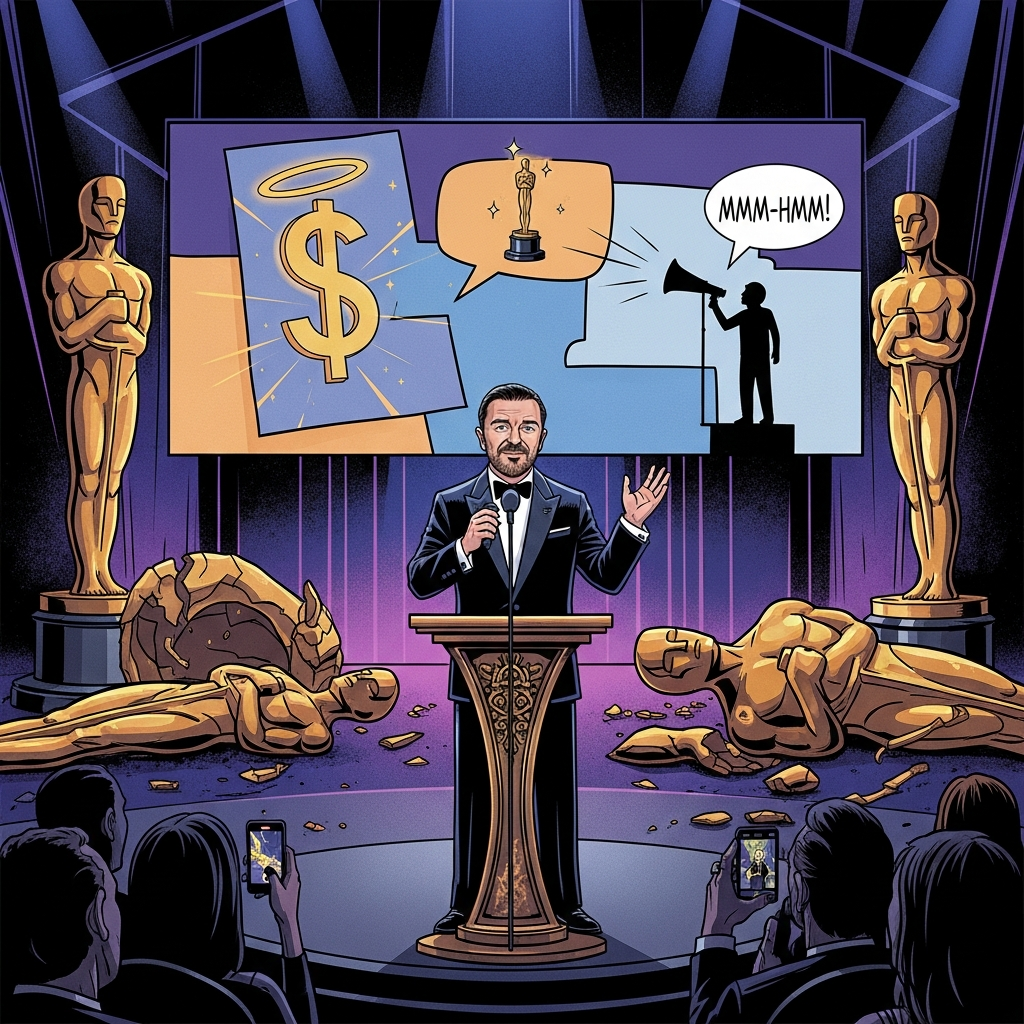
The 2026 Grammy Awards sparked immediate controversy, not just for the musical triumphs but for a wave of politically charged acceptance speeches. Comedian Ricky Gervais, a vocal critic of celebrity activism on such platforms, swiftly took to social media, reigniting a familiar debate. His post, featuring an excerpt from his iconic 2020 Golden Globes monologue and a poignant “They’re still not listening” emoji, underscored a deep philosophical divide in the entertainment world.
This year’s Grammys saw artists leverage their global spotlight to advocate for social justice, particularly regarding U.S. immigration policies. This clash between artists using their voice and Gervais’s call for non-political award ceremonies has captivated audiences and fueled widespread discussion.
Ricky Gervais’s Unwavering Stance on Celebrity Platforms
Ricky Gervais has consistently argued against celebrities using award shows for political grandstanding. His position, articulated repeatedly, gained significant traction during his 2020 Golden Globes hosting gig. During that memorable monologue, Gervais directly advised the A-list audience. He urged them, “If you do win an award tonight, don’t use it as a political platform to make a political speech.” He further asserted their perceived disconnect from everyday reality. “You’re in no position to lecture the public about anything,” he declared. “You know nothing about the real world.”
Gervais’s 2026 X post, complete with a crying emoji, mirrored his reaction to the 2025 Emmys. After that ceremony, “Hacks” star Hannah Einbender notably used her acceptance speech to say “fuck ICE” and “free Palestine.” Gervais had posted, then deleted, an identical message. This pattern highlights his steadfast belief that award stages should celebrate artistic achievement, not serve as political soapboxes.
The Evolution of Gervais’s Critique
Commentators have observed a shift in Gervais’s comedic targets over time. Early in his career, he was known for “punching up.” He aimed his “vicious and vitriolic jokes” at “sanctimonious and self-righteous members of the high A-list.” This era saw him challenging powerful figures, such as in 2013. Following the devastating Moore tornado, Gervais criticized pop stars Beyoncé and Rihanna for “performative inaction.” He highlighted their “public prayers” without tangible contributions. Gervais explicitly tweeted advice: “You can support #Moore response by txting REDCROSS to 90999 to give $10, or online at redcross.org #ActuallyDoSomethingForOklahoma.” He famously quipped, “Praying for something but not doing anything… has the same effect as writing to Santa.”
More recently, however, some critics suggest a different approach. His latest works, like the Armageddon special, have been described as targeting “easier targets.” This has led to questions about whether his current critiques of celebrity activism still carry the same “punch up” weight. His recurring “they’re not listening” comment at award shows might now be viewed through this evolving lens.
The 2026 Grammys: A Resounding Chorus for Advocacy
Despite Gervais’s well-known perspective, the 2026 Grammy Awards proved to be a powerful platform for social and political messaging. The theme of immigrant rights and opposition to U.S. Immigration and Customs Enforcement (ICE) resonated throughout the ceremony. Many musicians wore “ICE Out” pins, including Justin and Hailey Bieber, Bon Iver’s Justin Vernon, and Jack Antonoff. This visual protest amplified the spoken messages from several winners.
Billie Eilish’s Direct Stance
Billie Eilish, accepting Song of the Year for “Wildflower,” delivered a particularly impactful statement. She directly declared, “fuck ICE,” drawing significant applause. Eilish expanded on her stance, emphasizing, “No one is illegal on stolen land.” She continued, “We just need to keep fighting and speaking up and protesting, and our voices really do matter, and the people matter.” Her words underscored a prevailing sentiment of urgency among many artists.
Bad Bunny’s Message of Humanity and Love
Bad Bunny, a huge winner that night, secured Album of the Year for “Debí Tirar Más Fotos” (DTMF) and Best Música Urbana Album. During his acceptance speeches, he emphatically proclaimed “ICE out!” His message transcended mere protest, advocating for unity and humanity. “We’re not savage, we’re not animals, we’re not aliens,” Bad Bunny asserted. “We are humans and we are Americans.” He then passionately declared, “Hate gets more powerful with more hate. The only thing that is more powerful than hate is love. So please, we need to be different. If we fight, we have to do it with love.” His Album of the Year win, a Spanish-language album, held profound significance. It came amidst rising anti-immigrant sentiment and even backlash against his upcoming Super Bowl Halftime Show announcement. This further underscored his role as a powerful cultural and political voice from Puerto Rico.
Other Powerful Voices for Immigrants
The advocacy extended beyond direct mentions of ICE. Other winners used their moment to champion immigrant communities. Olivia Dean, accepting Best New Artist, shared a personal connection. “I want to say I’m up here as a granddaughter of an immigrant,” she announced. “I wouldn’t be here… I’m a product of bravery, and I think those people deserve to be celebrated. We are nothing without each other.”
First-time Grammy winner Shaboozey, for Best Country Duo/Group Performance (“Amen” with Jelly Roll), dedicated his award. “Immigrants built this country, literally,” he stated. “So this is for them, for all children of immigrants.” He praised those seeking “a better opportunity to be part of a nation that promised freedom for all.” He concluded, “Thank you for bringing your culture, your music, your stories and your traditions here. You give America color. I love y’all so much.” These heartfelt speeches showcased a collective commitment to immigrant rights.
The Unending Debate: Art, Activism, and Audience Expectations
The 2026 Grammys vividly illustrated the ongoing tension between entertainment and advocacy. Ricky Gervais’s repeated critiques represent one perspective. He believes award ceremonies should remain separate from political discourse. Conversely, many artists feel a moral imperative to use their considerable influence. They see their global platforms as vital for addressing social issues. This philosophical divide shapes public perception and often leads to heated discussions online and offline.
Some audience members resonate deeply with artists speaking out. They view it as a necessary use of power to champion the marginalized. Others, like many who commented on the original article, express skepticism. They criticize such activism as “performative” or question celebrities’ understanding of “the real world.” This highlights the complexity of celebrity influence in a politically charged environment. The question remains: can these two perspectives ever truly find common ground, or will award shows continue to be a battleground for ideas?
Frequently Asked Questions
What specific political messages were delivered at the 2026 Grammys?
At the 2026 Grammy Awards, several artists delivered politically charged messages, primarily focusing on immigrant rights and opposition to U.S. Immigration and Customs Enforcement (ICE). Billie Eilish explicitly stated “fuck ICE” and declared, “No one is illegal on stolen land.” Bad Bunny, during his acceptance speeches for Album of the Year and Best Música Urbana Album, also proclaimed “ICE out!” and emphasized the humanity of immigrants, stating, “We are humans and we are Americans.” Olivia Dean and Shaboozey dedicated their awards to immigrants, celebrating their contributions and bravery. Many artists, including Justin and Hailey Bieber, also wore “ICE Out” pins.
Where did Ricky Gervais first articulate his stance on political award speeches?
Ricky Gervais first widely articulated his stance against celebrities using award platforms for political speeches during his hosting monologue at the 2020 Golden Globes. He famously told the audience, “If you do win an award tonight, don’t use it as a political platform to make a political speech. You’re in no position to lecture the public about anything.” He has since reiterated this position multiple times, including after the 2025 Emmys and, most recently, after the 2026 Grammy Awards.
Why do celebrities choose to use award shows for political statements despite criticism?
Celebrities often choose to use high-profile award shows like the Grammys as a platform for political statements due to their immense global reach and visibility. These events provide an unparalleled opportunity to bring attention to issues they care about, influencing public discourse and mobilizing support. Despite criticism, many artists believe it is their moral responsibility to leverage their influence for social justice, using their voice to champion causes, advocate for marginalized communities, and challenge prevailing political narratives. They view their platform as a powerful tool for change, transcending the traditional entertainment aspect of the event.
The Dialogue Continues
The 2026 Grammy Awards underscored an undeniable truth: the intersection of art and activism is a constant, evolving dialogue. Ricky Gervais’s consistent critique of political speeches at award shows stands in stark contrast to the growing number of artists who feel compelled to speak out. This ongoing tension reflects broader societal debates about celebrity influence, freedom of speech, and the role of entertainment in addressing critical global issues. As long as artists feel passionate about causes and platforms provide a voice, this fascinating and vital discussion is set to continue.
References
- variety.com
- nypost.com
- www.yahoo.com
- www.yahoo.com
- <a href="https://www.cracked.com/article42685ricky-gervais-reminds-us-of-when-he-punched-up-with-hilarious-throwback-post.html”>www.cracked.com