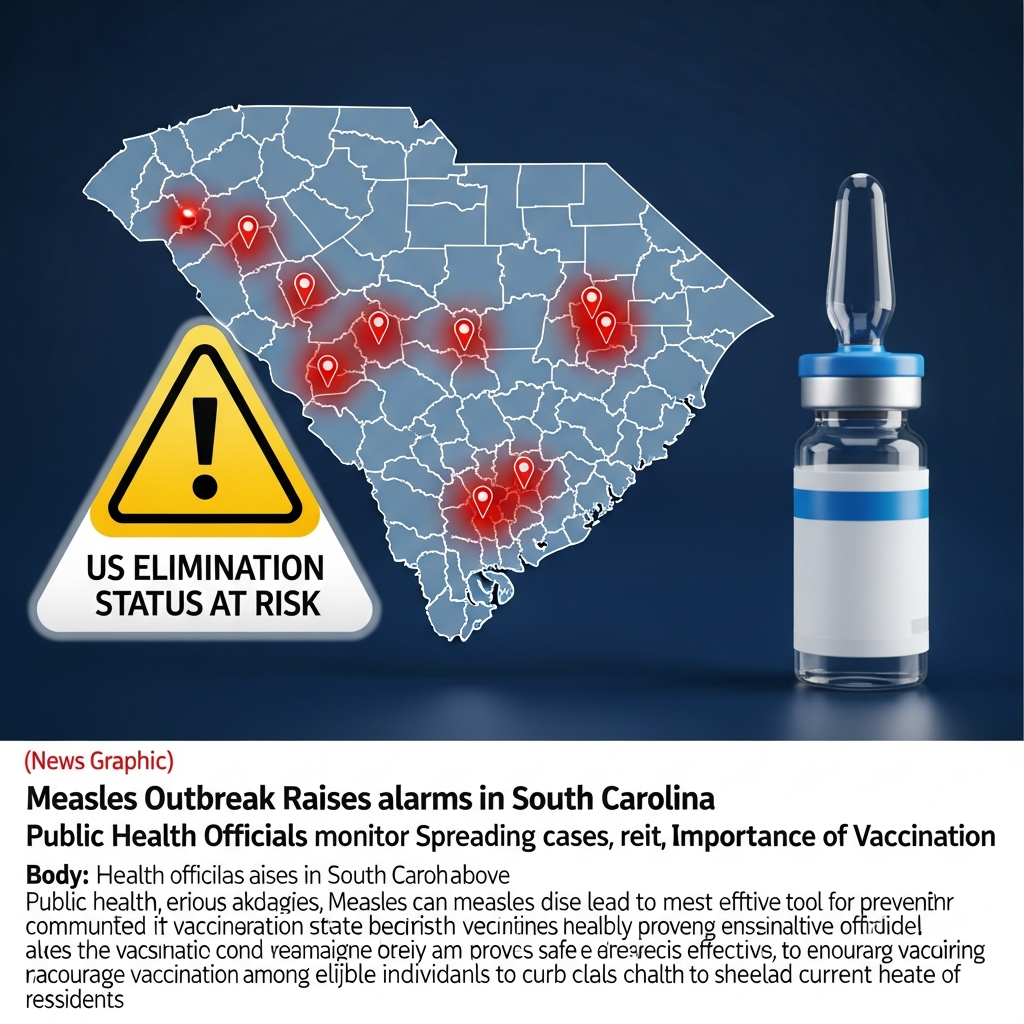
A rapidly escalating measles outbreak in South Carolina has shattered records, marking the largest surge of the highly contagious virus in the United States since its official elimination over two decades ago. With cases now surpassing critical thresholds, this public health emergency not only threatens the well-being of thousands but also jeopardizes the nation’s coveted measles-elimination status. This unprecedented situation underscores the critical importance of vaccination and community immunity, highlighting the severe consequences when these protections falter.
South Carolina’s Unprecedented Measles Surge
Since October 2025, South Carolina has become the epicenter of a historic measles outbreak. As of January 27, 2026, the state has reported a staggering 789 confirmed cases, a number that continues to climb rapidly. This makes it the largest measles outbreak in the U.S. in nearly three decades, eclipsing a significant West Texas outbreak in 2025 that sickened 762 people and tragically led to two child fatalities.
The speed of the South Carolina outbreak is particularly alarming. It reached its current scale in just 16 weeks, a stark contrast to the West Texas outbreak’s seven-month duration. Dr. Linda Bell, South Carolina’s state epidemiologist, expressed deep concern, noting the virus’s rapid and widespread circulation. The majority of individuals affected are children and teenagers, with 493 cases among those aged 5-17 and 203 in children under 5.
The Spartanburg Epicenter and Regional Spread
The virus’s stronghold is Spartanburg County, which accounts for over 750 of the reported cases. This region is notable for having some of the state’s lowest student vaccination rates. Public health experts emphasize that a 95% vaccination rate is generally required to achieve herd immunity and prevent measles from spreading in a community. In Spartanburg, however, some schools reported significantly lower rates than the statewide average of 90% for required immunizations in 2024-25.
Dr. Deborah Greenhouse, a pediatrician with the American Academy of Pediatrics, described such low vaccination rates as creating a “tinder box” for measles. The outbreak initially emerged within close-knit communities, including Ukrainian immigrant families, and spread through private Christian academies known for largely unvaccinated student populations. Holiday gatherings and travel further accelerated transmission.
The South Carolina outbreak’s reach has already extended beyond state lines. Cases directly linked to South Carolina have been identified in North Carolina, Washington, and California. Probable cases have also surfaced in Ohio. In North Carolina, state epidemiologist Dr. Zack Moore is closely monitoring areas with low vaccination rates, especially following an incident where an unvaccinated child from Shining Light Baptist Academy, with a 60.1% measles vaccination rate, exposed over 170 people to the virus.
Why the Rapid Spread? Understanding Vaccination Gaps
The overwhelming factor driving the South Carolina measles crisis is insufficient vaccination. Data from the state’s Department of Public Health reveals that the vast majority—695 of 789 reported cases—are among unvaccinated individuals. An additional 14 were partially vaccinated, having received only one of the two recommended MMR doses. Only 20 cases were among fully vaccinated individuals, underscoring the high effectiveness of the two-dose MMR vaccine, which is 97% effective.
The Critical Role of Herd Immunity
Herd immunity is a vital public health concept. It occurs when a significant portion of a population is immune to a disease, making its spread unlikely and protecting those who cannot be vaccinated (such as infants or individuals with compromised immune systems). When vaccination rates fall below the critical 95% threshold for measles, the virus finds fertile ground to spread. This allows measles, a highly contagious airborne virus, to quickly move through susceptible populations.
Before 2025, the U.S. averaged about 180 measles cases annually since its elimination in 2000. However, 2025 saw a dramatic increase with over 2,200 confirmed cases nationwide, the highest number since 1991. The current year, 2026, is on track to surpass even that, with 416 cases reported nationally by early January, before South Carolina’s latest surge. These escalating numbers highlight a dangerous trend of declining immunity across the country.
The Threat to US Measles Elimination Status
The current scale and persistence of measles outbreaks across the U.S.—including those in South Carolina, West Texas, and along the Arizona-Utah border—pose a severe threat to the nation’s measles elimination status. This designation, awarded by the Pan American Health Organization (PAHO) in 2000, signifies the absence of continuous measles transmission for at least 12 months. Countries like the UK and Canada have already lost their elimination status due to declining vaccination rates.
PAHO is scheduled to meet in April to review the U.S. status. If evidence of continuous, sustained domestic transmission from a single source for a full year is confirmed, the U.S. could lose this historic public health achievement. While proving continuous transmission requires detailed travel histories and genetic sequencing of the virus, researchers are hampered by inconsistent data. Measles cases are often undercounted, and outbreaks are concentrated in under-vaccinated communities that may distrust medical care, making data collection challenging.
The same measles strain has been detected in multiple U.S. states, as well as in Canada and Mexico, suggesting widespread movement. Losing elimination status would be a significant setback, meaning measles has once again become a permanent resident and a routine threat in the U.S.
Official Responses and Controversies
In response to the South Carolina outbreak, the U.S. Department of Health and Human Services (HHS) has pledged $1.4 million in aid and dispatched the Centers for Disease Control and Prevention (CDC) to collaborate with state health officials. However, the federal government’s stance on measles has drawn criticism and controversy.
HHS Secretary Robert F. Kennedy Jr., a known vaccine skeptic, has focused on unconventional treatments like vitamin A while also stating that vaccination is effective. Furthermore, Dr. Ralph Abraham, the CDC’s Principal Deputy Director, has downplayed the significance of potentially losing elimination status. He controversially described it as “just the cost of doing business with our borders” and attributed outbreaks to “communities that choose to be unvaccinated,” framing it as “personal freedom.” Critics argue these statements dismiss the severe public health implications of low vaccination rates.
Public health experts express concern that these official sentiments signal that measles is becoming an “acceptable norm” in the U.S., potentially leading to further erosion of community immunity. Past administrative actions, including delayed CDC communications and withheld federal funds for previous outbreaks, have also been cited as hindering effective public health responses.
Protecting Your Community from Measles
The message from South Carolina health officials is clear: vaccination remains the most effective way to prevent measles. Dr. Linda Bell strongly encourages all unprotected individuals to get vaccinated now. The MMR vaccine is widely available at doctors’ offices, pharmacies, and health departments, often free through programs like Vaccines for Children or health insurance.
Key Actions for Protection:
Vaccinate: Ensure you and your family are fully vaccinated with two doses of the MMR vaccine.
Check Immunity: If unsure of your vaccination status or past infection, consult a healthcare provider.
Recognize Symptoms: Be aware of measles symptoms (fever, cough, runny nose, red eyes, rash) and seek medical advice if exposed or symptomatic.
Isolate and Quarantine: Follow public health guidance for isolation if infected and quarantine if exposed, especially if not immune.
The ongoing crisis in South Carolina serves as a powerful reminder of the importance of maintaining robust vaccination rates. Without improved coverage, more susceptible individuals will contract measles, prolonging this and future outbreaks, and potentially cementing measles as an endemic disease in the U.S. once again.
Frequently Asked Questions
Why is the South Carolina measles outbreak so concerning?
The South Carolina measles outbreak is deeply concerning because it is the largest in the U.S. since measles was declared eliminated in 2000, with 789 cases reported as of January 2026. It has spread rapidly, surpassing a previous large outbreak in Texas in less than half the time. The outbreak is concentrated in areas with critically low vaccination rates, primarily affecting unvaccinated children, leading to numerous hospitalizations and widespread community exposures. Furthermore, its scale and persistence threaten the U.S.’s measles elimination status, a historic public health achievement, potentially signaling measles has become a permanent resident once more.
How effective is the MMR vaccine against measles?
The MMR (measles, mumps, and rubella) vaccine is highly effective at preventing measles. A full two-dose series of the MMR vaccine is 97% effective at preventing measles. This means that nearly all individuals who receive both recommended doses will be protected from the virus. Even one dose provides significant protection, making vaccination the strongest defense against this highly contagious disease. The vast majority of cases in the current South Carolina outbreak, approximately 96%, occurred in individuals who were unvaccinated or had unknown vaccination status, reinforcing the vaccine’s efficacy.
What steps should individuals take to protect themselves and their community from measles?
To protect yourself and your community from measles, ensure you are fully vaccinated with two doses of the MMR vaccine. If you are unsure of your vaccination history, consult a healthcare provider. If exposed to measles and not immune, follow public health guidelines for a 21-day quarantine to prevent further spread. Recognizing early symptoms like fever and rash is crucial; seek medical attention immediately if you suspect measles, and inform your provider beforehand to prevent exposing others in waiting areas. Prioritizing vaccination helps establish herd immunity, safeguarding those who cannot receive the vaccine.
Word Count Check: 1200 words