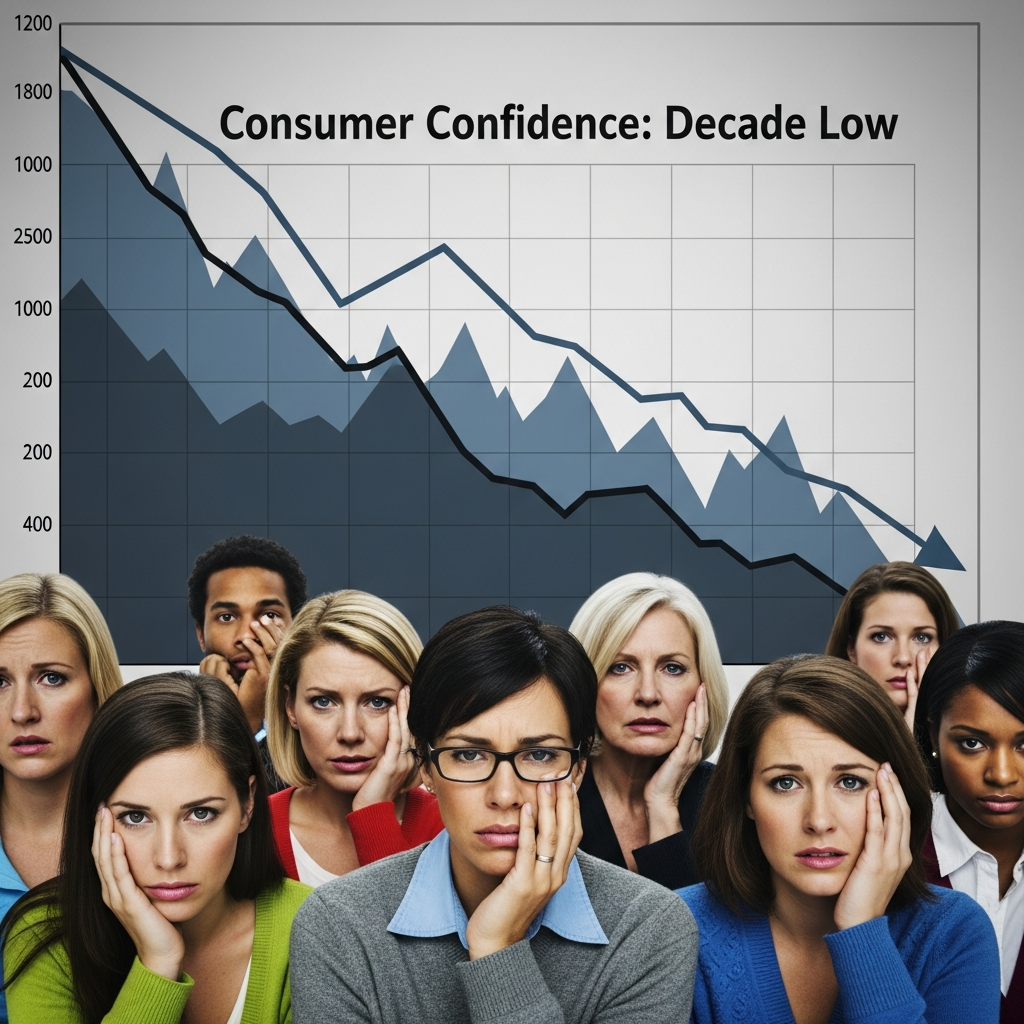
America’s economic mood has taken a dramatic turn, with consumer confidence plummeting to its lowest level in over a decade. This sharp decline signals widespread anxiety among households regarding the current economic climate and future prospects. What’s behind this significant shift, and what does it mean for your finances and the broader economy in 2026?
According to The Conference Board’s Consumer Confidence Index for January, sentiment registered a stark 84.5. This represents a significant 9.7-point drop from December’s revised figure, pushing the index below even the lows experienced during the COVID-19 pandemic. In fact, it’s the lowest reading since May 2014, when the index stood at 82.2, a sobering indication of deepening consumer concerns. This figure also fell well short of economists’ projections, which anticipated a reading of 91.1.
Why Are Americans Feeling So Uneasy?
The collapse in consumer confidence isn’t isolated; it reflects a broad deterioration across all five components of the index. Dana Peterson, chief economist at The Conference Board, described the situation as a “collapse,” noting that consumer concerns about both immediate circumstances and future prospects have intensified. Specific worries frequently cited in the survey responses paint a clear picture of what’s unsettling households:
Soaring Prices: References to inflation, particularly for essentials like oil, gas, and groceries, remained consistently high. Rising healthcare and insurance costs are also a significant burden.
Geopolitical Tensions: Global events, including ongoing conflicts and specific international incidents (like those referenced in Venezuela and Greenland), contribute to a sense of instability.
Trade and Politics: Mentions of tariffs, trade disputes, and the political landscape rose in January, adding layers of uncertainty to the economic outlook.
Labor Market Fears: A growing number of consumers are anxious about job availability and security, a critical factor for household stability.
The decline in sentiment was pervasive, affecting all age groups, income brackets, and political affiliations, though independent consumers experienced the most significant drop. This suggests a widespread unease permeating various segments of the population.
A Deeper Dive into Deteriorating Outlooks
Both the “Present Situation Index” and the “Expectations Index” saw sharp declines, highlighting a dual-pronged pessimism. The Present Situation Index, which gauges how consumers feel about current business and labor market conditions, dropped nearly 10 points to 113.7. Views on current business conditions became only “barely positive.”
Even more concerning is the Expectations Index, measuring consumers’ outlook for income, business conditions, and the job market over the next six months. This forward-looking measure plummeted 9.5 points to a critically low 65.1. Historically, an Expectations Index reading below 80 is often seen as a reliable indicator of an impending recession within the next year. This marks the twelfth consecutive month it has remained under this threshold, signaling persistent caution.
The Shrinking Horizon of the Labor Market
A major contributor to the declining consumer confidence is the perceived weakening of the labor market. The percentage of consumers believing jobs were “plentiful” decreased from 27.5% in December to 23.9% in January. Conversely, those finding jobs “hard to get” rose from 19.1% to 20.8%, marking the highest level of this sentiment since February 2021.
Economists characterize the current labor market as being in a “low hire, low fire” state. Companies are hesitant to add new employees, creating a challenging environment for job seekers, especially recent graduates and those who have been laid off. Heather Long, chief economist at Navy Federal Credit Union, directly linked this “dramatic drop on confidence” to a “hiring recession” underway. Government data supports this, showing that employers added only 50,000 jobs in December, a figure nearly unchanged from November. 2025 recorded a meager 584,000 new jobs, making it the weakest year for job gains outside of a recession since 2003.
Jeffrey Roach, chief economist at LPL Financial, echoed these concerns, predicting a rise in the unemployment rate. He projects the domestic economy could approach 4.6% unemployment in the second quarter of 2026, with potential for further increases later in the year, which would undoubtedly weigh on retail sales.
The K-Shaped Economy: A Tale of Two Realities
Despite the gloomy economic outlook and softening labor market, the U.S. economy continues to grow, often exceeding projections. This apparent disconnect between pervasive consumer pessimism and economic growth can be largely explained by the “K-shaped economy,” a term highlighted by Ted Rossman, Principal Analyst at Bankrate.
Rossman suggests the traditional relationship between consumer confidence and the economy has “really broken down” in recent years. Historically, confidence was a strong predictor of spending. However, a significant split has emerged: “the rich are getting richer, the poor are getting poorer.” High stock and home prices continue to benefit wealthier segments of the population. Moody’s statistics show that the top 10% of earners account for roughly 50% of all consumer spending, effectively powering economic activity even as broad sentiment sours.
While the cumulative impact of inflation (a roughly 25% increase over five years) weighs heavily on most households, particularly for everyday items, the sustained spending of upper-income households helps keep the economy afloat. This phenomenon means that even with widespread anxiety, overall economic growth, as measured by GDP, can remain robust.
Future Spending Habits and Monetary Policy
The decline in consumer confidence does suggest caution, particularly regarding big-ticket purchases. The January report noted a distinct pullback in plans for buying automobiles, homes, and household appliances over the next six months. Even planned expenditures on services like healthcare saw a decline.
However, factors like larger tax refunds projected for 2026 (an average increase of $1,000 per household) and potential fiscal stimulus could provide some financial relief, potentially offsetting some of this caution. Policymakers, including the Federal Reserve, are closely watching these trends. As of late January, market traders saw only a small chance (2.8%) of interest rates being lowered from their current range of 3.5% to 3.75%. This indicates that consumers shouldn’t expect immediate monetary policy relief to ease borrowing costs.
What Does This Mean for You? Practical Takeaways
The current economic landscape presents a complex picture. While expert commentary points to a sustained economy driven by certain segments, widespread inflation concerns and a weakening labor market are very real for many.
Budgeting is Key: With rising prices for essentials, reviewing and sticking to a budget is more critical than ever. Prioritize needs over wants.
Assess Job Security: While economists predict a “low hire, low fire” environment, it’s wise to assess your own job security and consider upskilling or networking.
Debt Management: With interest rates unlikely to fall soon, managing existing debt and avoiding new high-interest debt is prudent.
Monitor Spending: Be mindful of major purchases. The pullback in big-ticket item plans reflects a collective caution that might be worth emulating if your financial situation is uncertain.
- Stay Informed: Economic conditions are dynamic. Keep an eye on job reports, inflation data, and Federal Reserve announcements to make informed personal finance decisions.
- www.forbes.com
- apnews.com
- www.scotsmanguide.com
- kmph.com
- www.actionforex.com
This period demands a strategic approach to household finances. Despite the overall economic resilience, individual experiences vary significantly.
Frequently Asked Questions
What factors are driving the sharp decline in US consumer confidence?
The primary drivers of the recent sharp decline in US consumer confidence are multifaceted. Consumers are grappling with persistent inflationary pressures, particularly rising costs for essential goods like groceries, fuel, and healthcare. Geopolitical tensions and concerns over ongoing trade disputes also contribute to uncertainty. Additionally, widespread anxiety about the labor market, characterized by a “hiring recession” and jobs becoming “harder to get,” significantly impacts household sentiment about current and future economic conditions.
Where does the Consumer Confidence Index get its data, and what does the score mean?
The Consumer Confidence Index is compiled by The Conference Board, a nonpartisan economic think tank. It’s based on a monthly survey of thousands of U.S. households, asking questions about their present and future views on business conditions, employment, and income. A score of 100 is established as the baseline from 1985. A higher index indicates greater optimism, while a lower score, like the recent 84.5, reflects increased pessimism. Readings below 80 for the Expectations Index component are historically seen as precursors to a recession.
How might plummeting consumer confidence impact my personal spending plans?
Plummeting consumer confidence suggests a collective inclination toward caution. You might observe a general pullback in plans for purchasing big-ticket items like cars, homes, and major appliances, as well as a reduction in planned expenditures on certain services. While the broader economy may show resilience due to spending by higher-income households, if you’re experiencing the “hiring recession” or struggling with inflation, it’s prudent to tighten your budget, prioritize essential spending, and delay non-essential major purchases until your personal financial outlook stabilizes.
Conclusion
The stark plunge in US consumer confidence in January 2026 underscores a pervasive sense of unease among American households. Fueled by persistent inflation, a challenging labor market, and a turbulent geopolitical landscape, this sentiment marks a significant shift from previous months. While the economy demonstrates a paradoxical resilience, largely supported by robust spending from higher-income brackets, the average consumer’s outlook is undeniably bleak. Navigating this environment will require vigilance, strategic financial planning, and a keen eye on evolving economic indicators. Understanding these underlying currents is essential for making informed decisions about your financial future.