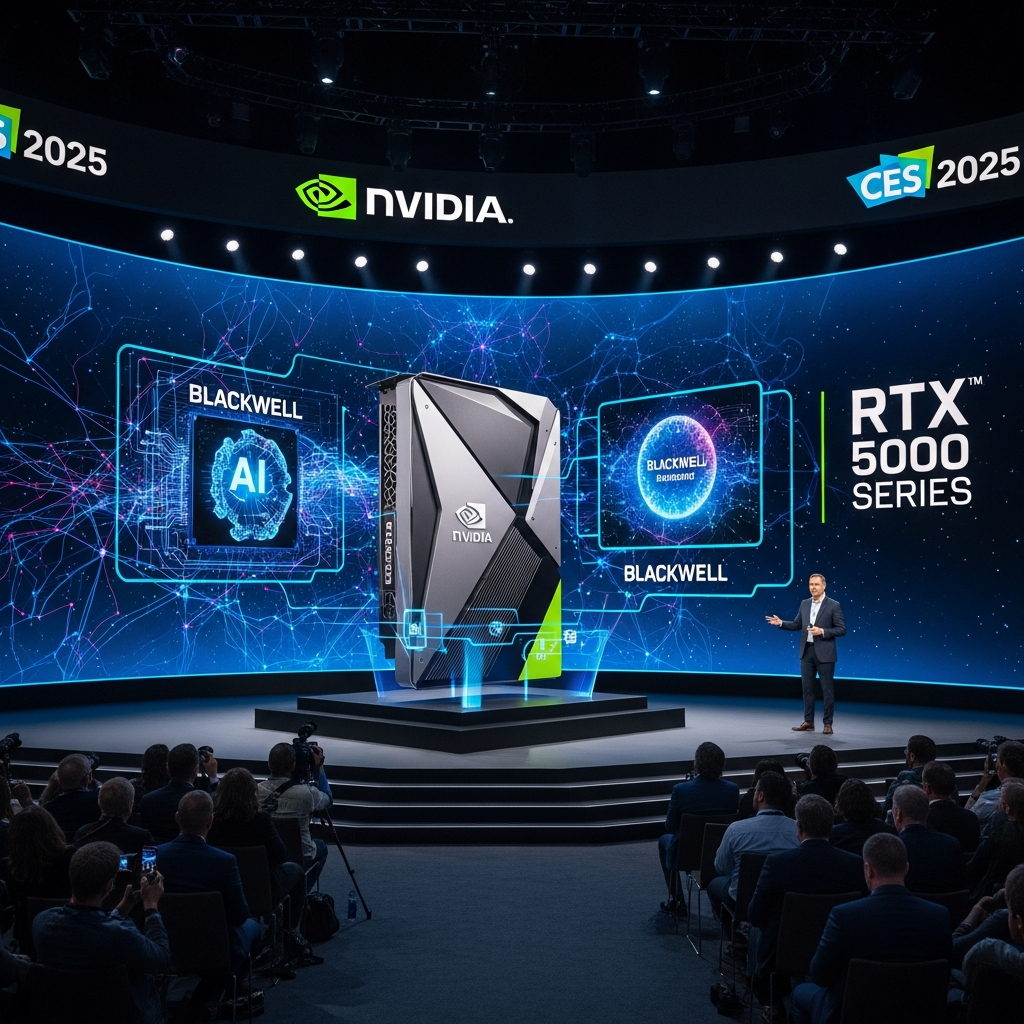
The gaming and AI world is buzzing with anticipation as Nvidia officially pulls back the curtain on its groundbreaking RTX 5000 Series GPUs. Unveiled at CES 2025, these next-generation graphics cards, built on the advanced Blackwell architecture, promise a revolution in performance driven by artificial intelligence. While earlier, speculative leaks hinted at prices soaring to $5,000 for the flagship RTX 5090 by 2026 due to insatiable AI industry demand, official announcements paint a different picture for launch pricing. However, expect significant supply challenges for high-end models as Nvidia strategically navigates the booming AI market.
The Dawn of Blackwell: Nvidia’s RTX 5000 Series Unveiled
Nvidia CEO Jensen Huang took center stage at CES 2025 on January 6th, marking a pivotal moment for PC enthusiasts and AI innovators alike. The keynote formally introduced the highly anticipated Nvidia RTX 5000 Series GPU family, featuring four new powerhouses: the RTX 5090, RTX 5080, RTX 5070 Ti, and RTX 5070. All models are slated for a market release in January, with the RTX 5070 potentially following in February and the RTX 5060 in March. This new generation, codenamed “Blackwell,” represents Nvidia’s comprehensive vision for an AI-driven technological future.
Official Pricing & Performance Expectations
The official launch prices for the Nvidia RTX 5000 Series offer a clearer outlook than earlier rumors. The flagship RTX 5090 is set at an MSRP of $1,999, directly challenging its predecessor’s market performance. The RTX 5080 will debut at $999, the RTX 5070 Ti at $749, and the RTX 5070 at a surprisingly accessible $549. A standout revelation, met with considerable enthusiasm, is that the RTX 5070 is engineered to deliver performance equivalent to the previous generation’s high-end RTX 4090, which launched at $1,599. This impressive performance-to-price ratio is attributed directly to advancements in artificial intelligence.
It’s crucial to address the earlier, widely circulated speculation suggesting the RTX 5090 could reach $5,000 by 2026. This figure likely represented a market projection influenced by extreme demand and potential scalping, or a highly speculative early leak. While the official launch price is significantly lower, the underlying concerns about market forces and AI demand remain relevant for potential future price fluctuations. The RTX 5090 is also rumored to be the first “true” 4K-capable gaming graphics card, poised to significantly outperform the RTX 4090 in demanding 4K titles.
Blackwell Architecture: A Leap for Gaming & AI
The Blackwell GPU architecture underpinning the RTX 5000 Series represents a substantial technological leap. These new cards boast an impressive 92 billion transistors, utilizing cutting-edge G7 memory with a staggering 1.8TB/s memory bandwidth. Performance metrics include 125 Shader TFLOPS, 380 RT TFLOPS, and 4000 TOPS of AI compute power, complemented by a dedicated AI-Management Processor. Nvidia highlights a remarkable fourfold improvement in performance per watt compared to the previous generation. For enterprise applications, the Blackwell silicon features an astonishing 130 trillion transistors, praised by CEO Huang as an “incredible design” and “state of the art” engineering.
The AI Advantage: Redefining Graphics Performance
A core theme of Nvidia’s presentation was the indispensable role of AI in enhancing graphics performance and enabling new capabilities. The Nvidia RTX 5000 Series leverages neural technology and machine learning to dynamically improve game graphics, reduce RAM consumption, and even “predict the future” by inferring and generating three additional frames for every frame calculated. This means the system only renders a fraction of total pixels, using AI to predict the rest. Jensen Huang explicitly stated that real-time ray tracing, a complex light simulation, would be impossible without artificial intelligence. The affordability of these new GPUs, particularly models like the RTX 5070, was also directly linked to AI, with Huang declaring, “None of this is possible without AI.” The RTX 5000 series is also confirmed to introduce DLSS 4, promising significant advancements in graphics quality and performance over the current DLSS 3.5.
Battle for Supply: Will You Get an RTX 5000?
Despite the exciting technological advancements and competitive official pricing, securing an Nvidia RTX 5000 Series GPU at launch might prove challenging, especially for the high-end models. Persistent rumors, originating from reputable leakers like Moore’s Law Is Dead (MLID), suggest significant supply shortages, particularly for the flagship RTX 5090. Some US distributors reportedly expect “zero stock” for the RTX 5090 at launch and an allocation of only around 20 RTX 5080 boards for the first month—a drastic reduction compared to previous generations. Graphics card manufacturers have echoed these concerns, predicting RTX 5090 stock levels akin to the “vanishingly thin” supply of the RTX 3090 at its release. Even Nvidia’s internal contacts have observed warnings about very limited Founders Edition availability for employees.
The VPA (Verified Priority Access) scheme, which allows US consumers with an Nvidia account to purchase Founders Edition cards at launch price, could be a crucial tool against scalping. However, its US-only and seemingly temporary nature are significant drawbacks. Online retailers are also unlikely to improve inflated pricing soon, meaning direct purchases from Nvidia, if stock allows, might be the best bet for securing cards at their official MSRPs.
Why the Scarcity? AI Demand & Nvidia’s Strategy
The primary driver behind the anticipated scarcity of high-end Nvidia RTX 5000 Series GPUs is the colossal demand from the AI industry. Nvidia is strategically allocating its most advanced Blackwell chips to its highly lucrative AI division, where “all the big profits lie,” rather than prioritizing gaming GPUs like the 5090. Furthermore, the current lack of direct high-end competition from AMD’s upcoming RDNA 4 architecture reduces immediate pressure on Nvidia to flood the market with its top-tier gaming cards. This strategic prioritization of AI computing ensures Nvidia capitalizes on the most profitable segment of its business, even if it means a constrained supply for eager gamers. Expect AIB (add-in board) partner cards to potentially carry a higher premium, with some leaks suggesting the RTX 5080 AIB models could cost around $1,349, compared to the Founders Edition’s $999.
Detailed Specs & Anticipated Performance
The leaked specifications, largely corroborated by official announcements and insights, paint a clear picture of the power housed within the Nvidia RTX 5000 Series.
Nvidia GeForce RTX 5090: This top-tier GPU is set for significant upgrades, featuring a widened 512-bit memory interface and a substantial 32GB of GDDR7 video memory (up from 24GB GDDR6 on the RTX 4090). It boasts 21,760 shader units, a considerable jump from the RTX 4090’s 16,384. Its GB202-300-A1 graphics processor has a full expansion capability of 24,576 shader units, likely reserved for professional or future Ti/Titan variants. This massive computing power comes with a demanding 600W Total Graphics Power (TGP), up from 450W.
Nvidia GeForce RTX 5080: Positioned as a strong performer, the RTX 5080 is anticipated to offer a 15 to 25 percent performance improvement over its predecessor. It will feature approximately 10,752 shader units (up from 9,728) and maintain a 256-bit memory connection, but with faster 16GB GDDR7 video memory. Its TGP will see a moderate bump from 320W to 400W. Notably, a considerable gap in computing power exists between the RTX 5080 and 5090, with the latter offering almost twice as much.
- Nvidia GeForce RTX 5070: The RTX 5070 is expected to maintain 12GB of GDDR7 video memory via a 192-bit interface. The upgrade to GDDR7 is projected to increase memory bandwidth by approximately a third, reaching up to 672GB/s. The TGP for the RTX 5070 will rise from 200W to 250W. While exact shader unit counts are not fully confirmed, performance increases over the RTX 4070 might be modest but significant given the price point.
- www.techradar.com
- www.windowscentral.com
- www.pcworld.com
- www.techradar.com
- www.notebookcheck.net
Broader Vision: Nvidia’s AI & Robotics Ecosystem
Beyond consumer graphics, Nvidia’s CES keynote illuminated its broader ambitions in AI and robotics. A key reveal was “NVIDIA Cosmos,” described as a “world foundation model” engineered to comprehend the physical world. This initiative signals a shift towards creating a comprehensive “world model,” deemed crucial for the future of robotics, trained on 20 million hours of video data focused on dynamic physical elements and real-world accuracy.
The company also announced a new suite of Agentic AI models, including Nano, Super, and Ultra, built upon NVIDIA Llama Nemotron Language Foundation Models. Jensen Huang reiterated his belief that “machine learning has changed how every application will be built, and how computing is done,” asserting that “every single layer of the technology stack has been completely changed… all thanks to AI.” Nvidia is also committing to establishing Windows and WSL2 (Windows Subsystem for Linux) as a “first-class platform for AI,” indicating deep integration of AI capabilities into mainstream operating systems.
Frequently Asked Questions
What is the official launch price for the Nvidia RTX 5090, and why were higher prices rumored?
The official launch price for the Nvidia RTX 5090, as announced at CES 2025, is $1,999. Earlier rumors, which circulated widely and speculated on prices up to $5,000, likely stemmed from various factors. These included initial speculative leaks about future market conditions, projections of extreme demand from the burgeoning AI industry, and the potential for scalping and inflated reseller prices that have plagued previous high-demand GPU launches. The official price reflects Nvidia’s MSRP, but market dynamics could still influence street prices.
How can consumers increase their chances of purchasing an RTX 5000 series Founders Edition card at launch price?
To increase your chances of acquiring an RTX 5000 series Founders Edition card at its official launch price, several strategies can be employed. Nvidia’s “Verified Priority Access” (VPA) scheme, which is currently US-only and requires an Nvidia account created by a specific date, is designed to combat scalping by offering direct purchasing opportunities. Monitoring official Nvidia channels for direct sales, signing up for stock alerts from major retailers, and being prepared to act quickly at launch are crucial. Due to anticipated scarcity, especially for the RTX 5090, direct purchases from Nvidia often offer the best chance to avoid inflated prices from third-party retailers or scalpers.
What key performance upgrades and AI features can users expect from the new Blackwell-architecture RTX 5000 series GPUs?
Users can expect significant performance upgrades from the Blackwell-architecture RTX 5000 series GPUs, including up to 4x better performance per watt. Key enhancements involve a shift to faster GDDR7 memory, larger memory interfaces (e.g., 512-bit on the RTX 5090), and increased shader units. The series integrates a dedicated AI-Management Processor and boasts impressive AI compute power (4000 TOPS). Crucially, the RTX 5000 series will introduce DLSS 4, leveraging advanced AI to boost frame rates, enhance graphics, and enable complex features like real-time ray tracing, which Nvidia states would be impossible without AI.
The Future of Gaming & AI is Here
The Nvidia RTX 5000 Series heralds a new era for PC gaming and professional AI applications. With its powerful Blackwell architecture, significant performance leaps, and deep integration of artificial intelligence, these GPUs are set to redefine expectations. While the official pricing is more competitive than early speculation suggested, the reality of high demand, particularly from the booming AI industry, will likely translate into significant supply challenges. Securing these cutting-edge graphics cards, especially the flagship RTX 5090, may require diligence and quick action. The future of computing, driven by AI, is unequivocally here, and Nvidia’s RTX 5000 series is at its forefront.