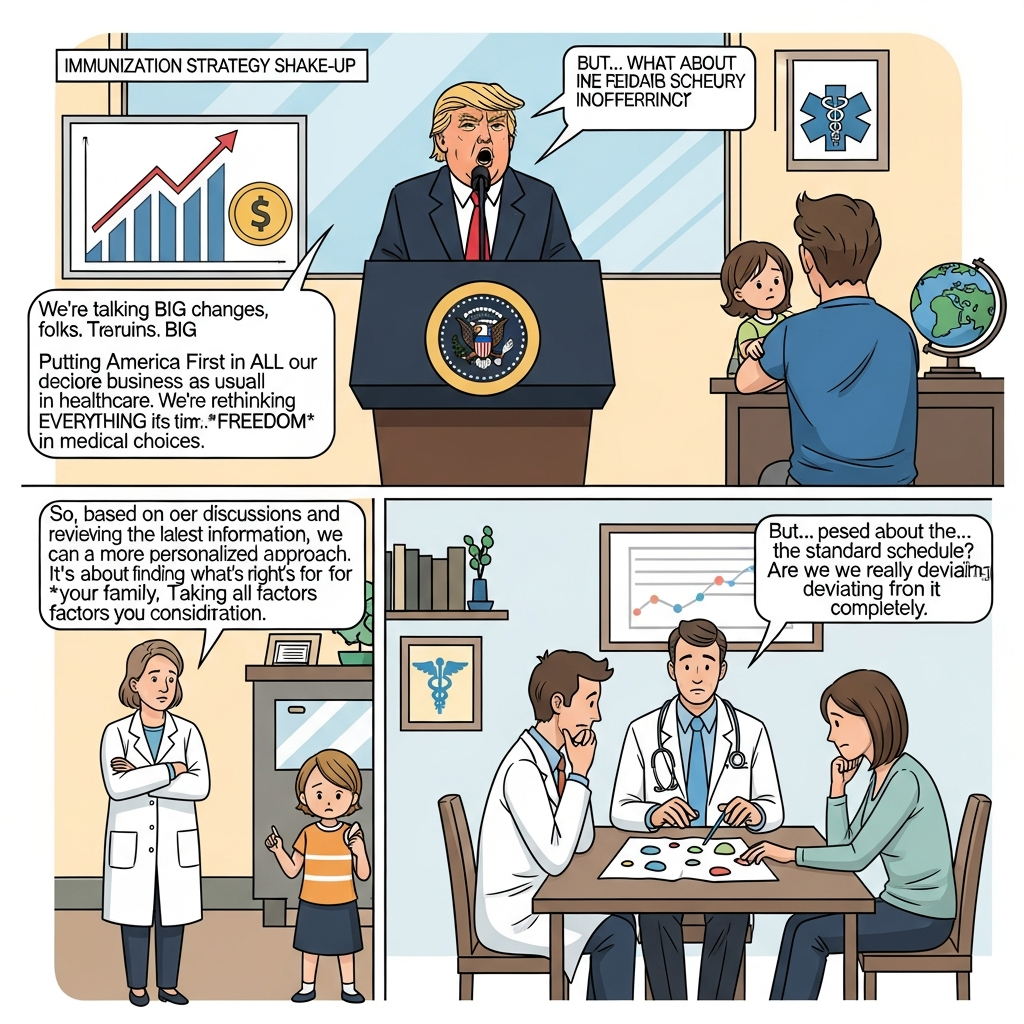
A significant overhaul of the United States’ childhood immunization strategy may be on the horizon, potentially shifting federal recommendations away from a universal approach and towards more individualized discussions between parents and medical professionals. This proposed change, under consideration by the Trump administration, draws comparisons to Denmark’s model, which advises fewer childhood vaccinations. However, the potential pivot has ignited intense debate among public health experts, who warn of serious implications for children’s health and disease prevention.
Understanding the Proposed US Vaccine Policy Shift
The Trump administration is reportedly planning to move the federal government away from its long-standing role of directly recommending most childhood vaccines. Instead, new guidance would encourage parents to engage in “shared clinical decision-making” with their doctors regarding many immunizations. This approach, which has already seen limited application for certain vaccines, marks a fundamental departure from the current system, where federal health agencies typically provide comprehensive guidance on protecting children against infectious diseases.
Health Secretary Robert F. Kennedy Jr., a vocal critic of the existing childhood vaccine schedule, has been a central figure in advocating for this revised approach. His influence is evident in recent shifts and the composition of key advisory bodies. The proposed changes also align with President Donald Trump’s directive to explore recommending fewer shots, referencing the U.S. as an “outlier” among developed nations, while ensuring continued access to available vaccines.
The Denmark Model: A Point of Comparison
At the heart of the proposed shift is a closer alignment with Denmark’s immunization schedule. The current U.S. schedule typically recommends vaccinations to protect against 18 infectious diseases, including COVID-19. In contrast, Denmark’s schedule covers approximately 10 infectious diseases. Notably, Denmark does not routinely recommend vaccinations for children against common pathogens like influenza, respiratory syncytial virus (RSV), or chickenpox.
However, public health experts strongly caution against a direct superimposition of Denmark’s policies onto the U.S. context. They emphasize significant differences in population size, healthcare systems, and disease burdens between the two nations. Demetre Daskalakis, former CDC respiratory diseases and immunization expert, stated, “You don’t just superimpose policies from other countries without context onto the United States. This is not gold standard science.” Denmark boasts a small, universal healthcare system with robust social services and universal prenatal care, which contrasts sharply with the larger, more diverse U.S. population and its uneven access to quality medical attention.
The Critical Case of the Hepatitis B Vaccine
One area of particular concern for public health officials is the potential impact on the universal newborn hepatitis B vaccination. This vaccine is not just a shield against infection; it is considered the first anti-cancer vaccine, preventing liver cancer later in life. Since the Centers for Disease Control and Prevention (CDC) first recommended universal vaccination for all babies at birth in 1991, chronic hepatitis B infections in children and adolescents have dramatically plummeted by 99%. Studies indicate that U.S. children vaccinated as newborns are 22% less likely to die from any cause.
The American Academy of Pediatrics (AAP) unequivocally recommends the universal birth dose, emphasizing its life-saving benefits and exceptional safety record. Dr. Sean O’Leary, chair of the AAP’s infectious-diseases committee, reports never seeing a serious reaction in thousands of doses administered. Yet, there are proposals to reconsider this universal recommendation, potentially delaying the first dose until babies are older or targeting only those whose mothers carry the virus. This targeted approach failed in the U.S. in the 1980s due to challenges like undiagnosed carriers and inadequate prenatal care. Delaying the birth dose, even by a few months, could lead to thousands of preventable infections, hundreds of additional liver cancers, and hundreds of preventable deaths annually, alongside millions in excess healthcare costs.
Political Influence on Key Advisory Bodies
The move to reconsider established vaccine protocols is linked to political appointments within federal health agencies. Health Secretary Robert F. Kennedy Jr. has notably dismissed and replaced members of the CDC’s Advisory Committee on Immunization Practices (ACIP) with hand-picked advisers, some of whom have limited experience in vaccine research and hold vaccine-skeptical views. This disruption has hindered timely guidance and raised alarms about the integrity of scientific recommendations. For instance, the new ACIP discussed COVID-19 vaccines but failed to vote on recommendations in a timely manner, creating confusion for healthcare providers and insurers.
COVID-19 Vaccines: A Precedent for “Shared Decision-Making”
The rollout of updated COVID-19 vaccines for the 2025–26 season offers a glimpse into how “shared clinical decision-making” can create uncertainty. The U.S. Food and Drug Administration (FDA) approved these new formulations only for specific risk groups, such as individuals aged 65 and older or those with underlying health conditions. However, the CDC’s delayed recommendations, partly due to political interference and changes within ACIP, have led to significant confusion among physicians, insurers, and the public regarding access and cost.
Without clear CDC guidelines, insurance coverage for these vaccines remains inconsistent, as coverage is legally tied to CDC recommendations. While some independent organizations like the American Academy of Pediatrics and the American College of Obstetricians and Gynecologists have issued their own recommendations for children and pregnant patients, these do not always guarantee insurer coverage. This situation highlights how a shift away from direct federal endorsement can complicate patient access and create a fragmented public health response, leaving individuals and providers to navigate a complex landscape of varying advice and coverage.
Expert Concerns and Potential Repercussions
Public health experts voice profound concerns about the proposed changes to the U.S. vaccine schedule. David Higgins, an assistant professor of pediatrics, warns that applying shared clinical decision-making broadly to vaccines currently routinely recommended “creates the false impression that experts are divided on the best way to protect health.” Such a shift could confuse both doctors and parents, making it harder for healthcare providers to offer clear guidance and for parents to make informed decisions for their children.
Furthermore, state laws dictate school vaccination requirements, and many mandate vaccines not included in Denmark’s schedule. A federal shift could create widespread confusion regarding compliance. Critics argue that removing strong government endorsements for established vaccines undermines decades of public health progress. James Campbell, vice chair of the American Academy of Pediatrics’ infectious-diseases committee, emphasized, “We do not believe in the one-size-fits-all approach nor the approach of choose one random alternate national schedule and adopt it.” This debate highlights the complex interplay of public health, individual choice, and political influence on a cornerstone of children’s well-being.
Frequently Asked Questions
What is “shared clinical decision-making” and how could it change US childhood vaccine policy?
“Shared clinical decision-making” involves parents consulting with their doctor, pharmacist, or other medical professional to decide on vaccinations, rather than following direct federal recommendations for universal immunization. This approach shifts the onus from a broad government endorsement to an individualized discussion of risks and benefits. If widely adopted for the U.S. childhood vaccine schedule, it would fundamentally alter how most children receive immunizations, potentially leading to fewer shots being recommended federally and creating varied vaccination practices across the country, similar to how COVID-19 vaccine guidance has evolved for specific groups.
What are the major concerns about changing the universal newborn Hepatitis B vaccine recommendation?
Experts express serious alarm about altering the universal newborn Hepatitis B vaccine recommendation because it has been incredibly effective, leading to a 99% drop in chronic infections in children since 1991. The vaccine is unique as the first “anti-cancer” vaccine, preventing future liver disease and cancer. Abandoning the universal approach in favor of a targeted one, as attempted unsuccessfully in the 1980s, could result in thousands of preventable infections, hundreds of liver cancers, and hundreds of deaths annually. This is due to challenges in identifying infected mothers, gaps in prenatal care, and the high infectivity of the virus to newborns.
How do the US and Denmark vaccine schedules primarily differ, and why are experts wary of direct comparison?
The U.S. vaccine schedule currently recommends protection against 18 infectious diseases, while Denmark’s covers approximately 10, notably excluding routine vaccinations for children against influenza, RSV, and chickenpox. Public health experts are wary of direct comparison because the countries differ significantly in population size, healthcare systems, and disease burden. Denmark’s small, universal healthcare system with robust prenatal care and social services is not easily comparable to the U.S.’s large, diverse population with uneven access to quality care. Simply adopting Denmark’s model without considering these contextual differences could compromise U.S. public health achievements.
Navigating the Future of Childhood Immunizations
The potential shift in the US vaccine schedule represents a pivotal moment for public health. While proponents advocate for more individualized medical freedom and question the existing schedule, leading medical and public health organizations consistently affirm the safety and efficacy of current recommendations. The debate highlights the complex balance between federal guidance, clinical autonomy, and the collective health of a nation. As these plans evolve, open dialogue with trusted healthcare providers will become even more crucial for parents seeking to make the best health decisions for their children in an increasingly uncertain landscape.