Saturn’s mysterious moon, Titan, long considered a prime candidate for a vast subsurface ocean, may hold a far more complex secret. New research, spearheaded by scientists at NASA’s Jet Propulsion Laboratory (JPL) in Southern California, challenges the prevailing view, suggesting Titan’s interior is not a global liquid ocean but rather a dynamic mix of ice, slushy layers, and pockets of warm water. This groundbreaking re-evaluation of data from the iconic Cassini mission fundamentally reshapes our understanding of Titan and its potential for harboring life.
The Decades-Old Mystery of Titan’s Interior
For years, planetary scientists have pondered the enigmatic depths of Titan, Saturn’s largest moon. With its dense atmosphere and surface lakes of liquid methane, Titan stands out as a unique world in our solar system. A key focus has been its interior, particularly the possibility of a hidden liquid water ocean beneath its icy crust. Such an ocean would place Titan firmly within the elite category of “ocean worlds,” like Jupiter’s Europa or Saturn’s Enceladus, significantly boosting its astrobiological prospects.
Cassini’s Initial Clues: The Global Ocean Hypothesis
The initial hypothesis of a global subsurface ocean on Titan emerged in 2008, following groundbreaking observations by NASA’s Cassini spacecraft. Cassini, a cooperative mission involving NASA, ESA, and the Italian Space Agency, meticulously studied Saturn and its moons for over a decade. Scientists analyzed radio frequency data from Cassini’s close flybys of Titan. They observed that the moon was flexing significantly under the gravitational influence of Saturn. This substantial deformation, known as tidal flexing, led them to conclude that only a large, responsive liquid interior could explain such malleability. Imagine a water-filled balloon versus a solid billiard ball – the balloon flexes far more easily.
Unveiling the Truth: A Novel Approach to Old Data
However, science is an ongoing process of refinement. A team led by JPL postdoctoral researcher Flavio Petricca, with co-author Julie Castillo-Rogez, recently re-examined this archival Cassini data. Their reanalysis, published in the journal Nature, utilized advanced processing techniques to uncover hidden details previously masked by noise. What emerged was a profoundly different picture of Titan’s internal structure. This underscores the immense power of revisiting planetary science data with fresh eyes and sophisticated analytical tools, allowing discoveries to be made years after spacecraft missions conclude.
How Scientists Probed Titan’s Deep Secrets
Unlocking the secrets of celestial bodies from millions of miles away requires ingenious methods. Scientists remotely probe planets and moons by studying radio frequency communications between spacecraft and NASA’s Deep Space Network. This “listening” process reveals subtle gravitational effects that shed light on internal composition.
Decoding Doppler Shift and Tidal Flexing
The core of this investigative technique lies in analyzing the Doppler shift of radio signals. As a spacecraft flies past a moon, variations in the moon’s gravity field (due to uneven mass distribution) cause the spacecraft to subtly speed up or slow down. These minuscule changes in speed alter the frequency of the radio waves – the Doppler shift. By meticulously analyzing this shift, scientists gain insight into a moon’s gravity field and its shape, particularly how that shape changes over time due to gravitational pulls.
Titan experiences immense tidal flexing. Saturn’s powerful gravitational field constantly squeezes and stretches the moon as it traverses its slightly elliptical orbit. This flexing generates internal heating as energy is dissipated within the moon’s structure. Previous analyses interpreted this strong flexing as definitive proof of a liquid ocean.
The “Smoking Gun”: A 15-Hour Lag
The breakthrough in the new study came from a refined analysis of this tidal flexing. Petricca and his team meticulously measured the timing between Saturn’s gravitational tug and Titan’s response. They detected a critical detail: a significant 15-hour delay between the peak gravitational pull and the corresponding rise of Titan’s surface.
Flavio Petricca explained that an immediate surface response would be expected with a fully liquid interior. This substantial lag, however, acts as a “smoking gun,” strongly indicating a much thicker, more viscous internal structure. It suggests that rather than a free-flowing global ocean, Titan’s interior is composed of slushy ice layers interspersed with pockets of liquid water. This delay reveals strong energy dissipation deep within Titan, a signature consistent with friction generated as ice crystals rub against one another in a slushy environment.
A New Model: Titan’s Slushy Core and Warm Water Pockets
Based on these compelling findings, the researchers propose a revolutionary new model for Titan’s interior. It dramatically redefines the moon’s inner workings.
Beyond the Global Ocean: A Dynamic Interior
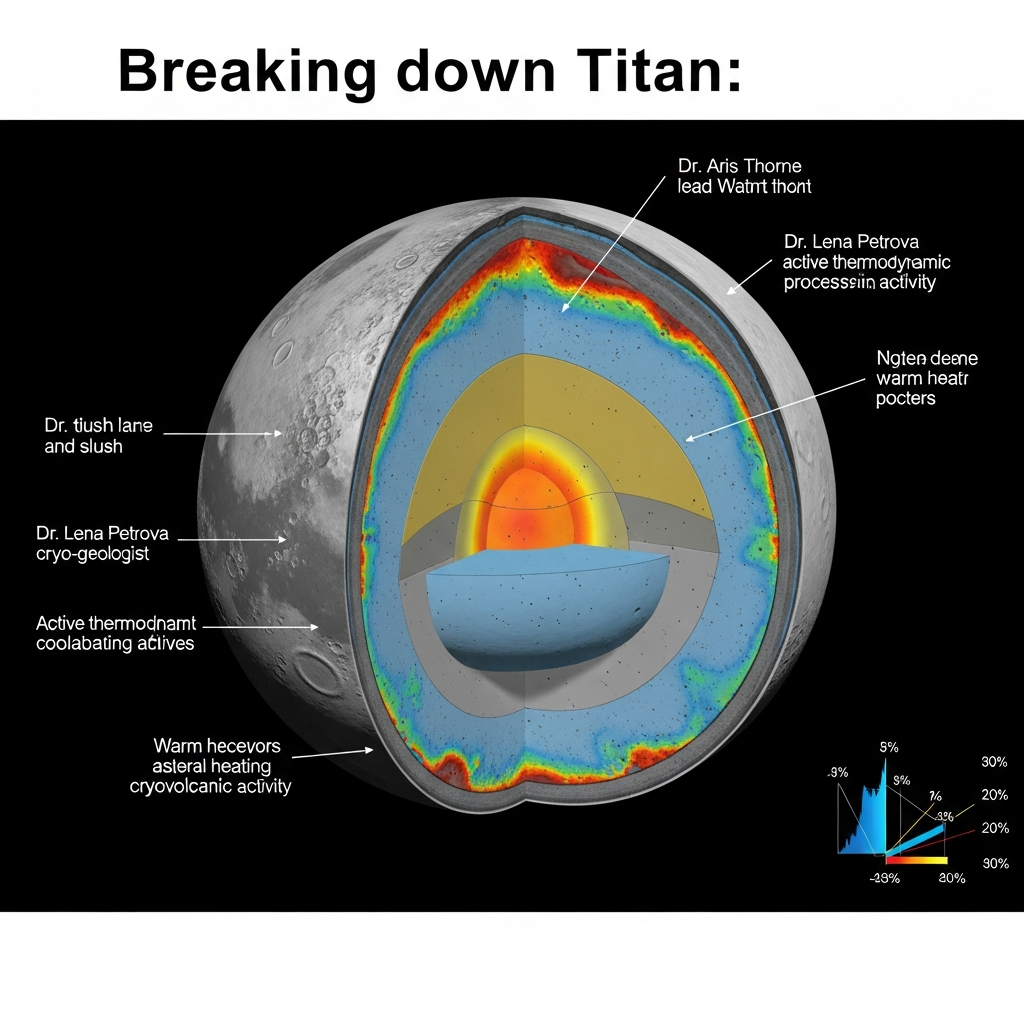
In this revised scenario, Titan’s interior consists of layers featuring a dynamic mix of ice and water. The moon’s outermost shell is a thick layer of solid ice, estimated to be approximately 100 miles deep. Beneath this, extending another 250 miles, are layers of slush and distinct pockets of liquid water, reaching a total depth of over 340 miles. These liquid pockets are not a vast, continuous ocean, but rather isolated reservoirs of meltwater.
Crucially, these water pockets are not frigid. Heated by the dissipating tidal energy from Saturn’s pull, some of these isolated pools could reach temperatures as warm as 20 to 21 degrees Celsius (68 degrees Fahrenheit). The low viscosity of the slush still allows the moon to bulge and compress in response to Saturn’s tides, effectively removing heat that would otherwise completely melt the ice. Researchers speculate that Titan’s interior hydrosphere might be in a state of flux, either freezing over from a past ocean or gradually melting.
The Physics Behind the Slush: Cryo-Mineral Insights
To further support their theory, the team, including Baptiste Journaux from the University of Washington, conducted planetary cryo-mineral physics experiments. These simulations explored how water and ice behave under the immense pressures found deep inside Titan, demonstrating that the physics differ significantly from Earth’s conditions. These computer models confirmed that such an interior structure of ice, slush, and water layers could account for the observed tidal flexing and the critical 15-hour lag.
Re-evaluating Titan’s Potential for Life
The revelation that Titan likely lacks a global subsurface ocean might seem to diminish its astrobiological prospects. However, the new study suggests quite the opposite, potentially making Titan even more intriguing in the search for extraterrestrial life.
Smaller Pockets, Richer Habitats?
Flavio Petricca posits that these localized pockets of liquid water could be excellent candidates for harboring basic life forms. He suggests that the absence of a global ocean “makes Titan more interesting.” In smaller, isolated pools, nutrients would be more concentrated than in a vast, diluted ocean. These pockets could facilitate the cycling of organic molecules and nutrients upwards from the moon’s rocky core, through the high-pressure slushy ice layers, to the solid icy shell at the surface. Such environments, enriched by both internal processes and material delivered via meteorite impacts, could provide prime conditions for microbial life.
Terrestrial Parallels: Life in Extreme Environments
Baptiste Journaux emphasizes that the findings offer “strong justification for continued optimism regarding the potential for extraterrestrial life.” He points out that nature often demonstrates far greater creativity than scientists can imagine, suggesting any life on Titan, likely microscopic, could be highly adapted. The slushy, near-melting environment draws parallels to Earth’s polar ecosystems or terrestrial aquifers, where life thrives in specific, concentrated pockets of water amidst vast icy landscapes. This expanded view of what constitutes a “habitable environment” could have implications for the search for life beyond Earth.
The Future of Titan Exploration: Dragonfly Mission
While the new research offers compelling evidence, not all scientists are fully convinced. Luciano Iess of Sapienza University of Rome, whose earlier Cassini work suggested a hidden ocean, acknowledges the new study as “certainly intriguing” but states that the evidence is “not sufficient to exclude Titan from the family of ocean worlds.” This highlights the dynamic and evolving nature of planetary science.
More definitive answers are anticipated with NASA’s ambitious Dragonfly mission. This groundbreaking mission, scheduled for launch no earlier than 2028 and an expected arrival in 2034, will deploy a rotorcraft to explore Titan’s surface. Dragonfly will investigate the moon’s habitability firsthand, flying to various locations across its alien landscape. Equipped with a seismometer, the mission aims to provide crucial measurements of Titan’s interior structure, offering invaluable “ground truth” to either validate or refine these new findings, depending on what seismic events occur during its operation. Baptiste Journaux, a co-author of the recent study, is also a member of the Dragonfly team, underscoring the vital link between current research and future exploration.
Frequently Asked Questions
What did the new NASA study reveal about Titan’s interior?
A recent NASA study, led by researchers at JPL and published in Nature, revealed that Saturn’s moon Titan likely does not harbor a vast, global subsurface ocean. Instead, the reanalysis of Cassini mission data suggests Titan’s interior is composed of deep layers of slushy ice, with isolated pockets of warm liquid water (up to 20-21°C) near its rocky core, covered by a thick outer ice shell. This challenges previous assumptions of a planetary ocean.
How did scientists determine Titan’s internal structure?
Scientists analyzed radio frequency data from the Cassini spacecraft, focusing on the Doppler shift and Titan’s tidal flexing under Saturn’s gravity. A crucial finding was a 15-hour delay between Saturn’s gravitational pull and Titan’s surface deformation. This lag, along with advanced noise reduction techniques applied to the data, indicated a more viscous, slushy interior rather than an instantaneously responsive liquid ocean. Computer modeling and cryo-mineral physics experiments further supported this interpretation.
Does the absence of a global ocean on Titan reduce its potential for life?
Surprisingly, no. Researchers suggest that while a global ocean may not exist, the presence of smaller, localized pockets of warm liquid water makes Titan “more interesting” for astrobiology. These isolated pockets could concentrate nutrients, fostering richer conditions for microscopic life compared to a diluted global ocean. The internal heating and cycling of organic molecules from the core could create unique, habitable environments similar to Earth’s extreme polar ecosystems.
Conclusion
The latest research from NASA’s Jet Propulsion Laboratory marks a pivotal moment in our understanding of Saturn’s largest moon. By applying innovative analysis to archived Cassini data, scientists have peeled back the icy layers of Titan, revealing an interior far more intricate than previously imagined. While the dream of a vast global ocean may be redefined, the possibility of warm, nutrient-rich water pockets within a slushy interior presents an exciting new frontier for astrobiology. The upcoming Dragonfly mission promises to further unlock Titan’s secrets, providing unprecedented insights into this captivating world and its enduring potential to host life. The quest for answers continues, reminding us that the cosmos constantly challenges our assumptions and sparks new avenues of discovery.