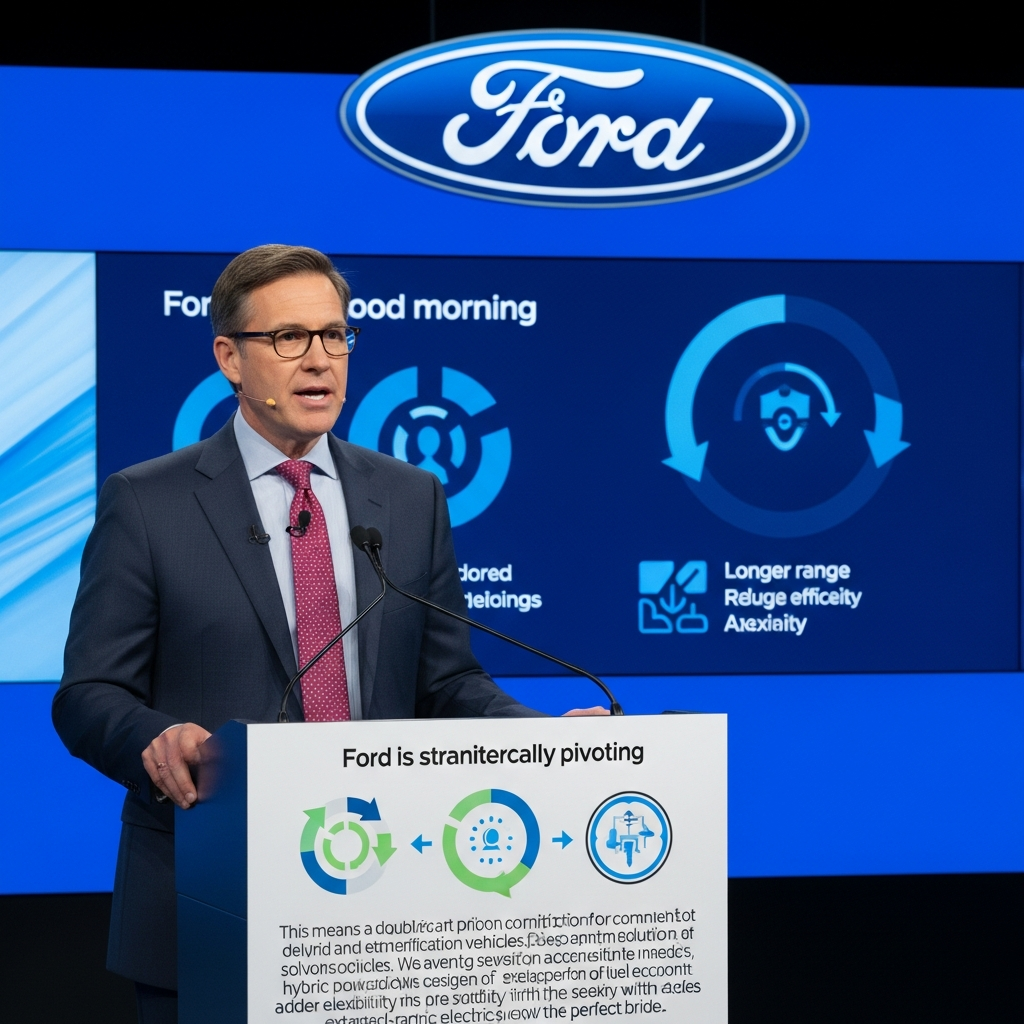
Ford Motor Company is undergoing a dramatic shift in its electric vehicle (EV) strategy, acknowledging a market reality that has prompted a substantial $19.5 billion charge. CEO Jim Farley, who once warned about the impact of ending EV subsidies, is now steering the automaker toward a more diversified future, heavily prioritizing hybrid and extended-range electric vehicles (EREVs) over pure-play EVs. This strategic pivot, described by Farley as “customer-driven,” signals a significant reevaluation of the automotive industry’s electrification timeline and consumer demand patterns.
For years, Ford championed an aggressive EV rollout, establishing its Model E division in 2022 to innovate within the electric space. However, despite lofty ambitions, Model E has faced a “brutal business-wise” reality, accumulating over $13 billion in losses in under three years. This financial strain, more than double Ford’s net income for 2024, underscores the immense challenges of a rapidly evolving market. Ford’s latest financial move, booking a massive $19.5 billion charge primarily in 2026, includes an $8.5 billion asset write-down specifically for the Model E division. This signals a clear recalibration of expectations and investment focus.
The Reality Check: From EV Ambition to Strategic Pivot
Farley had previously voiced concerns that ending the nearly two-decade-long federal EV tax credit could halve America’s electric vehicle market. In September, he predicted that without the $7,500 consumer incentive, U.S. EV sales could plummet from an anticipated 10-12% of the market down to 5%. Speaking more recently, Farley confirmed that the market has, in fact, already shrunk to approximately 5% of the U.S. vehicle market. This stark reality means Ford’s initial pure-play EV lineup was simply out of sync with current consumer preferences.
Model E’s Steep Financial Climb: Billions in Losses
The Model E division’s losses highlight the immense capital required and the fierce competition in the EV sector. Beyond the $13 billion deficit, the division reported a staggering $3.6 billion in losses in just the first three quarters of the current year alone. These figures paint a clear picture of the financial pressures driving Ford’s current strategic realignment. The goal now is to redeploy capital into higher-return opportunities such as Ford Pro, trucks/vans, hybrids, and a new battery energy storage business.
The High-End EV Dilemma: Why Luxury Electric Isn’t Selling
A critical insight from Farley is that “the very high-end EVs, the 50, 60, 70, $80,000 vehicles, they just weren’t selling.” This directly contradicts earlier assumptions about market adoption, indicating a strong consumer preference for affordability. High battery prices, coupled with a broader affordability crisis, have made premium EVs a tough sell for many car buyers. Ford’s pivot acknowledges that price point is a dominant factor influencing purchasing decisions in the current economic climate.
Ford’s New Direction: Embracing Hybrids and EREVs
As part of this significant Ford EV strategy pivot, the company is making tangible changes to its production line. Ford will cease production of the original electric F-150 Lightning, once lauded as an industry breakthrough. Instead, the automaker plans to retool the F-150 Lightning to include a gas-powered generator, effectively making it an Extended Range Electric Vehicle (EREV). This move signifies a clear shift towards hybrid and semi-gas-powered EREVs, which Farley states are what customers are truly interested in today.
Redefining Production: New Plants, New Priorities
The strategic realignment extends to Ford’s manufacturing facilities. The Tennessee Electric Vehicle Center will be repurposed into the Tennessee Truck Plant, ceasing EV production to manufacture new Built Ford Tough truck models starting in 2029. Similarly, Ford’s Ohio plant will assemble new gas and hybrid cars from 2029. These changes will involve redeploying a third of the F-150 Lightning production workforce to gas and hybrid F-150 models after 2025. This allows Ford to maintain employment while adapting to evolving demand.
Farley’s Vision: Listening to the Customer & Shaping the Market
Farley emphasizes that Ford is “following customers to where the market is, not where people thought it was going to be, but to where it is today.” This consumer-centric approach dictates prioritizing a diverse powertrain portfolio. Ford aims to launch five new “affordable” vehicles by the end of the decade, with four assembled domestically, including a midsize pickup truck slated for 2027. This automotive market shift clearly moves away from an all-in pure-EV gamble.
The $7,500 Incentive Impact: A Game Changer No More
The expiration of the federal EV tax credit in September significantly impacted the EV landscape. Farley’s early warnings that its end would throttle demand proved prescient. This regulatory change, combined with an overall affordability crisis, has shifted the focus from government incentives to genuine customer value and cost-effectiveness. The market’s reaction underscores the power of these incentives in shaping consumer behavior and automaker strategies.
Policy, Affordability, and the Workforce Challenge
Beyond its internal strategy, Ford is also navigating broader economic and policy landscapes. CEO Jim Farley praised the Trump administration’s initiative to reset federal fuel-economy standards. He hailed it as a “victory for affordability and common sense,” arguing that previous Corporate Average Fuel Economy (CAFE) standards were “totally out of touch” and effectively “forced [automakers] to sell EVs.” This perspective suggests a desire for less regulatory pressure to dictate product offerings, allowing consumer choice to drive demand.
Beyond the Vehicles: Ford’s Battle for Skilled Labor
Farley also highlights a critical national issue: the severe shortage of skilled tradespeople. Ford currently cannot fill approximately 5,000 mechanic positions, despite offering substantial annual salaries up to $120,000. This crisis, affecting sectors from manufacturing to emergency services, is attributed to a lack of investment in vocational training. Farley, drawing inspiration from Henry Ford’s strategy of doubling wages to create a stable workforce, has championed converting temporary workers to full-time status and advocating for greater government investment in trade schools. This skilled labor crisis poses a significant challenge for all U.S. manufacturers.
Fuel Standards: A Win for Affordability?
The reset of fuel economy standards is positioned by Ford as a move that will bolster vehicle affordability. The Trump White House projected that this reset would result in cumulative savings of “$109 billion in total” for American families. Farley predicts that these “more reasonable” standards, combined with tariff adjustments, will lead to a sustained decline in car prices. This directly aligns with Ford’s strategy of focusing on affordable vehicles, which saw its affordable range sales surge by 25% in November despite an overall down market.
The Road Ahead: Profitability and Future Projections
While the Model E division is still projected to become profitable, its target date has been pushed back three years from 2026 to 2029. By 2030, Ford forecasts that hybrids, EREVs, and pure-play EVs combined will account for half of its global sales, a significant increase from the current 17%. Importantly, Farley emphasized that the majority of this projected growth will come from “hybrid and EREV” sales. This demonstrates a fundamental reorientation of Ford’s electrification strategy, betting on a diverse powertrain approach that is more aligned with existing consumer demand in the automotive industry trends.
Frequently Asked Questions
Why is Ford taking a massive $19.5 billion charge?
Ford is taking a $19.5 billion charge, primarily in 2026, due to a significant shift in its electric vehicle (EV) strategy. This includes an $8.5 billion asset write-down for its Model E division, which has incurred over $13 billion in losses in under three years. The charge reflects a recalibration of investments and production plans driven by lower-than-expected EV demand, high battery costs, the end of federal tax credits, and consumer preference for more affordable vehicle options like hybrids and EREVs. It signals a move away from its previous aggressive pure-EV growth projections.
What types of vehicles will Ford prioritize moving forward?
Moving forward, Ford will heavily prioritize hybrid and Extended Range Electric Vehicles (EREVs) over pure-play EVs. This strategic pivot involves ceasing production of the original electric F-150 Lightning in favor of a hybrid EREV version with a gas-powered generator. Ford also plans to launch five new “affordable” vehicles, including a midsize pickup truck by 2027. By 2030, the company expects hybrids, EREVs, and pure-play EVs to constitute 50% of its global sales, with the majority of this growth coming from its hybrid and EREV offerings, aligning with current customer demand.
How does Ford’s EV strategy shift reflect broader market trends?
Ford’s EV strategy shift reflects several critical broader market trends. Firstly, it acknowledges that the high cost of premium EVs, coupled with an affordability crisis, has dampened consumer enthusiasm for pure-electric models. Secondly, it highlights the significant impact of government incentives, as the market shrank after the federal EV tax credit ended. Thirdly, it underscores a strong and growing demand for hybrids and EREVs, which offer a bridge between traditional gasoline cars and full EVs, appealing to a wider range of customers seeking balance between fuel efficiency, range, and cost.
Ford’s bold pivot represents a calculated move to align its production with current market realities and consumer preferences. By embracing a more diversified powertrain strategy, focusing on affordability, and adapting its manufacturing footprint, the company aims to navigate a complex automotive landscape. While the financial impact is substantial, this Ford EV pivot underscores a commitment to long-term profitability and responsiveness to what customers truly want, rather than what the market was once predicted to be.