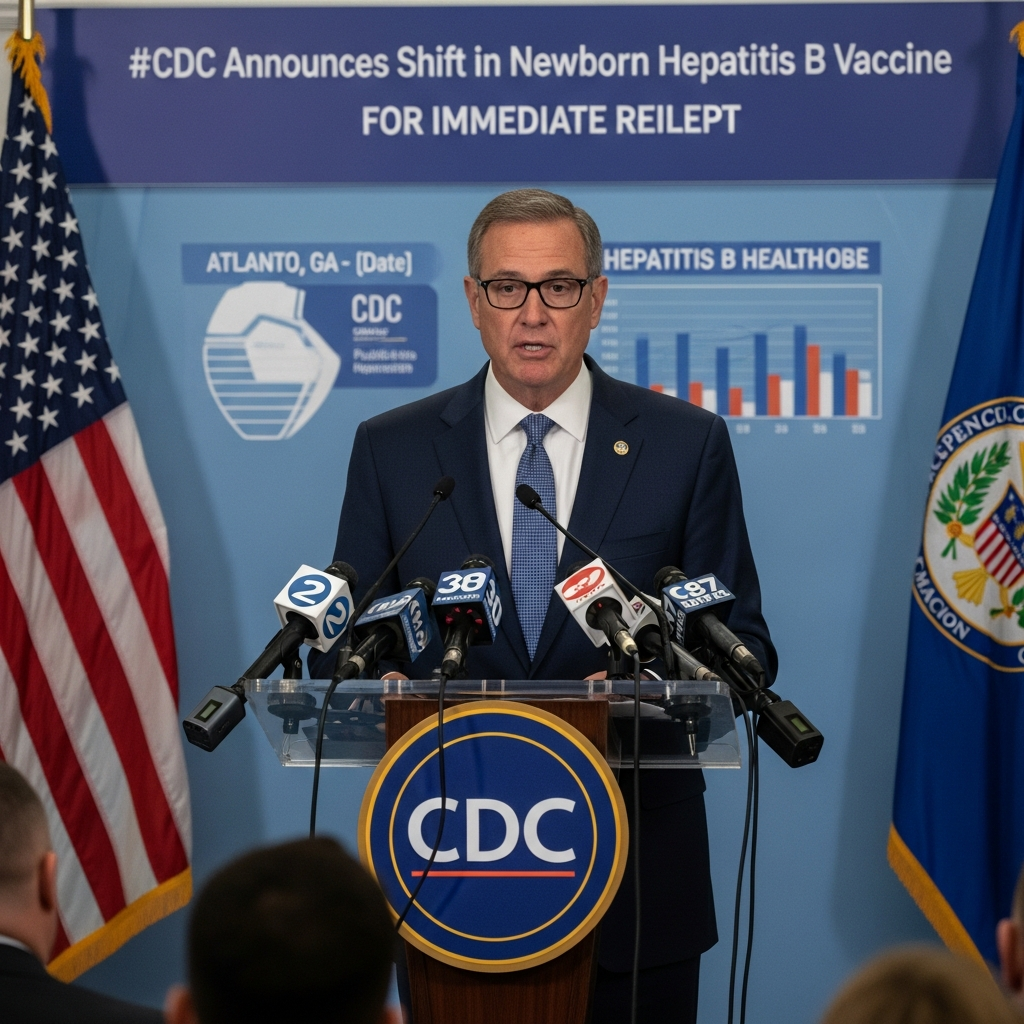
The U.S. Centers for Disease Control and Prevention (CDC) has dramatically altered its long-standing recommendation for the hepatitis B vaccine. As of December 16, 2025, the agency no longer advises universal vaccination for all American newborns. This groundbreaking decision marks an abrupt end to over three decades of established medical guidance, sending ripples through the public health community and sparking intense debate among experts and parents alike.
The change comes after a vote by a vaccine advisory panel appointed by Health Secretary Robert F. Kennedy Jr. Previously, every newborn in the U.S. received the first of a three-dose hepatitis B vaccine series shortly after birth. Now, the approach has shifted significantly.
Understanding the New Hepatitis B Vaccine Guidance
Under the updated CDC guidance, the hepatitis B vaccine will only be routinely recommended at birth for specific newborns. This includes infants whose mothers test positive for hepatitis B or whose infection status is unknown at the time of delivery. These high-risk babies will continue to receive the vaccine, often alongside hepatitis B immune globulin, as a critical measure to prevent potential permanent infection and severe liver damage.
For infants born to mothers who have tested negative for hepatitis B, the decision-making process has changed. The CDC now advises parents to consult with their healthcare provider to determine whether their newborn should receive the birth dose. If parents opt against immediate vaccination, the agency recommends waiting at least two months before administering the child’s first dose of the vaccine. This new policy is being framed as an “individual-based” and “shared clinical decision-making” approach, emphasizing parental consent.
The Rationale Behind the Policy Shift
Acting CDC director and deputy health secretary Jim O’Neill stated that the change aims at “restoring the balance of informed consent to parents whose newborns face little risk of contracting hepatitis B.” Proponents of the shift, including members of the advisory panel, suggest that universal birth dosing may not provide significant additional protection given the current low hepatitis B rates in the U.S. They also point to advancements in blood testing and harm reduction programs.
An analysis presented to the advisory committee indicated that the birth dose contributed minimally to the dramatic decrease in acute hepatitis B cases, with the most significant decline occurring before widespread universal vaccination. Furthermore, some committee members noted that the U.S. was an outlier among high-income nations, as many other economically similar countries do not provide birth doses to infants born to hepatitis B-negative mothers. The policy change aims to align U.S. practice with these international standards.
Public Health Experts Sound the Alarm
Despite the CDC’s rationale, the policy shift has ignited widespread concern and criticism from a broad spectrum of public health experts, doctors, and medical societies. Many fear the move could undermine decades of successful public health efforts and lead to a resurgence of preventable infections among children.
Michaela Jackson, program director of prevention policy at the Hepatitis B Foundation, warned of potential consequences. She anticipates an “increase in preventable infections among children” and expressed worry that parents will “not know who to trust any longer.” Jackson also highlighted that CDC recommendations significantly impact U.S. health insurance coverage and guide physicians’ vaccine choices, potentially creating “barriers to access.”
The Success Story of Universal Vaccination
The previous universal vaccination policy, in place since 1991, has been widely lauded as a major public health triumph. Historical data underscore its effectiveness:
Hepatitis B infections in the U.S. plummeted by nearly 90%, from 9.6 per 100,000 individuals before widespread vaccination in 1982 to approximately one per 100,000 in 2018.
Pediatric cases of acute hepatitis B saw an astounding 99% reduction between 1990 and 2019 following the universal birth dose recommendation.
Hepatitis B is a serious illness that can lead to severe liver disease, including cirrhosis and liver cancer. It is primarily spread through blood, semen, or other bodily fluids and can also be transmitted from an infected mother to her child during childbirth. Immunization in infancy offers lifelong protection against the virus.
The Controversy: Ignoring Science and Eroding Trust
Many critics argue that the new recommendation “is ignoring the science.” Dr. Emily Landon, an infectious diseases expert at the University of Chicago Medicine, voiced strong disapproval. She stated that the CDC’s endorsement of this policy “continues to reinforce that they are no longer committed to science-based recommendations for improving health.”
Experts point out that real-world healthcare systems are not foolproof. They are prone to errors such as lost test results, mislabeled samples, or undetected risk factors. Universal vaccination at birth served as a crucial safeguard against these potential system flaws, ensuring comprehensive protection for all newborns. Dr. Su Wang of the Hepatitis B Foundation emphasized that “risk-based recommendations do not work” due to real-world transmission complexities and potential gaps in screening.
Senator Bill Cassidy (R-La.), a liver doctor himself, publicly warned that “Ending the recommendation for newborns makes it more likely the number of cases will begin to increase again.” Dr. Cody Meissner, a long-serving ACIP member, stated, “Do no harm is a moral imperative. We are doing harm by changing this wording.”
Robert F. Kennedy Jr.’s Influence on Vaccine Policy
The policy change comes amidst a broader pattern of shifts within the CDC under the guidance of Health Secretary Robert F. Kennedy Jr., a self-described longtime anti-vaccine activist. Kennedy appointed new members to the CDC’s vaccine advisory committee earlier this year, dismissing previous members. Critics contend that these changes, including the controversial advisory committee meeting where the hepatitis B vote took place, represent a “systematic undermining of the nation’s vaccine program.”
The advisory committee’s discussion on the vaccine has been described as “rife with misinformation and cherry-picked data,” ignoring decades of evidence on vaccine safety and effectiveness. This context further fuels concerns about the scientific integrity of recent public health decisions.
What This Means for Parents and Pediatric Care
Despite the CDC’s new stance, parents should be aware that many medical organizations continue to uphold the universal birth dose recommendation. The American Academy of Pediatrics (AAP), for instance, still recommends the first dose of the hepatitis B vaccine within 24 hours of birth, followed by additional doses at 1-2 months and 6-18 months.
The Department of Health and Human Services has confirmed that the new recommendations will not immediately impact insurance coverage for the shots. The vaccine will also remain available free of charge to uninsured or underinsured children through the Vaccines for Children Program. This means the vaccine will remain accessible, but the conversation around its timing and necessity will now be more nuanced for parents.
This shift places a greater onus on parents to engage in detailed discussions with their baby’s doctor about the pros and cons of immediate birth dose vaccination. Should they choose to delay, it is crucial that the baby’s hepatitis B vaccine series commences at or after two months of age. Completing the entire three-dose vaccination schedule is critical for full protection, and relying on partial vaccination or antibody testing after one or two doses is not considered a reliable substitute.
Frequently Asked Questions
What is the new CDC recommendation for the newborn hepatitis B vaccine?
As of December 16, 2025, the CDC no longer universally recommends the hepatitis B vaccine at birth for all U.S. newborns. The birth dose is now specifically recommended only for infants whose mothers test positive for hepatitis B or whose status is unknown. For babies born to hepatitis B-negative mothers, parents are advised to consult their healthcare provider to decide on vaccination. If not given at birth, the first dose is recommended no earlier than two months of age.
Should my newborn still receive the hepatitis B vaccine at birth?
This decision now requires consultation with your healthcare provider, especially if you are a hepatitis B-negative mother. While the CDC has changed its universal recommendation, the American Academy of Pediatrics (AAP) and many other medical experts continue to recommend the first dose within 24 hours of birth for all infants. Discuss your specific situation, potential risks, and the long-term benefits of early vaccination with your pediatrician to make an informed choice for your child.
Why are health experts concerned about the CDC’s hepatitis B vaccine policy change?
Many public health experts and doctors are deeply concerned that ending the universal birth dose could lead to an increase in preventable hepatitis B infections. They highlight the vaccine’s proven success in dramatically reducing pediatric cases by 99% over three decades. Critics worry that real-world healthcare system errors, such as missed screenings or lost test results, could leave infants vulnerable. Furthermore, some experts believe the change ignores established scientific evidence and could erode public trust in vaccine recommendations, particularly given the influence of Health Secretary Robert F. Kennedy Jr., a known vaccine critic.
Conclusion
The CDC’s decision to end the universal newborn hepatitis B vaccine recommendation marks a profound shift in U.S. public health policy. While framed as a move toward greater parental informed consent, it has simultaneously ignited significant concern among medical professionals who champion the vaccine’s proven efficacy and the broad protection offered by universal administration. As this new “individual-based decision-making” approach takes hold, it underscores the critical importance for parents to engage actively with their healthcare providers. Understanding the risks, benefits, and the ongoing recommendations from professional medical societies will be paramount in safeguarding the health of the next generation.