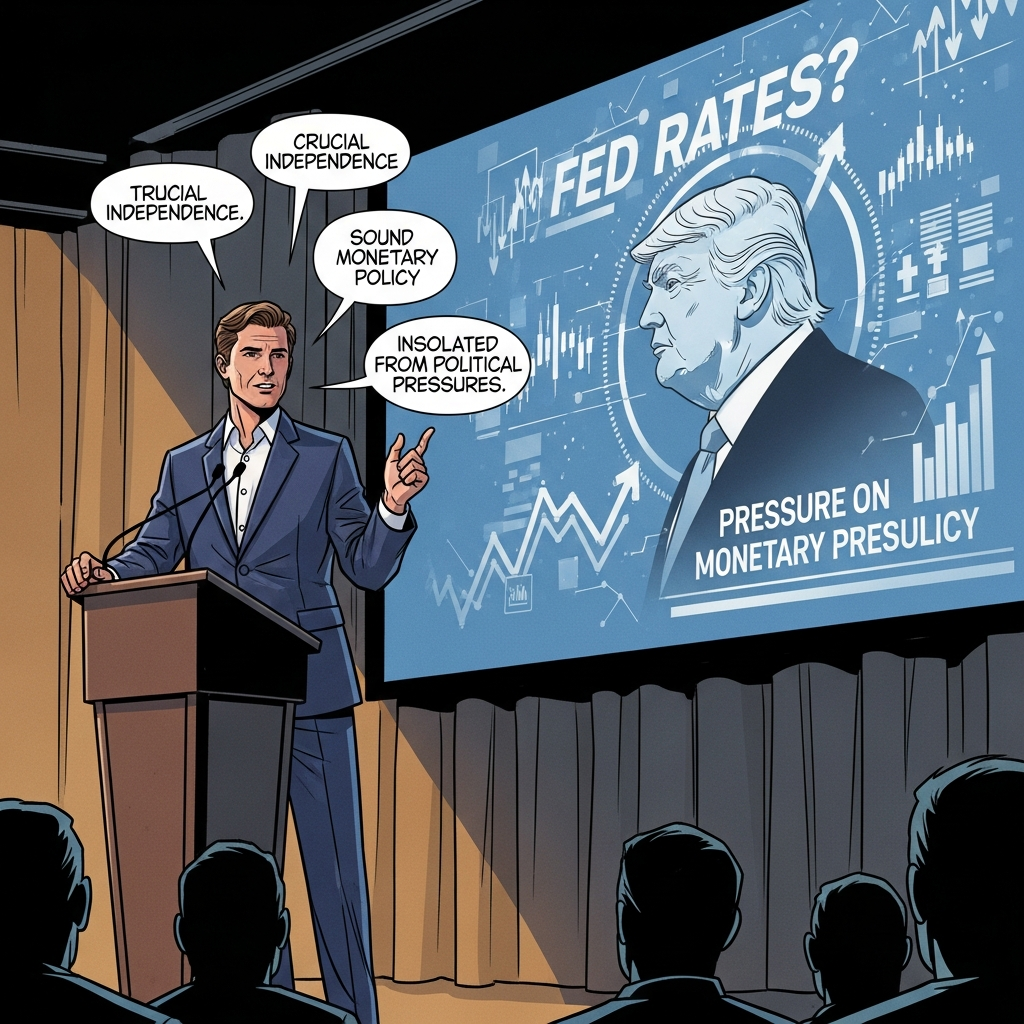
The debate over the Federal Reserve’s autonomy takes center stage as Kevin Hassett, a leading contender for the next Fed Chair, firmly asserts presidential opinions would hold “no weight” on interest rate decisions if he were appointed. This declaration comes amidst President Donald Trump’s repeated insistence on influencing monetary policy, citing his personal financial success. Hassett’s stance underscores the critical importance of an independent central bank in shaping the nation’s economic future. As the race for the Fed Chair nomination heats up for a potential early 2026 appointment, understanding the candidates’ views on this crucial separation of powers becomes paramount for investors, policymakers, and the general public.
The Fed’s Unwavering Autonomy: A Core Principle
Kevin Hassett, currently the National Economic Council Director, made his position clear during a CBS’ Face the Nation interview. He acknowledged President Trump’s “very strong and well-founded views” on the economy. However, Hassett quickly emphasized the Federal Reserve’s independent structure. He highlighted that the Fed Chairman’s role is to build consensus among the rate-setting Federal Open Market Committee (FOMC) members. Ultimately, decisions are made by committee vote, not by external political directives.
Hassett’s statement directly counters President Trump’s past remarks. Trump has often expressed a desire for more say in monetary policy, even suggesting his financial acumen should grant him influence. Hassett, however, articulated that a president’s opinion, while welcome for discussion, would only carry actual weight if it were “good” and “based on data.” Even then, it would be presented to the committee, which retains the right to reject it and vote differently. This commitment to data-driven, independent policy-making is a cornerstone of the Federal Reserve’s role in managing the U.S. economy.
Why Central Bank Independence Matters
The independence of a central bank like the Federal Reserve is vital for several reasons. It safeguards monetary policy from short-term political pressures, which can often prioritize immediate gains over long-term economic stability. An independent Fed can make unpopular but necessary decisions, such as raising interest rates to curb inflation, without fear of political retaliation. This fosters confidence in financial markets, as investors trust that decisions are based on economic data and not political expediency. Historically, countries with more independent central banks tend to have lower inflation rates and more stable economies.
Hassett’s willingness to engage with the president daily, even as Fed Chair, demonstrates a blend of respect for the office and an unwavering commitment to the Fed’s mandate. He explicitly stated that President Trump’s voice would not have “equal weighting” to voting FOMC members. This clear distinction is a key signal for how Hassett, or any future Fed Chair, would navigate the often-turbuous waters of economic policy amidst political demands.
The Intense Race for the Federal Reserve Chairmanship
The competition to succeed current Fed Chair Jerome Powell, whose term concludes in May 2026, is intensifying. President Trump has indicated that the choice has narrowed to Hassett and former Fed Governor Kevin Warsh. He notably referred to them as “the two Kevins.” This comment caused significant ripples across financial markets and prediction platforms.
Market odds on platforms like Kalshi saw Hassett’s probability of nomination dip from 80.6% to 50%, while Warsh’s odds surged from 11% to 41%. Similarly, Polymarket data showed Hassett at 52% and Warsh at 40%. These shifts highlight the volatility and intense scrutiny surrounding the selection process. Trump reportedly met with Warsh at the White House, pressing him on his willingness to support rate cuts. This interaction suggests that a candidate’s stance on monetary easing is a significant factor in the President’s decision-making.
Hassett’s Dovish Leanings and Potential Impact
Kevin Hassett is widely regarded as a dovish candidate. This means he generally favors looser monetary policy, including lower interest rates, to stimulate economic growth. He has a history of advocating for more easing and has been a strong economic proponent for Trump’s policies. While Hassett pledges independence, his inherent dovish stance naturally aligns with President Trump’s frequent calls for rate cuts.
This alignment presents an intriguing dynamic. An independent Hassett-led Fed might still implement policies, such as aggressive rate reductions, that broadly concur with the President’s economic stimulus objectives. For some market segments, particularly “Bitcoin bulls” as noted by analysts, such an outcome could sustain a bullish price trajectory for cryptocurrencies. The expectation is that lower interest rates make holding less risky assets less attractive, potentially pushing capital into higher-yielding or speculative assets.
Navigating Political Tensions and Safeguarding Independence
Since joining Trump’s second administration, some of Hassett’s former colleagues have voiced concerns. They suggest he has shown signs of acting more as a political loyalist. Hassett has frequently appeared on cable news, defending Trump’s policy priorities, downplaying unfavorable economic data, and echoing White House positions on issues like inflation and the legitimacy of federal statistics. This history adds a layer of complexity to his assertions of Fed independence.
The Federal Reserve has proactively taken steps to reinforce its autonomy. The central bank recently approved the unanimous reappointment of all 12 regional Reserve Bank presidents and first vice presidents. This move is widely seen as a strategic measure to “Trump-proof” the institution against potential political interference, especially concerning interest rate policies. This action effectively countered an earlier administration proposal, which Hassett himself had supported, for a district residency requirement for Fed presidents. Such a requirement had raised fears of a broader leadership shake-up intended to exert greater political control. Justin Wolfers, a professor of public policy and economics at the University of Michigan, remarked that the reappointments effectively secured the Fed’s independence.
The Fed’s Role in Economic Stability
The Fed’s actions directly influence various aspects of the economy. Interest rate decisions impact borrowing costs for consumers and businesses, affecting everything from mortgage rates to business expansion loans. Its monetary policy tools aim to achieve maximum employment and price stability. When the Fed signals a “wait and see” approach, as Chair Powell recently did regarding the economy’s development, markets react with shifts in probabilities for future rate adjustments. For instance, Polymarket data indicated an 82% chance of no rate change and only an 18% chance of a 25-basis-point cut following such signals, emphasizing the market’s close watch on independent, data-driven decisions. Hassett’s statements offer a crucial insight into how he would navigate these sensitive decisions while upholding the central bank’s autonomy.
Frequently Asked Questions
Why is Federal Reserve independence considered crucial for economic stability?
Federal Reserve independence is crucial because it shields monetary policy from short-term political pressures. An autonomous Fed can make decisions, such as raising or lowering interest rates, based purely on economic data and its dual mandate of maximum employment and price stability, rather than electoral cycles or political expediency. This ensures greater predictability and stability in financial markets, fostering confidence among investors and businesses, and ultimately contributing to long-term economic health.
Who are the leading candidates being considered for the next Federal Reserve Chair?
The leading candidates currently being considered for the next Federal Reserve Chair, as indicated by President Donald Trump, are National Economic Council Director Kevin Hassett and former Fed Governor Kevin Warsh. Both individuals have been referred to as “the two Kevins” by Trump. Their probabilities of nomination have fluctuated on prediction markets, with Hassett and Warsh both showing significant chances to replace current Chair Jerome Powell, whose term concludes in May 2026.
How might Kevin Hassett’s ‘dovish’ economic views influence future interest rate decisions if he becomes Fed Chair?
If Kevin Hassett, known for his dovish economic views, becomes Fed Chair, he would likely favor looser monetary policy, which includes supporting significant interest rate cuts. While he pledges to uphold the Fed’s independence from political pressure, his intrinsic leanings align with the goal of stimulating economic growth. This could mean a greater likelihood of more aggressive rate reductions, potentially impacting borrowing costs, inflation expectations, and even market segments like cryptocurrencies, as lower interest rates may encourage investment in riskier assets.
In conclusion, the prospective leadership of the Federal Reserve remains a pivotal point of discussion, deeply intertwined with the principle of its independence. Kevin Hassett’s unequivocal statement regarding presidential influence offers a clear indication of his commitment to the Fed’s autonomous function. Yet, his own dovish policy inclinations suggest a complex interplay between independence and potential policy outcomes. As the 2026 nomination deadline approaches, all eyes will be on how this delicate balance of power shapes the future of U.S. monetary policy.