Deadly clashes along the disputed Thai-Cambodian border have triggered a massive humanitarian crisis, forcing over half a million people to flee their homes. As the conflict intensifies, US President Donald Trump has pledged diplomatic intervention to halt the violence, which has already claimed at least 15 lives. This escalating crisis underscores the deep-seated tensions arising from a colonial-era border dispute, threatening regional stability and displacing vast populations into temporary shelters across both nations.
Unprecedented Displacement: Half a Million Flee Violent Border Clashes
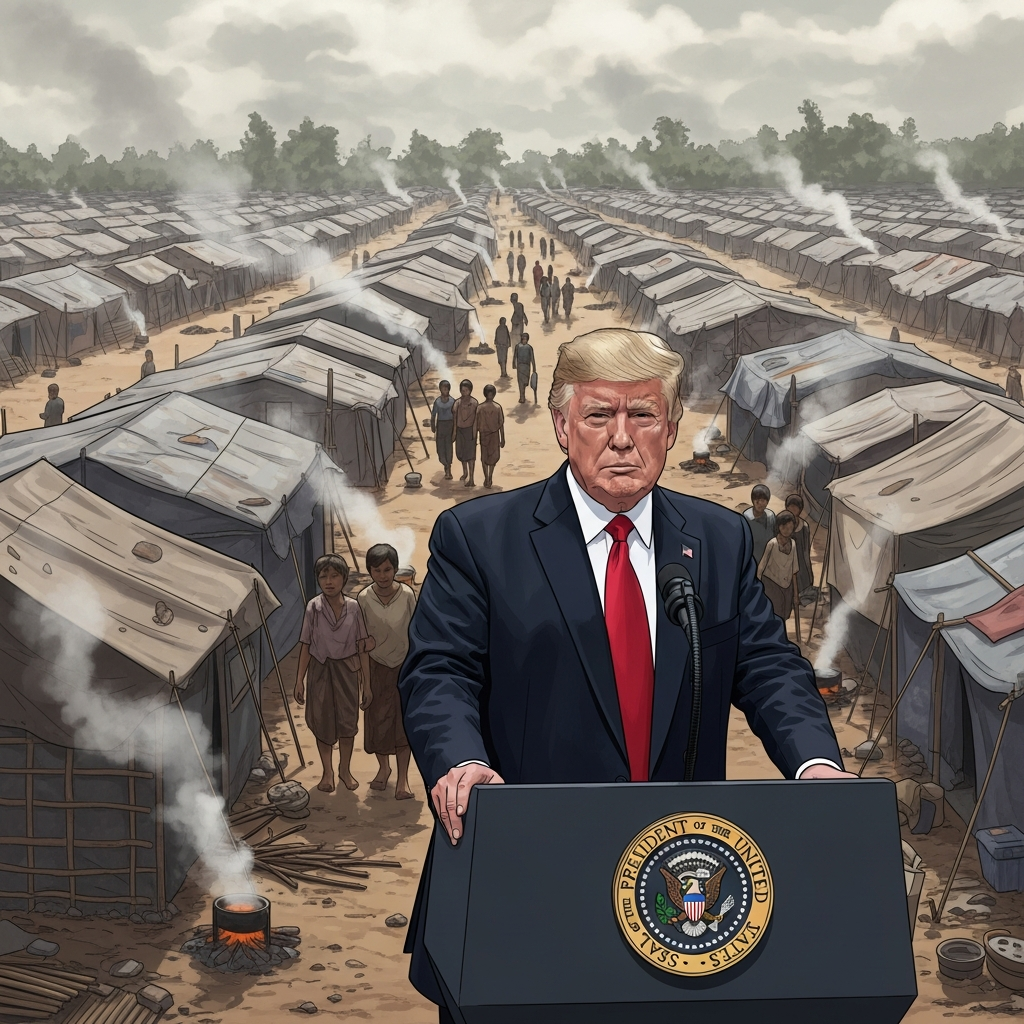
The renewed conflict between Thailand and Cambodia has sparked an urgent mass evacuation, displacing more than 500,000 individuals. Families, like 30-year-old Seut Soeung, describe a terrifying situation where their homes are “not safe anymore,” prompting a desperate exodus. This includes over 400,000 civilians evacuated in Thailand and more than 101,000 in Cambodia, all seeking refuge in pagodas, schools, and relatives’ homes.
Eyewitness accounts paint a grim picture. Sugarcane farmer Niam Poda, 62, from Thailand’s Sa Kaeo province, recounted hearing a loud explosion and “just had to run for my life” for the second time in five months. She expressed a profound hope for peace to return, longing to care for her farm once more. The humanitarian toll is immense, with countless individuals leaving behind vital possessions and medicines as they scramble for safety. These border areas have become active battlegrounds, witnessing the deployment of advanced military hardware, including jets, tanks, and drones.
Humanitarian Crisis Deepens Amidst Ongoing Fighting
The scale of this displacement highlights the severe impact on civilian lives. People are sheltering wherever they can, from established evacuation centers in Thailand’s Sa Kaeo and Surin provinces to temporary havens in Cambodia’s Oddar Meanchey and Srei Snam. Visuals depict crowded roads, with vehicles laden with people, pets, and scant belongings, all fleeing the active combat zones. This mass movement of people not only creates an immediate need for food, water, and shelter but also disrupts livelihoods and communities for an indefinite period. The sustained nature of the conflict, now in its third day, exacerbates these challenges significantly.
Roots of Conflict: A Century-Old Border Dispute Reignites
The core of the Thai-Cambodian border dispute traces back to a colonial-era demarcation of their 800-kilometer (500-mile) frontier. Competing claims over historically significant temples situated along this contested border have frequently ignited armed confrontations. This latest flare-up marks the deadliest escalation since five days of fighting in July, which also resulted in dozens of casualties and displaced approximately 300,000 people before a fragile truce was brokered.
The Ta Krabey temple, along with other ancient sites like the vicinity of Phanom Dong Rak hospital in Surin province, remains central to the territorial disagreements. These aren’t isolated incidents; sporadic clashes over disputed land, particularly around 900-year-old temples, have occurred intermittently since 2008, consistently leading to deaths and large-scale displacement. Both nations accuse each other of instigating the current hostilities, which have now tragically expanded to five provinces on both sides of the border.
Historical Tensions Fuel Current Violence
The long history of these border skirmishes reveals a deeply entrenched issue, where national identity and historical claims often overshadow diplomatic efforts. Each side views certain temple grounds as integral to its cultural heritage, making compromise exceedingly difficult. The colonial-era maps, created without full understanding of local dynamics, have left ambiguities that continue to haunt modern relations. This makes finding a lasting resolution for the Thai-Cambodian border dispute particularly challenging. The repeated collapse of truces, despite international mediation, underscores the fragility of peace in this volatile region.
Blame Games and Escalation: Accusations from Both Sides
The current wave of hostilities has seen both Thailand and Cambodia trading sharp accusations. Cambodia’s defence ministry spokesperson, Maly Socheata, accused the Thai army of “indiscriminately firing into civilian areas and schools.” She specifically cited the shelling of Ta Krabey temple, which she described as a “sacred site of Cambodia.” Conversely, the Thai army reported that Cambodian forces fired rockets early on Wednesday, with some landing near Phanom Dong Rak hospital in Surin province—a facility previously struck during the July fighting.
Casualty figures continue to rise, with reports indicating at least 15 to 19 deaths. These include Thai soldiers and Cambodian civilians, with one infant tragically among the deceased. The Cambodian interior ministry updated its civilian death toll to 10. In response to the escalating insecurity, the Thai military imposed an overnight curfew from 7 pm to 5 am in parts of Sa Kaeo province, reflecting the severity of the situation.
Military Responses and Civilian Impact
The use of advanced military hardware like jets, tanks, and drones in this Thai-Cambodian border conflict signals a significant escalation in the fighting. Such weaponry poses an immense threat to civilian populations, forcing mass evacuations and exacerbating the humanitarian crisis. The imposition of curfews further restricts movement and livelihood, particularly for those living close to the frontier. These military actions, while aimed at securing disputed territories, inadvertently inflict profound suffering on innocent people caught in the crossfire, highlighting the urgent need for a peaceful resolution.
Trump’s Diplomatic Push: Can International Intervention Halt the Violence?
US President Donald Trump has announced plans to intervene diplomatically, vowing to call the leaders of Thailand and Cambodia on Thursday. Expressing confidence, Trump stated he could settle the hostilities “pretty quickly,” asserting, “Who else can do that?” This isn’t his first foray into mediating the Thai-Cambodian border dispute. Back in July, the US, alongside China and Malaysia (then chair of ASEAN), brokered a “shaky truce” following five days of deadly clashes.
In October, Trump backed a follow-on joint declaration, linking new trade deals with Thailand and Cambodia to the prolongation of their truce. However, Thailand suspended that agreement the following month, illustrating the difficulty in maintaining a lasting peace. Thailand’s foreign ministry spokesperson, Nikorndej Balankura, made it clear that while talks would eventually end the fighting, “now was not the time for dialogue.” He added that Thailand could not accept mediation from a third country at this stage, feeling that “the line has been crossed” with Thai citizens killed, and trust needing to be re-established.
Challenges to External Mediation Efforts
Despite President Trump’s optimism and past involvement, the current stance from Thailand highlights significant challenges for external mediation. The sentiment that “the line has been crossed” indicates a deep-seated grievance that requires internal resolution before external parties can effectively facilitate dialogue. The recurring nature of this Thai-Cambodian border conflict, and the breakdown of previously brokered truces, suggests that superficial agreements are insufficient without addressing the underlying historical and territorial claims that fuel the violence. The involvement of powerful nations like the US and China underscores the regional and international significance of stability in Southeast Asia.
Broader Regional Impact and International Concern
The escalating Thai-Cambodian border conflict has reverberations beyond the immediate disputed areas. Cambodia notably withdrew from the Southeast Asian Games, which were being hosted in Thailand, citing safety concerns for its athletes. This decision underscores the severe disruption the conflict is causing to national activities and international relations in the region. The broader Southeast Asian community, particularly through ASEAN, watches nervously as a major regional dispute flares up, threatening to undermine collective stability and cooperation.
International organizations have also voiced grave concerns. The United Nations cultural agency has called for the “protection of the region’s cultural heritage in all its forms,” highlighting the ancient temples at risk. UN Human Rights Chief Volker Turk expressed dismay that past agreements “have yet to translate into effective protection of civilians on the ground.” Even Pope Leo XIV called for a ceasefire and offered prayers for those displaced. These statements emphasize the global recognition of the humanitarian crisis and the urgency for a peaceful resolution to this enduring Thai-Cambodian border dispute.
Impact on Regional Stability and International Relations
The persistence of the Thai-Cambodian border conflict poses a significant threat to regional stability. As a member of ASEAN, both nations are expected to uphold principles of peace and dispute resolution. However, the recurring violence strains these relationships and could impact future economic cooperation and regional security initiatives. The involvement of global powers like the US and China in mediation efforts reflects the broader strategic importance of Southeast Asia, making a peaceful resolution crucial not only for the affected countries but also for the wider international community.
Frequently Asked Questions
What caused the latest surge in fighting between Thailand and Cambodia?
The recent escalation in the Thai-Cambodian border conflict stems from a long-standing colonial-era dispute over their 800-kilometer frontier and competing claims to historic temples, such as Ta Krabey. Both nations accuse each other of reigniting the violence. The current clashes, which are the deadliest since July, began after a previously brokered truce collapsed, leading to the deployment of advanced military hardware and expansion into five provinces on both sides.
Where are the displaced civilians from the Thai-Cambodian border conflict seeking refuge?
Over half a million civilians have been evacuated from the disputed Thai-Cambodian border areas. They are primarily seeking refuge in temporary shelters, which include pagodas, schools, and the homes of relatives. In Thailand, over 400,000 people have been moved to shelters in provinces like Sa Kaeo and Surin. In Cambodia, more than 101,000 individuals have found safety in similar temporary accommodations, highlighting the widespread humanitarian effort to protect those fleeing the violence.
Why has international mediation struggled to achieve lasting peace in this conflict?
Despite efforts by international actors, including US President Donald Trump, China, and Malaysia, to mediate and broker truces, a lasting peace in the Thai-Cambodian border conflict remains elusive. Challenges arise from deeply entrenched historical and territorial claims, particularly concerning sacred temples. Thailand’s foreign ministry has stated that “now is not the time for dialogue” and that third-country mediation is currently unacceptable because “the line has been crossed” with Thai citizens killed, indicating a need for internal trust to be re-established before effective talks can begin. This sentiment, coupled with repeated truce breakdowns, underscores the complexity of achieving a durable resolution.
Conclusion
The ongoing Thai-Cambodian border conflict represents a profound humanitarian crisis and a significant challenge to regional stability. With half a million people displaced and lives lost, the human cost of this century-old dispute is undeniable. Despite diplomatic overtures from international figures like President Trump, and previous mediation efforts, a lasting peace remains elusive. The deep-seated historical grievances and competing claims over sacred sites continue to fuel cycles of violence, demonstrating the critical need for a comprehensive and sustainable resolution that prioritizes civilian safety and regional cooperation. Until genuine trust and dialogue can be re-established between Thailand and Cambodia, the prospect of peace for the displaced populations along this volatile frontier remains a distant hope.