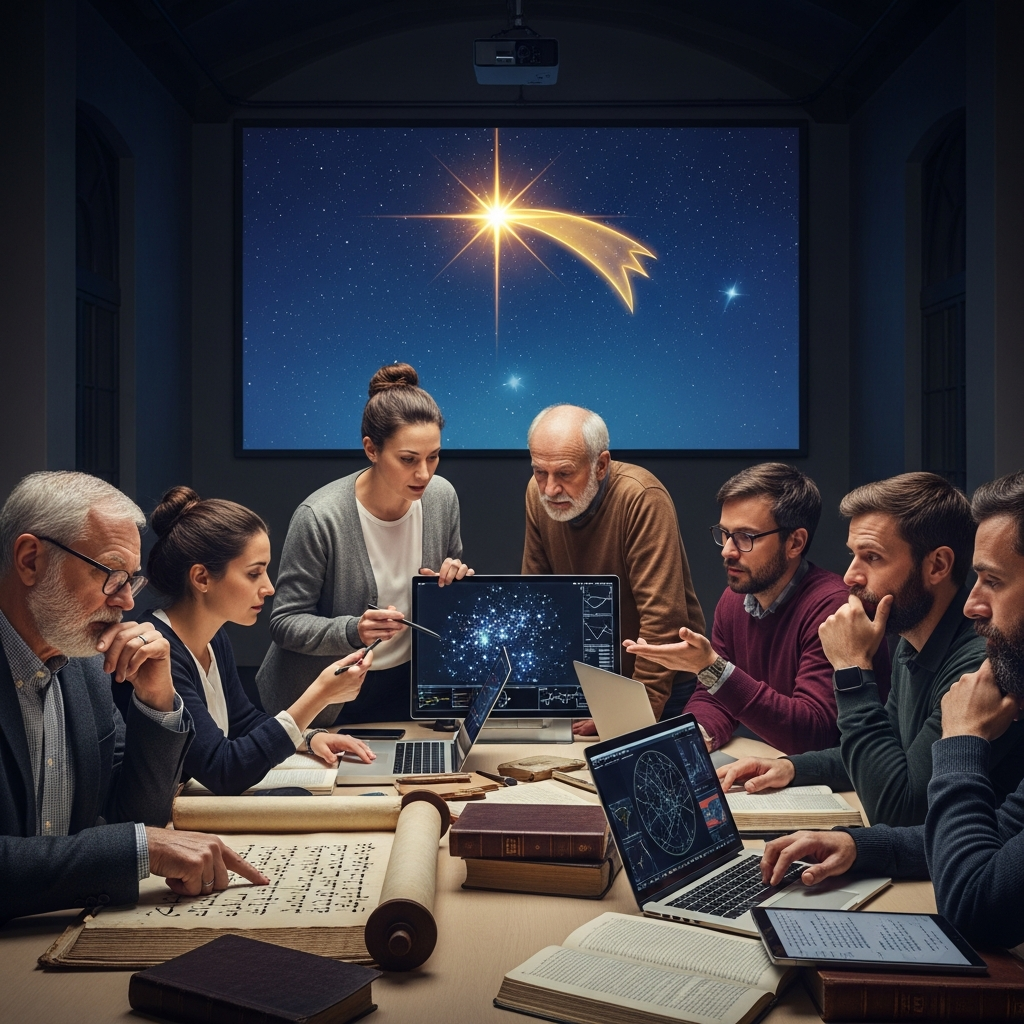
For millennia, a celestial mystery has captivated historians, theologians, and astronomers alike: the Star of Bethlehem. This enigmatic beacon, described in the Gospel of Matthew, reputedly guided the Magi to the birthplace of Jesus Christ. Was it a miracle, a myth, or a verifiable astronomical event? This comprehensive guide delves into the leading Star of Bethlehem theories, exploring the scientific and historical evidence behind attempts to unmask this ancient wonder. Prepare to explore the fascinating possibilities that might explain the radiant star of Christmas lore.
Unraveling the Biblical Narrative of the Christmas Star
The Gospel of Matthew provides the primary, and indeed only, biblical account of the Star of Bethlehem. It describes wise men, or Magi, from the East who observed a unique star. They interpreted its appearance as a sign of a new king’s birth in Judea. Following this celestial guide, they traveled to Jerusalem, then to Bethlehem, where they found the infant Jesus. This brief but profound narrative has fueled centuries of speculation. Understanding the cultural and astronomical context of the time is crucial for evaluating any Star of Bethlehem theory. Ancient astrologers deeply studied the heavens, believing celestial events held profound meaning for earthly affairs and human destiny.
The Magi: Astronomers or Astrologers?
The term “Magi” often conjures images of kings. However, historically, they were likely priests or scholars from Persia or Babylon. These learned men excelled in astronomy, astrology, and dream interpretation. Their journey, motivated by a star, suggests a sophisticated understanding of celestial movements. For them, a significant astronomical phenomenon would undoubtedly signal an event of immense importance. This perspective frames the search for a natural explanation for the Star of Bethlehem.
Leading Astronomical Star of Bethlehem Theories
Many scientists and historians propose that the Star of Bethlehem was a real, observable astronomical event. These astronomical explanations attempt to pinpoint a celestial occurrence aligning with biblical timelines and descriptions. While definitive proof remains elusive, several compelling theories have emerged over the centuries. Each offers a unique perspective on what the Magi might have witnessed.
The Great Conjunction Theory: Jupiter and Saturn
One of the most widely accepted Star of Bethlehem theories revolves around a rare planetary alignment. In 7 BC, the gas giants Jupiter and Saturn underwent a triple conjunction in the constellation Pisces. A triple conjunction means they appeared to meet three times in the sky over several months.
Significance of Jupiter: Often associated with kingship.
Significance of Saturn: Linked to Judea or Israel.
Significance of Pisces: Believed to represent the Jewish nation.
This conjunction would have been an extraordinary sight. It would have undoubtedly captured the attention of ancient astrologers. Johannes Kepler, a renowned astronomer, first proposed this theory in the 17th century. He discovered a triple conjunction of Jupiter and Saturn occurred in 7 BC, sparking renewed interest. This specific alignment offers a strong candidate for the biblical star.
Other Planetary Conjunctions
Beyond the Jupiter-Saturn event, other planetary alignments are considered:
Jupiter and Venus Conjunction (2 BC): This event would have been visually stunning. Venus, the brightest planet, and Jupiter, the second brightest, would have appeared incredibly close. Some scholars argue this conjunction could have been bright enough to warrant the “star” description. It might even have appeared as a single, incredibly luminous object.
Regulus and Jupiter/Venus: The “king star” Regulus was also involved in conjunctions with Jupiter and Venus around this period. Such alignments would have underscored a message of kingship to the Magi.
These conjunction theories offer plausible natural explanations. They fit the Magi’s astrological worldview.
The Nova or Supernova Hypothesis
Another intriguing Star of Bethlehem theory suggests the star was a supernova or nova. These events involve a star suddenly increasing dramatically in brightness.
Nova: A white dwarf star undergoes a temporary brightening.
Supernova: The catastrophic explosion of a massive star.
Chinese and Korean astronomical records from that era document various celestial phenomena. Some mention a “guest star” in the constellation Aquila in 5 BC. This record could potentially correspond to a nova. A nova would have been bright, appearing suddenly and remaining visible for several weeks or months. Its ephemeral nature aligns with a “star” that eventually disappeared. This would explain why it was seen as a unique event.
The Comet Theory
Some scholars propose the Star of Bethlehem was a comet. Comets are known for their bright tails and unusual appearance. Halley’s Comet, for instance, appeared in 12 BC. However, this is too early to align with most estimates of Jesus’ birth (typically between 6 BC and 4 BC). Other comets might have appeared.
Visual Impact: Comets are distinctive and highly visible.
Ancient Interpretation: Comets were often seen as omens, sometimes of significant births or deaths.
The main challenge with the comet theory is that ancient texts often viewed comets as bad omens. It seems unlikely the Magi would follow something traditionally associated with ill fortune.
The Chronological Puzzle: When Was Jesus Born?
The dating of Jesus’ birth is critical to evaluating any Star of Bethlehem theory. Traditional Christmas is celebrated on December 25th. However, historical and biblical scholars largely agree Jesus was not born in December. Evidence points to a birth between 6 BC and 4 BC. This timeframe is largely derived from the death of King Herod the Great. Matthew’s Gospel states Herod ordered the “Massacre of the Innocents” in Bethlehem following the Magi’s visit. Historical sources place Herod’s death in 4 BC. Therefore, the Star of Bethlehem event must have occurred before this date. This narrow window allows astronomers to retroactively search for candidate celestial events.
Challenges and Theological Interpretations
Despite the compelling astronomical theories, no single explanation for the Star of Bethlehem is universally accepted. Each hypothesis faces its own set of challenges.
Conjunctions: While visually impressive, would they have appeared as a single “star” bright enough to guide travelers?
Nova/Supernova: Would a nova in 5 BC truly fit all aspects of the biblical narrative?
Historical Records: Gaps in ancient astronomical records make definitive correlation difficult.
Furthermore, many religious scholars maintain a theological interpretation. They believe the Star of Bethlehem was a miraculous sign. It defied natural explanation, appearing uniquely for this divine purpose. From this perspective, seeking an astronomical explanation is unnecessary. It detracts from the spiritual significance of the event. The narrative emphasizes the miraculous nature of Christ’s birth.
The Enduring Fascination with the Christmas Star
The quest to identify the Star of Bethlehem continues to captivate. It bridges the worlds of faith, history, and science. Modern technology and advanced astronomical simulations allow researchers to model ancient skies with incredible accuracy. This ongoing investigation sparks renewed interest each holiday season. The debate itself highlights the intersection of belief and scientific inquiry. Whether a divine sign or a natural phenomenon, the Star of Bethlehem remains a powerful symbol. It represents hope, guidance, and the enduring mystery of a pivotal moment in history. Understanding its various interpretations enriches our appreciation for this profound biblical tale.
Frequently Asked Questions
What are the most popular scientific explanations for the Star of Bethlehem?
The most popular scientific explanations for the Star of Bethlehem involve astronomical events observable by ancient sky-gazers. These include planetary conjunctions, particularly the triple conjunction of Jupiter and Saturn in 7 BC, which was proposed by Johannes Kepler. Another strong candidate is the Jupiter and Venus conjunction in 2 BC, which would have appeared incredibly bright. Some theories also suggest it could have been a nova or supernova, with records of a “guest star” from Chinese astronomers in 5 BC providing some support for this idea.
How do researchers use ancient astronomical records to identify the Star of Bethlehem?
Researchers utilize ancient astronomical records, primarily from Chinese and Korean observatories, to identify potential candidates for the Star of Bethlehem. These records meticulously document “guest stars” (novas/supernovas) and other celestial phenomena like comets. By cross-referencing these historical accounts with computer models that can simulate the ancient sky, astronomers can pinpoint events that occurred within the estimated timeframe of Jesus’ birth (between 6 BC and 4 BC). This helps to correlate biblical narratives with verifiable historical astronomical occurrences.
Why is there no single, universally accepted Star of Bethlehem theory?
There is no single, universally accepted Star of Bethlehem theory primarily due to the brevity of the biblical account and the challenges in aligning ancient texts perfectly with modern astronomical data. The Gospel of Matthew provides limited specific details, making interpretation difficult. Additionally, while astronomical theories offer plausible natural explanations, they often don’t account for every descriptive element, such as the star “moving and stopping over a particular house.” Many also uphold a theological perspective, viewing the star as a unique, miraculous event that defies natural explanation, which inherently conflicts with scientific inquiry.
Conclusion
The Star of Bethlehem, whether a divine miracle or a tangible celestial event, continues to ignite curiosity and wonder. From grand planetary conjunctions to fleeting novas, the various Star of Bethlehem theories offer compelling insights into how ancient peoples interpreted the heavens. While the definitive answer may forever remain veiled in history, the scientific pursuit of understanding this biblical enigma deepens our appreciation for both faith and the cosmos. The Christmas star endures as a powerful symbol, forever shining a light on one of history’s most fascinating mysteries.