Deep within the fabric of our universe lies one of its most enigmatic particles: the neutrino. Often called a “ghost particle,” this fundamental component of matter constantly streams through everything, including you, at nearly the speed of light. Yet, understanding the neutrino mystery remains a frontier in modern physics. Why do these particles hold such a critical key to the cosmos? This comprehensive guide delves into the fascinating world of neutrinos, revealing their elusive nature, the profound scientific riddles they pose, and the groundbreaking research pushing the boundaries of our knowledge. Join us as we explore how these tiny particles could unlock the universe’s most profound secrets.
What Exactly Are Neutrinos?
Neutrinos are fundamental particles, meaning they are not made up of smaller components. They belong to a family of particles called leptons, alongside the electron. Unlike electrons, however, neutrinos carry no electric charge. This lack of charge, combined with their incredibly tiny mass, makes them extraordinarily difficult to detect. They interact with other matter only through the weak nuclear force and gravity, allowing them to pass through planets, stars, and even human bodies without hindrance.
The Ghost Particle’s Elusive Nature
Imagine a particle so shy it rarely leaves a trace. That’s a neutrino. Trillions of them pass through your fingertip every second, mostly originating from the sun. Their weak interaction means experimental physicists must build massive detectors, often deep underground, to catch even a handful of these elusive particles. Observing a neutrino is like trying to find a needle in an entire haystack of haystacks. This “ghostly” characteristic is central to the ongoing neutrino mystery and the challenges in their study.
A Brief History of Discovery
The concept of the neutrino first emerged in 1930. Wolfgang Pauli proposed its existence to explain missing energy in a type of radioactive decay known as beta decay. For years, it remained a theoretical particle. It wasn’t until 1956 that Clyde Cowan and Frederick Reines experimentally confirmed its existence, observing antineutrinos produced by a nuclear reactor. Their pioneering work validated Pauli’s hypothesis, paving the way for a new era in particle physics research.
The Core Mystery: Neutrino Oscillation
The biggest enigma surrounding neutrinos, and the heart of the neutrino mystery, is a phenomenon called neutrino oscillation. Scientists discovered that neutrinos aren’t static entities; they can change their “flavor” or type as they travel. There are three known flavors: electron neutrino, muon neutrino, and tau neutrino. A neutrino born as an electron neutrino, for example, might arrive at a detector as a muon neutrino.
Flavors and Their Quantum Dance
This shape-shifting ability is a purely quantum mechanical effect. It suggests that neutrinos are not simply one type but a superposition of mass states. Imagine a dancer simultaneously performing three different moves until observed, at which point they commit to one. This “quantum dance” of flavors has profound implications. It directly proves that neutrinos must possess mass, no matter how small. This was a revolutionary discovery, as the Standard Model of particle physics initially predicted neutrinos to be massless.
Why Oscillation Implies Mass
The very act of oscillation is concrete evidence of neutrino mass. If neutrinos were massless, like photons, they would travel at the speed of light, and time would essentially stand still for them. In such a scenario, they couldn’t change their identity. Therefore, the observation of neutrino oscillation confirmed that these particles, however light, do have mass. Pinpointing the exact value of this tiny mass is another active area in neutrino physics.
Solving the Solar Neutrino Problem
Neutrino oscillation wasn’t just a theoretical curiosity; it provided a crucial solution to a long-standing astronomical puzzle known as the solar neutrino problem. For decades, scientists observed fewer electron neutrinos from the sun than predicted by solar models. This discrepancy led to much debate and questioning of either our understanding of the sun or the properties of neutrinos themselves.
A Cosmic Conundrum Unraveled
The sun is a powerful source of electron neutrinos, produced during the nuclear fusion reactions in its core. Early neutrino detectors could only register electron neutrinos. When these detectors consistently measured about one-third of the expected flux, it created a scientific crisis. Was the sun not burning as theorized? Or were the neutrinos vanishing? The answer, as it turned out, involved their mysterious transformations.
Early Challenges and Breakthroughs
The groundbreaking experiments at Super-Kamiokande in Japan and the Sudbury Neutrino Observatory (SNO) in Canada provided the definitive answer. SNO, in particular, was able to detect all three flavors of neutrinos. It confirmed that the total number of neutrinos arriving from the sun matched predictions, but some had changed flavor on their journey to Earth. The “missing” electron neutrinos had simply oscillated into muon and tau neutrinos, solving one of the most significant puzzles in astrophysics and validating the theory of oscillation. This was a triumph for neutrino physics.
Neutrinos: Cosmic Messengers and Beyond
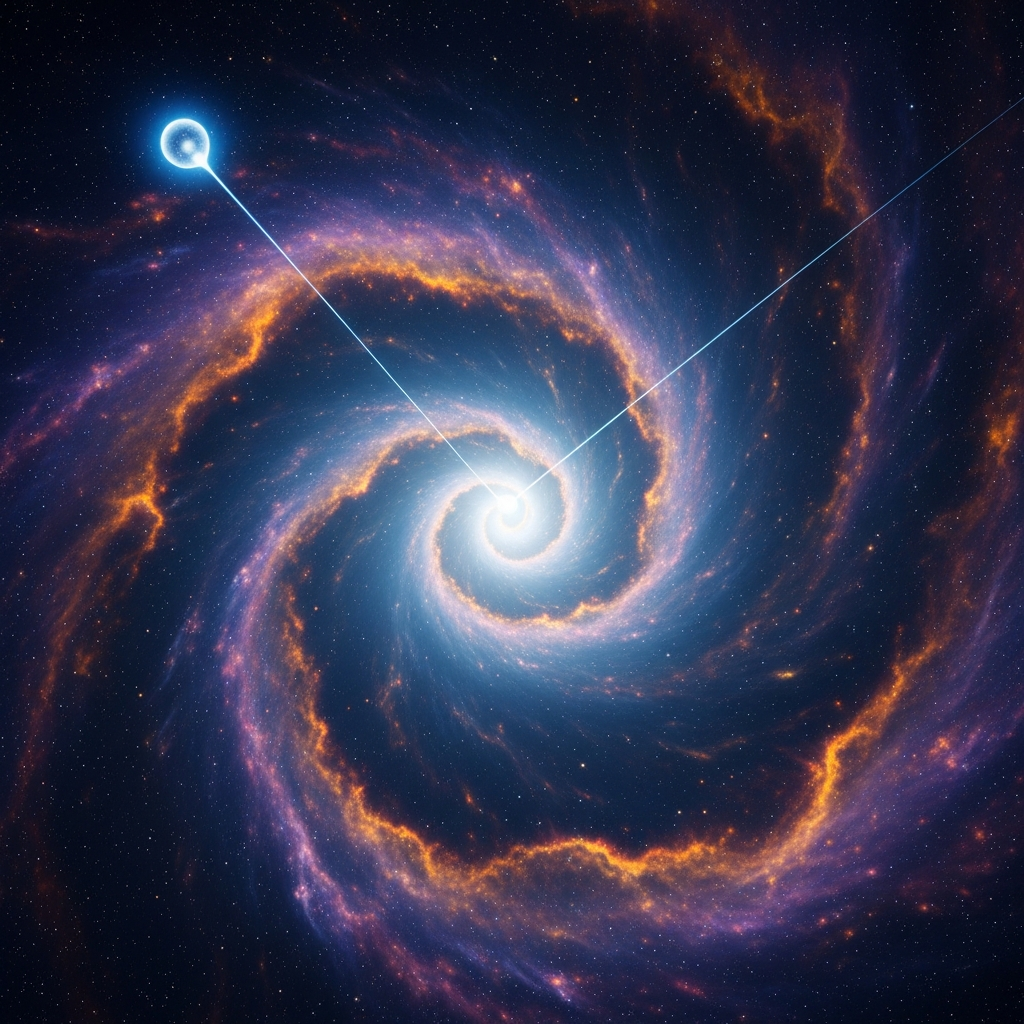
Beyond their role in solar processes, neutrinos are powerful tools for astronomy. Because they interact so weakly, they travel vast cosmic distances mostly unimpeded by matter or magnetic fields. This makes them ideal messengers, carrying direct information from some of the most extreme environments in the universe. High-energy cosmic neutrinos detected on Earth provide unique insights into distant astrophysical phenomena.
Peering into the Universe’s Extremes
Experiments like IceCube, a neutrino observatory buried deep under the Antarctic ice, search for these high-energy cosmic neutrinos. By tracking their paths, scientists can potentially pinpoint the sources of cosmic rays—another major physics mystery. These sources might include supernovas, active galactic nuclei, or even gamma-ray bursts. Neutrinos offer an unparalleled window into violent events far across the cosmos, revealing processes hidden from conventional telescopes.
Majorana or Dirac: A Fundamental Question
Another profound neutrino mystery revolves around their fundamental nature: are neutrinos Dirac particles or Majorana particles? A Dirac particle is distinct from its antiparticle (like an electron and a positron). A Majorana particle, however, is its own antiparticle. If neutrinos are Majorana particles, it would have profound implications for our understanding of matter-antimatter asymmetry in the universe and could explain why neutrinos have mass. Experiments searching for neutrinoless double-beta decay are attempting to answer this crucial question.
The Hunt for Neutrinos: Cutting-Edge Experiments
Studying neutrinos is a monumental task, requiring some of the most ingenious and massive scientific instruments ever built. These experiments are often located deep underground, in abandoned mines or under thick layers of ice. This shielding protects them from cosmic rays and other background radiation, allowing scientists to focus on the rare neutrino interactions.
Underground Labs and Ice Giants
From the Kamioka Observatory in Japan, home to Super-Kamiokande and Hyper-Kamiokande, to the Borexino detector in Italy’s Gran Sasso mountain, underground labs are neutrino hunting grounds. The IceCube Neutrino Observatory transforms a cubic kilometer of Antarctic ice into a giant detector, using thousands of sensors to register the faint flashes of light produced when high-energy neutrinos collide with atomic nuclei. These facilities are at the forefront of tackling the neutrino mystery.
Future Prospects in Neutrino Research
The future of neutrino research is vibrant and diverse. New projects like DUNE (Deep Underground Neutrino Experiment) in the United States aim to study neutrino oscillation with unprecedented precision, seeking to understand the order of neutrino masses (the “mass hierarchy”) and whether neutrinos and antineutrinos behave differently (CP violation). These experiments hold the potential to reveal new physics beyond the Standard Model.
Unanswered Questions and Future Implications
Despite significant progress, the neutrino mystery is far from solved. Many fundamental questions persist, prompting continued dedicated research. Answering these questions could revolutionize our understanding of elementary particles and the very origins of the universe.
Mass Hierarchy and CP Violation
Understanding the exact mass of each neutrino flavor and their precise hierarchy (whether the electron neutrino is the lightest or heaviest) is crucial. Furthermore, the search for CP violation in neutrinos—a difference in behavior between neutrinos and antineutrinos—could explain why there’s more matter than antimatter in the universe, a profound cosmic asymmetry. This could be one of the greatest contributions of neutrino physics to cosmology.
Connecting to Dark Matter and Cosmology
Neutrinos, being abundant and massive, might play a role in dark matter or dark energy, though likely not as the sole components. Their properties could also offer clues about the early universe’s conditions and its evolution. As new data emerges from advanced experiments, neutrinos continue to offer tantalizing glimpses into realms of physics we’re only just beginning to comprehend.
Frequently Asked Questions
What is neutrino oscillation, and why is it important in physics?
Neutrino oscillation is a quantum mechanical phenomenon where neutrinos change their “flavor” (electron, muon, or tau) as they travel. This is profoundly important because it provides direct proof that neutrinos possess mass, contradicting the original Standard Model of particle physics which predicted them to be massless. The discovery solved the long-standing solar neutrino problem and opened new avenues for understanding fundamental particle properties and potential new physics beyond the Standard Model.
Where are neutrinos studied, and what major experiments exist?
Neutrinos are typically studied in specialized observatories located deep underground or in remote, isolated environments to shield them from cosmic radiation. Major experiments include Super-Kamiokande in Japan, the Sudbury Neutrino Observatory (SNO) in Canada (now decommissioned but its data is still analyzed), the Borexino detector in Italy, and the IceCube Neutrino Observatory in Antarctica. Future large-scale experiments like DUNE (Deep Underground Neutrino Experiment) are currently under construction or planning.
Why should we care about neutrinos, and what’s their impact on our understanding of the universe?
We should care about neutrinos because they are fundamental particles with unique properties that could unlock some of the universe’s greatest secrets. Their mass, oscillation, and potential Majorana nature offer insights into why there’s more matter than antimatter. As cosmic messengers, they provide a unique lens to study extreme astrophysical events like supernovas and black holes. Ultimately, understanding neutrinos helps complete our picture of elementary particles and the forces governing the cosmos, potentially leading to new theories in particle physics and cosmology.
Conclusion
The neutrino mystery represents a vibrant and active frontier in particle physics. From their elusive nature as “ghost particles” to their transformative oscillations and their role as cosmic messengers, neutrinos continue to challenge and expand our understanding of the universe. Every new discovery about these tiny, unassuming particles brings us closer to unraveling fundamental questions about matter, energy, and the very origins of the cosmos. As scientists continue to build more sensitive detectors and devise ingenious experiments, the secrets held by neutrinos are slowly, but surely, coming to light, promising revolutions in physics for decades to come.