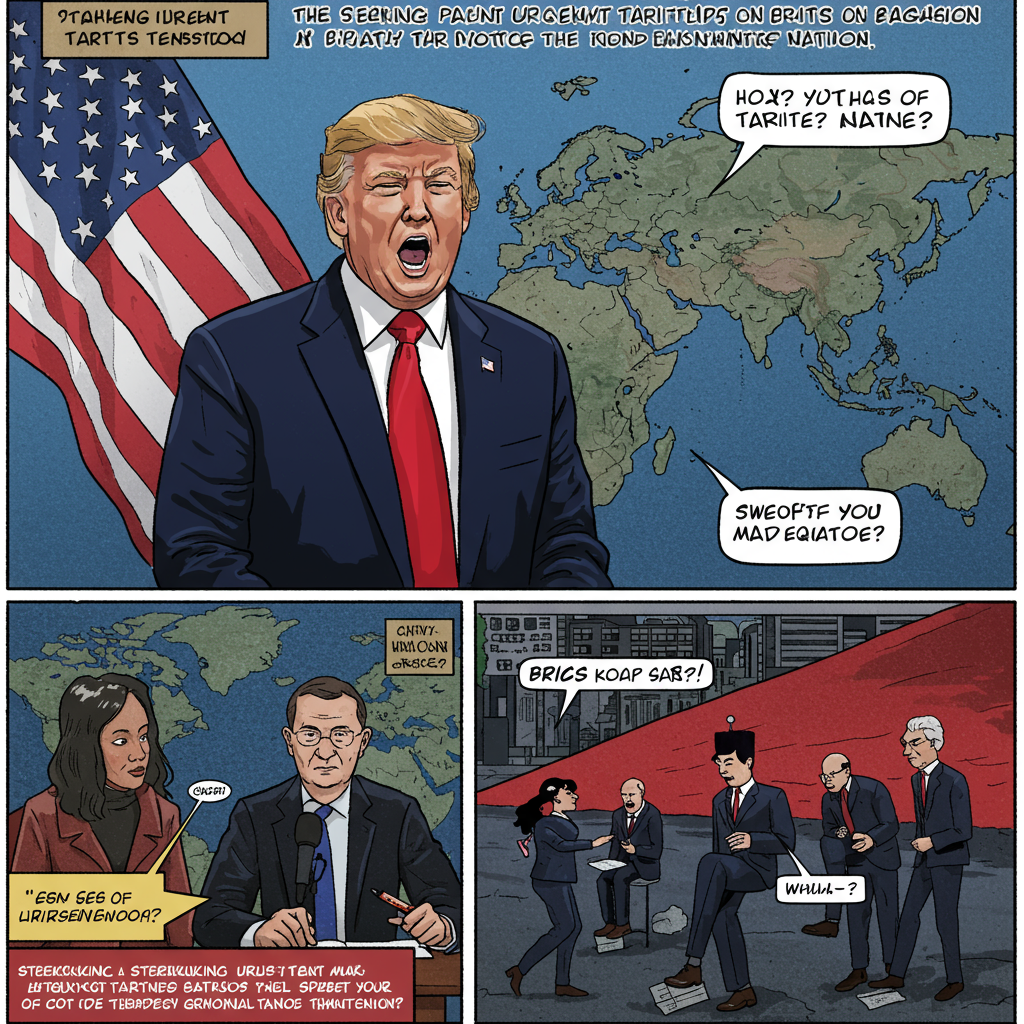
A sharp escalation in global trade tensions unfolded recently as former President Donald Trump threatened substantial new tariffs on countries associating with the brics economic alliance. Late Sunday, Trump announced via social media that nations aligning with BRICS’s “Anti-American policies” would face an “ADDITIONAL 10% tariff,” emphasizing this policy would have “no exceptions.” This threat emerged just hours after BRICS members, gathered for their 17th annual summit in Rio de Janeiro, issued a statement raising concerns about rising unilateral tariffs and their disruptive impact on international commerce.
Trump’s post did not detail the specific BRICS policies he deemed “Anti-American,” leaving the global community to interpret the potential scope of the proposed tariff hike. However, his administration has previously voiced concerns over BRICS’s ambitions to challenge the dominance of the U.S. dollar and proposed reforms to international financial institutions like the IMF. The BRICS group, which began as Brazil, Russia, India, and China, expanded significantly in 2010 to include South Africa, and recently welcomed Egypt, Ethiopia, Iran, Indonesia, Saudi Arabia, and the United Arab Emirates, now representing a large portion of the world’s population and aiming to promote a multipolar global power structure.
Understanding the BRICS Alliance and Its Aims
Originally conceived as a forum for major emerging economies, the BRICS alliance has evolved into a significant geopolitical and economic bloc. Its members cooperate on trade, security, and diplomacy, often presenting an alternative perspective to the U.S.-led Western order. With its recent expansion, the group’s collective economic footprint and influence on global affairs have grown considerably. Leaders at the Rio summit framed their efforts around “Strengthening Global South Cooperation for More Inclusive and Sustainable Governance,” implicitly criticizing protectionist measures while avoiding direct confrontation in their final declaration.
Despite the carefully worded declaration, which expressed “serious concerns about the rise of unilateral tariff and non-tariff measures,” Trump’s tariff threat underscores the growing friction between the bloc’s aspirations and U.S. trade policy. BRICS leaders pushed back against Trump’s comments. Brazil’s President Lula da Silva called the threat “reckless,” stating, “We don’t want an emperor, we are sovereign countries.” South Africa’s President Cyril Ramaphosa added that “the powerful should not seek vengeance.” Officials from China and South Africa also stated that BRICS cooperation is not directed against any third country and condemned coercive tariff use.
The Context of Trump’s Tariff Policies
This latest threat fits within the broader context of Trump’s assertive trade agenda. His administration introduced sweeping tariff measures earlier, famously announcing a “Liberation Day” on April 2 that included a provisional 10% tariff on goods from most trading partners and higher “reciprocal” tariffs on over 70 nations. The deadline for these higher tariffs was initially set for July 9 but later confirmed by U.S. officials like Commerce Secretary Howard Lutnick and Treasury Secretary Scott Bessent to be August 1. This delay was intended to provide time for trade negotiations with individual countries.
Trump indicated that letters detailing potential new tariff rates would be sent to countries failing to reach trade agreements before the August 1 deadline. Bessent described these communications as outlining a default tariff rate unless a deal is struck. The administration has been actively pursuing trade deals, recently completing agreements with the United Kingdom and Vietnam, and a partial deal with China. Talks are reportedly ongoing with key partners like the European Union and Japan.
Implications of Aligning with BRICS
The threat of an additional 10% tariff raises questions for countries navigating their relationships with both the U.S. and the BRICS bloc. For BRICS members and their strategic partners, this could mean facing increased import costs into the crucial U.S. market. The policy implies that participation in BRICS initiatives or support for the group’s geopolitical stance could trigger economic penalties from the U.S. This puts countries in a difficult position, potentially forcing them to balance their economic interests with their alignment in a multipolar world order.
Experts note the practical difficulties countries face in significantly reducing trade ties with major BRICS economies like China, especially in sectors where China dominates production, such as EVs, batteries, and critical minerals. Andrew Wilson of the International Chambers of Commerce highlighted this challenge. The U.S. tariff threat appears designed to discourage closer economic and political ties between other nations and the BRICS group, aiming to curb the bloc’s growing influence.
Navigating Geopolitical Tensions
The BRICS summit itself highlighted the complexities facing the group. While aiming for a unified stance, the diverse interests of its expanded membership can create internal challenges. For example, the final declaration offered a “watered-down rebuke” of U.S. airstrikes on Iran compared to stronger language regarding Israel’s actions in Gaza. Attendee absences, including President Putin participating remotely due to an ICC warrant and Iran’s president sending his foreign minister after airstrikes, also underscored the geopolitical pressures on the bloc.
Despite these challenges, the BRICS group remains committed to its long-term vision of reforming global governance and fostering development, presenting itself as a voice for the Global South. Trump’s tariff threat serves as a clear warning that the U.S. views the rise of the BRICS bloc, and its policies challenging Western dominance, as a direct potential threat to American interests, willing to employ economic tools to counter this perceived challenge.
Frequently Asked Questions
What specific BRICS policies did Trump describe as “Anti-American”?
While President Trump did not explicitly detail which BRICS policies he considers “Anti-American,” external analyses and previous statements suggest concerns center on the bloc’s efforts to challenge the U.S. dollar’s role as the dominant global currency and their proposals for reforms to international financial institutions like the IMF. The BRICS summit statement criticizing unilateral tariffs, which appeared shortly before Trump’s threat, also likely contributed to this designation.
What is the context of Trump’s previous tariff actions leading up to this threat?
This new tariff threat builds upon earlier actions taken by President Trump. On April 2, his administration announced a minimum 10% tariff on imports from most countries and higher “reciprocal” tariffs on numerous nations. The deadline for these higher tariffs, initially projected for July 9, was officially extended to August 1 to allow for trade negotiations. This BRICS-related threat adds another layer of potential tariffs targeting specific countries based on their alignment with the bloc.
How might this additional tariff threat impact countries aligning with BRICS?
Countries aligning with BRICS, particularly its full members and strategic partners, could face increased costs when exporting goods to the United States if this additional 10% tariff is implemented. This could pressure these nations to reconsider the extent of their alignment with BRICS policies deemed “Anti-American” by the U.S., potentially impacting trade volumes and forcing a strategic choice between economic ties with the U.S. and deeper cooperation within the BRICS framework.
Conclusion
The threat of new U.S. tariffs on nations aligned with the BRICS bloc marks a significant moment in the ongoing global trade and geopolitical landscape. It highlights the growing competition between established powers and emerging alliances seeking a multipolar world order. As the August 1 deadline for potential U.S. tariff implementations approaches, countries will be closely watching whether this threat materializes and how it reshapes international trade relations and the future trajectory of groups like BRICS.
Word Count Check: 919