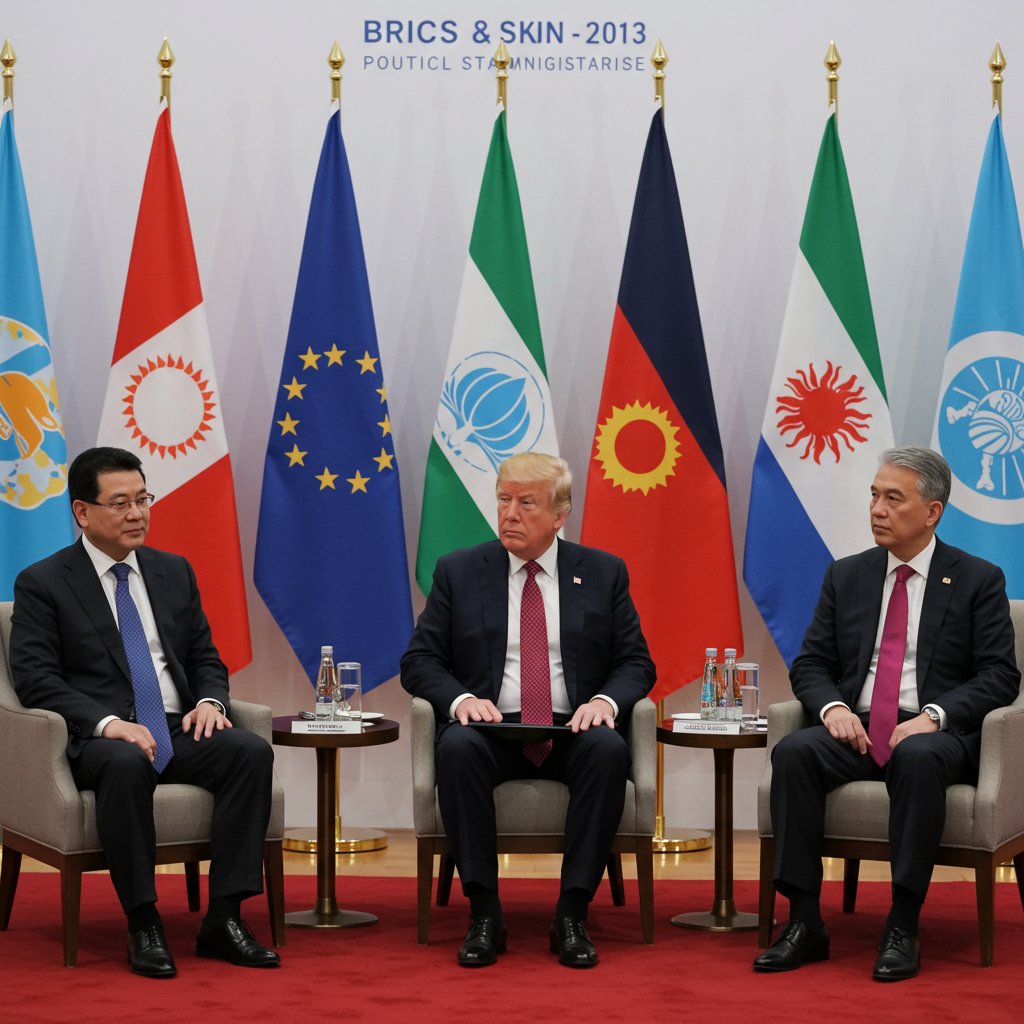
Leaders from the expanded brics group of developing nations convened in Rio de Janeiro on July 7, 2025, for a high-stakes summit overshadowed by renewed tariff threats from former-turned-future US President Donald Trump. The meeting served as a platform for the bloc to assert its vision for a multipolar world, push back against unilateral trade measures, and deepen economic cooperation among its members, representing roughly half the global population.
Hosted by Brazilian President Luiz Inacio Lula da Silva, who holds the group’s rotating chair, the summit highlighted the growing geopolitical and economic divergence between the rising powers of the Global South and the established Western order. Lula wasted no time addressing the tensions, declaring in his opening remarks that the world was witnessing the “unparalleled collapse of multilateralism.” He argued forcefully that if existing international governance structures fail to reflect the 21st century’s “new multipolar reality,” BRICS must step in to help modernize them. Lula also took aim at the NATO military alliance, accusing it of fueling a global arms race following a recent decision to set a defense spending target of 5% of GDP.
BRICS Leaders Condemn US Tariff Policy
A central focus of the summit and a key point of contention was the trade policy spearheaded by President Trump. BRICS leaders collectively issued a strong condemnation of what they termed his “indiscriminate” tariff approach. They voiced “serious concerns about the rise of unilateral tariff and non-tariff measures,” arguing that such actions “distort trade” and fundamentally contradict World Trade Organization (WTO) rules. These measures, the bloc stated, were negatively “affecting prospects for global economic development.”
This joint stance came directly in response to fresh threats from Trump. He had previously warned of tariffs up to 50% if countries didn’t reach trade deals with Washington by August 1. Then, on the very day the BRICS summit began, Trump escalated his rhetoric. Via his Truth Social platform, he vowed an additional 10% tariff specifically targeting countries “aligning themselves with the Anti-American policies of BRICS.” Trump’s post offered no clarification on what specific policies he deemed “Anti-American,” leaving the criteria open to interpretation.
The Implications of Trump’s Tariff Threats
Trump’s threat of a 10% tariff for merely aligning with the BRICS bloc introduces a new layer of complexity into international relations. While the specific threshold or nature of “alignment” remains undefined, it signals a direct challenge to the bloc’s increasing cohesion and influence. This adds to earlier, more drastic threats Trump has made, such as a hypothetical 100% tariff on BRICS trade should the group proceed with plans perceived as undermining the US dollar or establishing a common currency. Trump has openly accused BRICS leaders of trying to “play games with the dollar” by exploring such alternatives.
This aggressive tariff stance is consistent with Trump’s broader “America First” trade strategy, which includes a system of “reciprocal tariffs” designed to automatically match other countries’ import duties on US goods. He frames this approach as necessary for “fairness” in trade, asserting the US has been treated unfairly by allies. Economists and politicians alike have warned that sudden, steep tariffs imposed after decades of global economic integration could have “crippling effects” on economies and lead to significant market turmoil and rising consumer prices. The impact is already visible in certain sectors; for instance, copper prices have seen upward momentum, partly attributed to a US investigation into copper imports initiated by the Trump administration, seen as a potential precursor to duties aimed at boosting domestic production.
Understanding the BRICS Bloc: More Than Just “Anti-Western”
The BRICS group, originally comprising Brazil, Russia, India, China, and South Africa, underwent significant expansion last year, welcoming Egypt, Ethiopia, Iran, Saudi Arabia, the United Arab Emirates, and Indonesia as new members. This growth underscores the bloc’s ambition to increase its collective voice and influence on the global stage. While some Western analysts characterize BRICS primarily as an “anti-Western” alliance led by Russia and China, leaders within the bloc and some observers argue this view is inaccurate.
They contend that BRICS functions as a platform for “non-Western” nations to safeguard their economic interests and advocate for reforms to a global order largely shaped after World War II. Members like India play a significant role in decision-making, and several new members, including the UAE and Egypt, maintain strong ties with the United States. The bloc’s primary focus remains economic collaboration, promoting trade and investment among member states. A key priority for Brazil’s chairmanship, for example, has been “developing means of payment” to encourage the use of local currencies in transactions. While exploring alternatives to dollar dominance is discussed, Brazilian negotiators have clarified there is currently no concrete plan to replace the dollar entirely, but rather to increase the use of national currencies for trade settlement.
Diverse Agendas and Absences
The summit also highlighted the diverse priorities and geopolitical realities facing individual BRICS members. Indian Prime Minister Narendra Modi emphasized the bloc’s crucial role in leading the “Global South” in an increasingly multipolar international system. For India, BRICS is seen as vital to its foreign policy strategy, providing a platform for reforming the global order and acting as an economic gateway to broader regional markets through members like Iran (Central Asia), Egypt (North Africa), and Ethiopia (East/Central Africa). Multilateral forums like BRICS are considered essential for India to secure its interests, particularly when dealing with a US administration under Trump that has historically favored bilateral negotiations over multilateral engagement.
South Africa, another founding member, found itself directly addressing Trump’s tariff threat linked to BRICS alignment. South Africa’s trade ministry spokesperson publicly stated that the country is not “anti-American” and remains committed to negotiating a trade deal with the United States, clarifying that discussions have been constructive and ongoing since May 2025. This response underscores the complex balancing act many BRICS nations perform, seeking closer ties within the bloc while maintaining important bilateral relationships with Western powers.
Notably, two key leaders were absent from the Rio summit. Chinese President Xi Jinping opted not to attend in person, sending Premier Li Qiang instead. This marked the first time Xi had skipped a BRICS summit since becoming China’s leader in 2012, with Beijing offering no official reason for his absence. Russian President Vladimir Putin also stayed away physically but participated via videoconference. His decision stemmed from Brazil’s membership in the International Criminal Court (ICC); Brazil would be obliged to arrest Putin based on an ICC warrant related to the Ukraine invasion if he entered the country. In his virtual address, Putin remarked that the “model of liberal globalization is becoming obsolete,” asserting that the center of business activity is shifting towards emerging markets. He urged increased cooperation among members in areas like natural resources, logistics, trade, and finance.
Beyond economic and geopolitical strategy, the BRICS leaders addressed other pressing global issues. Their joint declaration included a strong condemnation of the terrorist attack in Pahalgam, Jammu and Kashmir, on April 22, 2025, which resulted in 26 deaths. They reaffirmed a commitment to combating terrorism in all its forms, specifically mentioning cross-border movement, financing, and safe havens—a point particularly relevant given the attack’s context concerning India-Pakistan tensions. The leaders also expressed “grave concern” regarding the humanitarian situation in Gaza and condemned Israeli and US military strikes on Iran, reiterating concerns about the resumption of continuous Israeli attacks against Gaza and the obstruction of humanitarian aid entry.
Frequently Asked Questions
What were the main points of conflict between BRICS and the US discussed at the summit?
The primary point of conflict discussed at the BRICS summit was US President Donald Trump’s imposition and threat of additional tariffs. BRICS leaders strongly condemned these “unilateral tariff and non-tariff measures,” viewing them as distorting trade and inconsistent with WTO rules. Trump, in turn, threatened an additional 10% tariff on countries aligning with BRICS policies, escalating trade tensions and challenging the bloc’s growing unity and influence on the global economic stage.
Why did certain leaders, like Xi Jinping and Vladimir Putin, not attend the BRICS summit in Brazil?
Chinese President Xi Jinping did not attend the summit in person, sending his Premier Li Qiang instead. This was notable as it was the first BRICS summit Xi had skipped since 2012, with China providing no official explanation. Russian President Vladimir Putin also did not attend physically but participated via videoconference. His absence in Brazil was due to Brazil’s status as a member of the International Criminal Court (ICC), which has issued an arrest warrant for Putin. Brazil would have been required to detain him if he entered the country.
What are BRICS’ goals regarding global currencies and trade, particularly in response to Trump’s threats?
BRICS countries are actively exploring alternatives to the dominant dollar-based trading system. They aim to boost trade and investment among members by increasing the use of local currencies for transactions. While discussions about a potential common currency have occurred, BRICS officials have clarified that there is no concrete plan currently in place to replace the US dollar. This push for alternative payment systems is partly a response to perceived vulnerabilities in the dollar system and global economic shifts, intensified by unilateral actions like the US tariff threats.
Conclusion: Navigating a Fragmenting World
The BRICS summit in Rio de Janeiro served as a clear indicator of the ongoing shifts in global power dynamics. Against the backdrop of renewed US tariff threats under Donald Trump, the expanded bloc positioned itself as a crucial voice for the Global South and a bulwark against what its leaders see as declining multilateralism and rising unilateralism. While unified in condemning the trade pressures from Washington, the summit also underscored the diverse interests and geopolitical constraints faced by individual members. The focus on enhancing economic cooperation, promoting trade in local currencies, and advocating for a more multipolar world order signals BRICS’ intent to play a larger role in shaping the future of international relations and the global economy, even as complex trade negotiations and geopolitical tensions with major powers like the United States continue to evolve.