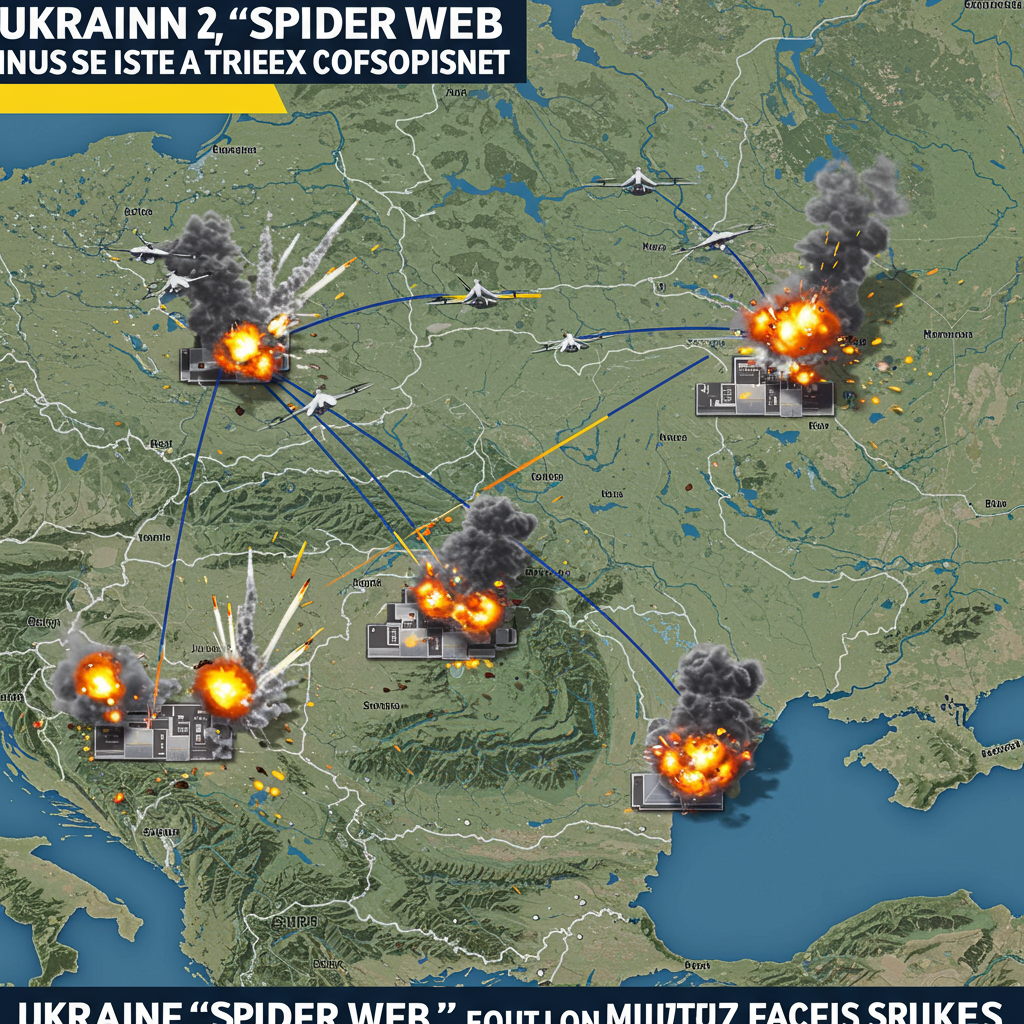
Ukraine’s military forces executed a highly complex and innovative drone operation deep within Russian territory on June 1st, codenamed “Spider Web” (or “Pavutyna”). This daring series of synchronized attacks targeted multiple Russian military air bases situated thousands of kilometers from the Ukrainian border, demonstrating a significant evolution in tactical capabilities.
The “Spider Web” operation derived its name from its widespread reach, striking various locations across vast distances and multiple time zones, from regions near the Arctic Circle all the way to Siberia. Bases in areas including Murmansk, Irkutsk, Ivanovo, Ryazan, and Amur reportedly came under attack.
The Unprecedented “Trojan Truck” Strategy
A key element that allowed Ukraine to bypass Russia’s conventional air defenses was an ingenious method involving smuggling the drones close to their targets. The operation reportedly utilized what has been dubbed the “Trojan Truck” tactic. This involved concealing FPV (First Person View) drones inside custom-built wooden cabins mounted on the back of lorries.
These lorries were then driven across Russia to locations near the targeted airbases, sometimes by individuals reportedly unaware of their true cargo. Once positioned, the cabins’ roofs could be opened remotely, allowing the hidden drones, some equipped with payloads, to be launched from just a few kilometers away from the bases. Verified video footage appears to show drones launching from such vehicles, a method specifically designed to achieve surprise and deny Russian forces adequate time to react with mobile air defenses or electronic jamming. Ukrainian officials stated that over 100 drones, some trained using AI for target recognition, were used in the coordinated strike.
Targets and Impact on Russian Air Power
The primary targets of the “Spider Web” attack were Russia’s strategic bomber fleet and other valuable military aircraft housed at these distant bases. These included critical assets like the nuclear-capable Tu-95, Tu-22M3, and Tu-160 strategic missile-carrying bombers, which Russia frequently uses to launch long-range cruise missile attacks against Ukrainian cities. Valuable A-50 military spy planes were also reportedly among the targets.
Estimates of the damage vary, but assessments based on satellite imagery and expert analysis suggest a significant impact. While Russia acknowledged damaged aircraft only at bases in Murmansk and Irkutsk, Ukrainian claims report over 40 aircraft hit, with several strategic bombers confirmed as destroyed or severely damaged at sites like the Belaya and Olenegorsk air bases. The loss or damage of these specific aircraft types is particularly costly for Russia, as these are older models that are no longer in production and are effectively irreplaceable. Ukraine’s Security Service (SBU) estimated the operation inflicted approximately $7 billion in damage and significantly impacted Russia’s strategic aviation capabilities.
Implications for Modern Warfare
The “Spider Web” operation is seen by many analysts as a significant event highlighting the evolving nature of modern warfare. By leveraging relatively low-cost, commercially available drone technology, combined with sophisticated planning, logistics, and innovative tactics, Ukraine demonstrated the ability to conduct precision strikes deep within an adversary’s territory, bypassing established air defenses.
This operation exemplifies the concept of “precise mass,” where readily accessible technology enables a wider range of actors to pose threats to high-value strategic assets far behind front lines. It underscores Ukraine’s adaptability and technological ingenuity in integrating off-the-shelf systems, potentially utilizing AI for enhanced targeting, and employing unique delivery methods to challenge traditional military power structures and capabilities.
The 18-month planning process and the successful execution and extraction of personnel involved further highlight the complexity and sophistication of this operation, which Ukrainian President Zelensky reportedly supervised directly. While Russia has launched an investigation into the breaches, the operation has significantly boosted Ukrainian morale and is seen as a bold demonstration of capability against Russia’s crucial strategic air force.
References
- https://www.bbc.com/news/articles/cq69qnvj6nlo
- https://www.reuters.com/graphics/UKRAINE-CRISIS/DRONES-RUSSIA/mypmjzayyvr/
- https://www.bbc.co.uk/news/articles/cq69qnvj6nlo
- https://united24media.com/war-in-ukraine/inside-ukraines-ai-drone-strike-that-cost-russia-7-billion-and-a-third-of-its-bombers-8803
- https://www.gpsworld.com/drones-at-war-ukraines-bold-attack-shows-future-warfare-era/