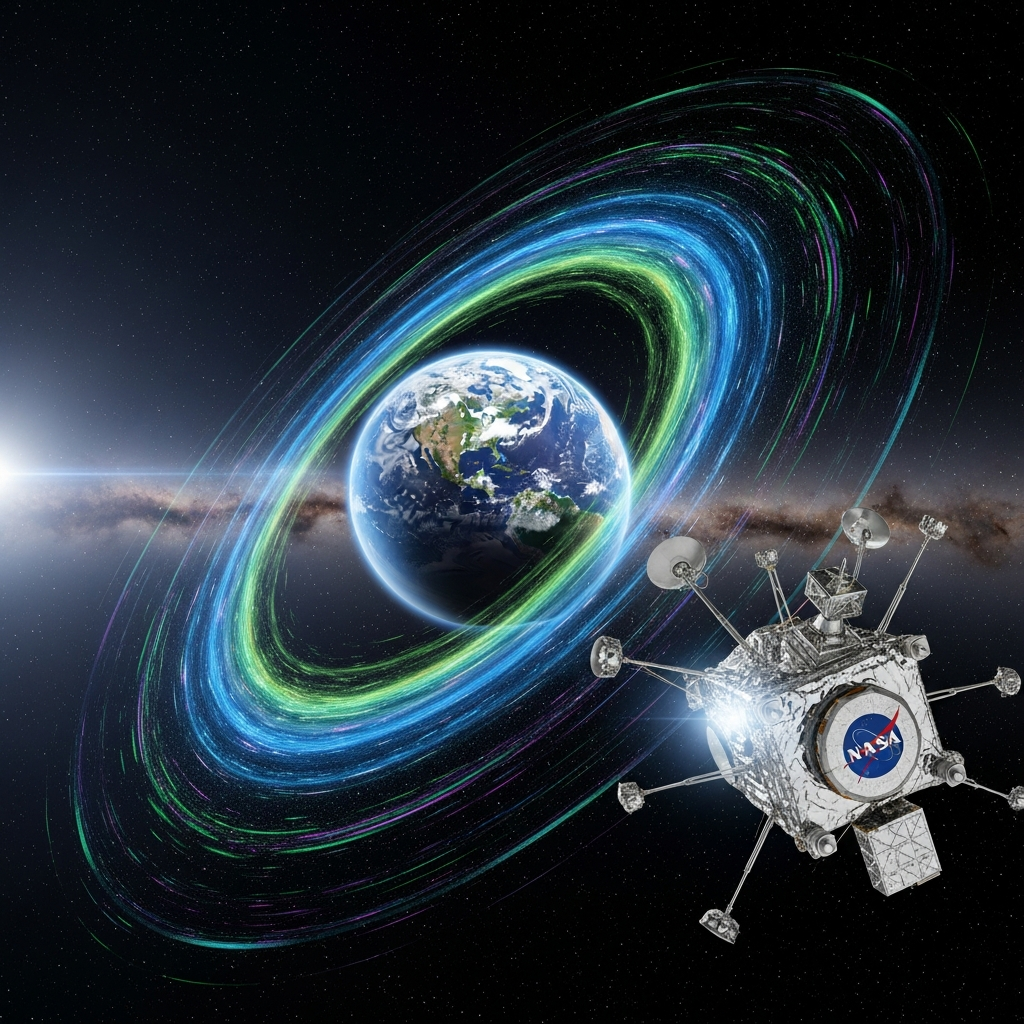
Earth is encircled by a mysterious, doughnut-shaped band of charged particles known as the ring current. This invisible, yet powerful, phenomenon plays a critical role in our planet’s interaction with the space environment, directly influencing space weather and posing potential threats to vital technology. To finally unlock its secrets, NASA and the U.S. Space Force are launching a groundbreaking mission called STORIE. This collaborative effort aims to pinpoint the origin of these elusive particles and understand their profound impact on our modern, satellite-dependent world.
Decoding Earth’s Invisible Shield: The Ring Current Explained
Imagine a vast, ethereal doughnut of electrically charged particles swirling around our planet. This is the ring current. While often overlapping with the outer Van Allen radiation belt, the ring current consists of lower-energy particles. These particles — both positive and negative — flow in opposite directions, creating electrical currents that constantly interact with Earth’s magnetic field. This dynamic interplay makes the ring current a key player in how our planet responds to solar activity.
For decades, scientists have grappled with a fundamental question: where do these mysterious particles come from? Do they originate from the sun, swept in by solar winds and coronal mass ejections, or are they sourced from Earth’s own atmosphere? Understanding this origin story is crucial for predicting and mitigating the effects of space weather. As Alex Glocer, STORIE’s principal investigator at NASA’s Goddard Space Flight Center, explains, “these particles have important space weather impacts.”
STORIE Mission: A High-Stakes Quest for Answers
The NASA mission, aptly named STORIE (Storm Time O+ Ring current Imaging Evolution), is designed to provide unprecedented insights. Its primary goal is to determine the precise source of the charged particles trapped in this cosmic doughnut. A key indicator scientists will be looking for is oxygen. “When you see oxygen, that comes from the atmosphere. You get very little of that from the solar wind,” Glocer confirms. Detecting a significant amount of oxygen would strongly suggest an Earthly origin for many of these particles.
This ambitious mission is a testament to international and inter-agency collaboration. NASA is partnering with the U.S. Space Force, deploying the STORIE instrument as part of the Department of Defense’s (DOD) Space Test Program. This long-running program, active since 1966, has consistently advanced space-based research and development, including vital studies on the effects of space weather on spacecraft materials. Such efforts are essential for designing future spacecraft capable of withstanding the harsh conditions of space.
Launching into Discovery: STORIE’s Journey to the ISS
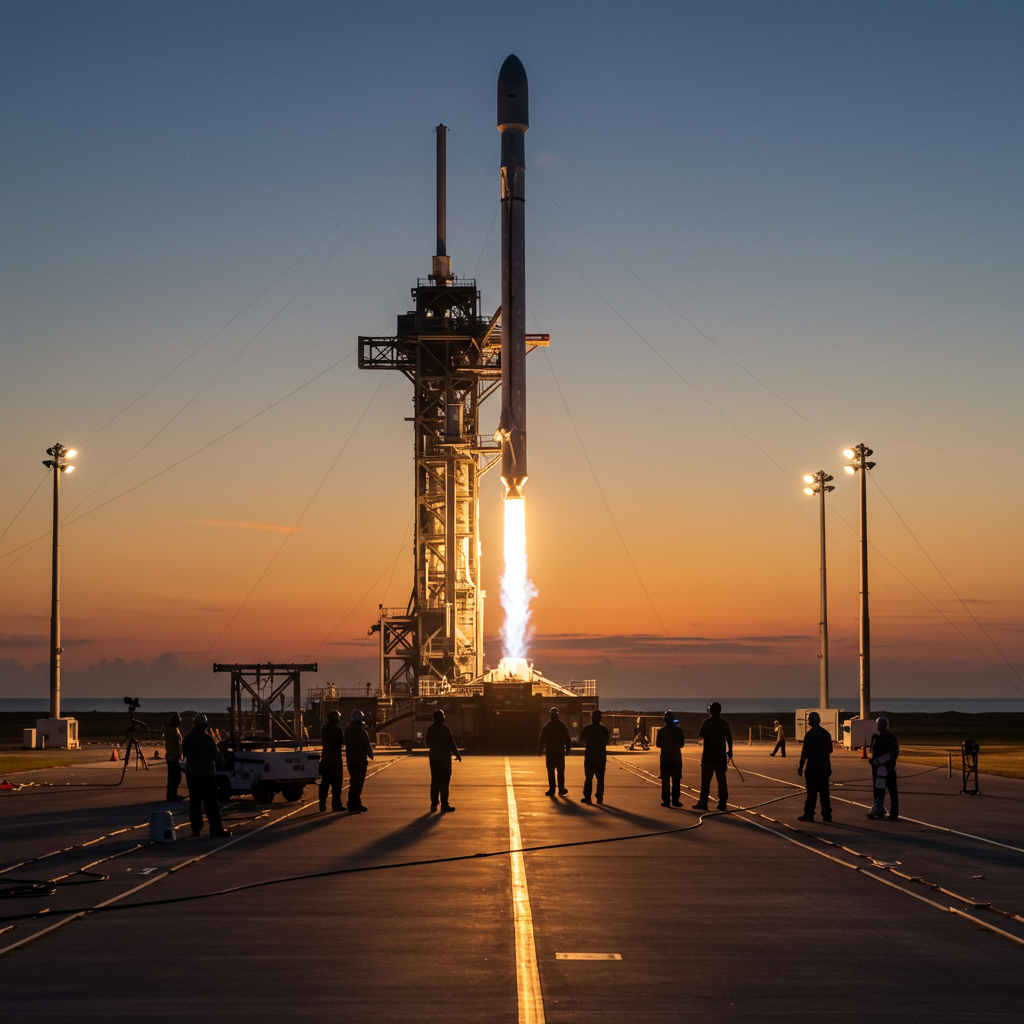
The STORIE instrument is scheduled for launch to the International Space Station (ISS) via a SpaceX Commercial Resupply Services (CRS) mission. This modern method of space transport highlights the sophisticated capabilities of today’s space industry. Just as advanced Earth-observing satellites, like those from BlackSky, can capture stunning, real-time imagery of powerful rockets like SpaceX’s Falcon Heavy during launch, STORIE represents another leap in our ability to observe and understand distant space phenomena. This mission exemplifies the precision and dedication required for complex space operations.
Once aboard the ISS, STORIE will be carefully mounted onto the station’s exterior as part of the Houston 11 (STP-H11) payload. From this unique vantage point, orbiting Earth every 90 minutes, STORIE will gain a comprehensive, all-sided view of the ring current. This persistent observation is a significant upgrade from previous missions, which often had limited viewing angles or provided only brief, localized data.
Tracking the Invisible: How STORIE Operates
STORIE’s innovative approach centers on tracking “energetic neutral atoms” (ENAs). These are charged particles from the ring current that, by “stealing” electrons from Earth’s atmosphere, become electrically neutral. Once neutral, they are no longer influenced by Earth’s magnetic field and can fly off in any direction. By meticulously tracking the speed and direction of these ENAs, particularly focusing on oxygen atoms, STORIE can trace their origin story.
Previous missions, like NASA’s IMAGE and TWINS spacecraft, provided valuable data on ENAs but encountered limitations. They often struggled with blind spots near the ring’s center due to Earth reflections, or at the equator because of viewing angles. Similarly, earlier sounding rocket missions offered only brief glimpses from within the current. STORIE’s continuous, comprehensive perspective from the ISS is set to overcome these challenges, offering an unprecedented look at the ring current’s dynamics.
Beyond Origins: The Far-Reaching Impacts of the Ring Current
Understanding the origin of the ring current particles is just one facet of STORIE’s mission. The instrument will also investigate several other critical aspects:
Solar Storm Response: How the ring current’s flow, size, shape, and electrical intensity warp and change during solar storms. This is particularly relevant as the sun’s 11-year solar cycle approaches its peak.
Infrastructure Threats: The potential effects of the current on Earth-based infrastructure, including pipelines and crucial power lines. Stray electrical currents generated by space weather can induce damaging surges.
- Satellite Lifespan: How energy transfers from the ring current to the upper atmosphere. This heating causes the atmosphere to “puff out,” increasing drag on orbiting satellites and potentially bringing them down sooner than expected. Safeguarding our satellite fleets is a paramount concern.
- www.space.com
- www.space.com
- science.nasa.gov
- www.bbc.com
- www.earth.com
Earth’s Cosmic Connections: A Universe of Mysteries
The quest to understand Earth’s ring current is part of a broader human endeavor to unravel the universe’s many mysteries. From the enigmatic forces of black holes, which scientists detect by observing their gravitational influence, to the peculiar “Diamond Ring” nebula that reveals how massive stars reshape their environments, our cosmos is full of hidden wonders. Even the Ring Nebula, a familiar celestial object, recently surprised astronomers with the discovery of a “bar-shaped cloud of ionized iron atoms,” hinting at the destruction of a planet. These ongoing discoveries underscore the dynamic and often unexpected nature of space.
Studying Earth’s ring current helps us understand our place within this vast, active universe. Just as scientists piece together the life cycles of stars or the evolution of cosmic bubbles, STORIE will contribute a crucial chapter to our understanding of Earth’s immediate space environment. The insights gained will not only deepen scientific knowledge but also provide tangible benefits for life on Earth.
The Urgency of Space Weather Research
Our increasingly interconnected world relies heavily on technology vulnerable to space weather. Solar activity, including solar flares and coronal mass ejections, can generate powerful geomagnetic storms. These storms can disrupt radio communications, interfere with GPS signals, and even damage power grids. Agencies like NOAA (National Oceanic and Atmospheric Administration) continuously monitor space weather, but accurate predictions depend on a deeper understanding of phenomena like the ring current. STORIE’s findings will be instrumental in improving these predictions, allowing for better protection of our critical infrastructure and space assets.
Frequently Asked Questions
What is Earth’s ring current and why is it important?
Earth’s ring current is a doughnut-shaped band of charged particles that encircles our planet. It plays a vital role in space weather, influencing how Earth responds to solar storms and affecting our technology. Understanding its dynamics is crucial because fluctuations in the ring current can damage satellites, disrupt power grids, and impact communications systems, making it a key area of study for protecting modern infrastructure.
How will the STORIE mission collect data on the ring current?
The STORIE mission will track “energetic neutral atoms” (ENAs) from its vantage point on the International Space Station (ISS). These are charged particles from the ring current that become neutral and escape Earth’s magnetic field. By meticulously measuring the speed and direction of these ENAs, particularly focusing on oxygen atoms, STORIE will determine their origin (from the sun or Earth) and how the ring current behaves during solar storms.
What are the real-world impacts of ring current fluctuations?
Fluctuations in the ring current have significant real-world impacts. Intense ring current activity can heat and expand Earth’s upper atmosphere, increasing drag on orbiting satellites and potentially shortening their lifespan. It can also induce damaging electrical currents in ground infrastructure, affecting pipelines and power lines, leading to outages or equipment damage. Improved understanding from STORIE will lead to better space weather predictions and mitigation strategies, safeguarding our technological reliance.
Protecting Our Future in Space
The NASA STORIE mission represents a vital step forward in humanity’s quest to understand and navigate the complex space environment. By unraveling the mysteries of Earth’s ring current, scientists aim to enhance our ability to predict space weather, safeguard critical satellites, and protect terrestrial infrastructure from the powerful forces emanating from our dynamic sun. This mission underscores a collective commitment to securing our technological future and deepening our scientific understanding of the cosmic dance between Earth and its star.