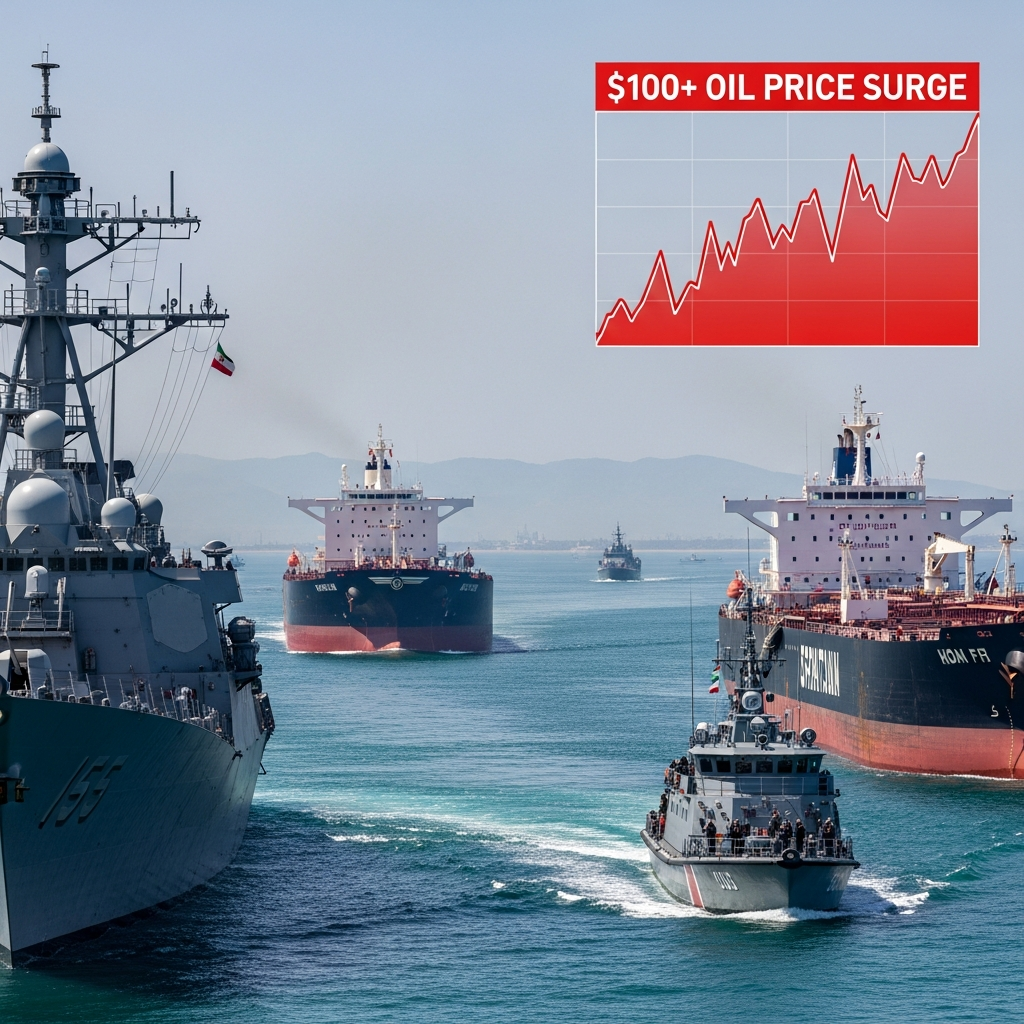
Global oil prices experienced a sharp rise on Friday following a significant military exchange between US and Iranian forces in the critical Strait of Hormuz. This sudden escalation immediately triggered fresh concerns about the security of vital energy shipments through one of the world’s most important maritime trade routes. Traders reacted swiftly, sending benchmark Brent crude above $100 a barrel as geopolitical risk premiums surged across the global energy market. This incident underscores the extreme fragility of the US-Iran ceasefire and highlights the ongoing volatility that defines the region.
The Hormuz Incident: A Flashpoint Reignites Tensions
Reports from Friday confirmed an exchange of fire between US and Iranian forces in the narrow Strait of Hormuz. The US military stated it intercepted “unprovoked Iranian attacks,” which included missiles, drones, and small boats. These intercepts led to “self-defense strikes” by US naval assets as they transited out of the Gulf. Three US Navy guided-missile destroyers—the USS Truxtun, USS Rafael Peralta, and USS Mason—were involved in the incident. US Central Command (CENTCOM) asserted that no American vessels were struck and denied seeking escalation. President Donald Trump later described the US actions as “just a love tap” and a “minor punishment.”
Conversely, Iran’s military offered a different narrative. Iranian state media, Islamic Republic of Iran Broadcasting, accused the US of violating an existing ceasefire by targeting its vessels, including an oil tanker, near the Strait of Hormuz. Iran reported “aerial attacks” along its coastline. Iranian forces allegedly retaliated, claiming to have inflicted “significant damage” on US military vessels. Despite these conflicting accounts, Iranian state media later confirmed that the situation had returned to normal.
Oil Markets React: Prices Surge Amid Lingering Uncertainty
The immediate consequence of the Hormuz clash was a noticeable jump in oil prices. On Friday morning, the global oil benchmark Brent crude climbed by 1.5% to $101.60 a barrel, easing slightly from an earlier 2% gain. US-traded West Texas Intermediate (WTI) also rose by 1.1% to $95.87. The July Brent contract on the Intercontinental Exchange increased by 1.52% to $101.58, while the June WTI contract on NYMEX climbed by 1.95% to $96.66 a barrel.
This swift market reaction reflects deep-seated concerns among traders. Associate professor Jiajia Yang from James Cook University highlighted that military actions along the Strait of Hormuz could severely imperil global energy shipments. Huifeng Chang, an economics researcher at the National University of Singapore, noted that traders perceive the existing US-Iran ceasefire as highly “fragile.” This perception prompted their decisive reaction, even as both the US and Iran attempted to downplay the tensions. The incident forced market participants to recalibrate the geopolitical risk premium embedded in crude oil prices, particularly concerning the Middle East.
The Strategic Importance of the Strait of Hormuz
The Strait of Hormuz is not merely a waterway; it is a critical global choke point with immense strategic and economic significance. Situated between Iran and Oman, this narrow channel connects the Persian Gulf to the Arabian Sea and beyond. More than one-fifth of the world’s total oil consumption, along with a substantial portion of its natural gas shipments, typically passes through this maritime route.
Any disruption or perceived threat to shipping in the Strait of Hormuz sends immediate shockwaves through the global energy market. Nations worldwide rely on this conduit for their energy supplies, making its security paramount. Historically, even minor incidents or threats of closure have led to significant surges in oil prices, demonstrating its pivotal role in global energy stability. The latest exchange of fire served as a stark reminder of this vulnerability, underscoring why traders respond so acutely to regional instability.
Behind the Tensions: A Fragile Truce and Nuclear Ambitions
The latest military confrontation occurred despite President Trump’s indefinite extension of a US-Iran ceasefire on April 21st. This truce, initially announced on April 7th, was intended to facilitate peace talks between the two nations. Trump confirmed that negotiations are ongoing, but reiterated Washington’s non-negotiable demand that Tehran must never possess a nuclear weapon.
Trump issued a stern warning, stating that if a deal isn’t signed, Iran would face “a lot of pain,” expressing his belief that Iran desires an agreement more than the US. He also made more assertive remarks, suggesting that failure to sign a deal “FAST” could lead to “a lot harder, and a lot more violently” strikes in the future. These statements further fueled market anxiety, directly influencing oil prices. The broader US-Iran conflict, which began on February 28th with US and Israeli attacks on Iran, has already seen energy prices surge due to Iran’s prior threats to attack ships in retaliation.
Global Ripple Effects: Beyond the Barrel
The implications of renewed US-Iran tensions extend far beyond oil prices. Global currency markets have become highly volatile, pushing investors towards traditional safe-haven assets. The US dollar has strengthened significantly, seen as a reliable haven amidst growing uncertainty. Conversely, currencies tied to energy imports, emerging markets, or global trade often weaken due to fears of inflation and slower economic growth. The Japanese yen and European currencies have also experienced pressure due to market volatility and reliance on imported energy.
For major energy importers like India, the situation carries significant economic risks. India imports nearly 90% of its crude oil requirements. A sustained increase in global oil prices could substantially widen India’s trade deficit and exert considerable strain on public finances. Industry estimates suggest that a mere $1 per barrel increase in crude prices escalates India’s import bill by approximately ₹16,000 crore annually, translating into higher costs for LPG and other fuels for consumers. Furthermore, global stock markets are exhibiting increased volatility, with energy and defense sectors sometimes benefiting, while others face uncertainty.
What This Means for the Future of Energy Stability
The recent flare-up near the Strait of Hormuz paints a clear picture of persistent instability in the global energy market. Experts from the International Energy Agency (IEA) have warned that the world is entering a highly volatile phase for energy. Brent crude prices are projected to fluctuate significantly, potentially trading within a range of $96 to $102 per barrel as uncertainty prevails.
As long as genuine and lasting security expectations for the Strait of Hormuz are not definitively re-established, a significant and sustained decline in oil prices will be difficult to achieve. The erratic progress of negotiations between the US and Iran suggests continued volatility above the $100 threshold for Brent crude. Should the geopolitical situation further deteriorate, it could provide substantial and sustained support for oil prices, potentially driving them to new highs. This ongoing tension also complicates decisions for central banks worldwide, as they grapple with managing inflation fueled by elevated energy costs versus potential dampening effects on global economic activity.
Frequently Asked Questions
What caused the recent surge in global oil prices?
Global oil prices surged following a military exchange between US and Iranian forces in the Strait of Hormuz. This critical waterway is essential for global energy shipments. The incident created immediate fears of supply disruptions and increased geopolitical risk, prompting traders to drive up crude oil prices. Both Brent and WTI benchmarks saw significant gains, with Brent climbing over 1.5% to $101.60 a barrel.
How strategically important is the Strait of Hormuz for global energy markets?
The Strait of Hormuz is exceptionally strategic as it is the world’s most vital oil transit choke point. Over one-fifth of the world’s oil and a significant portion of its natural gas shipments pass through this narrow passage daily. Any military action or threat to shipping in the Strait directly jeopardizes global energy supplies, causing immediate and substantial reactions in oil prices and broader financial markets, as evidenced by the recent surge.
What are the potential broader economic impacts of continued US-Iran tensions?
Beyond oil prices, continued US-Iran tensions can have widespread economic consequences. Currency markets become volatile, strengthening safe-haven assets like the US dollar while pressuring currencies reliant on energy imports. Global inflation could rise due to higher energy costs, impacting consumer spending and manufacturing. Countries like India, which import a vast majority of their crude, face significant economic strain, including widened trade deficits and increased fuel costs. Stock markets also experience heightened volatility due to the geopolitical uncertainty.
Conclusion
The recent military exchange in the Strait of Hormuz serves as a potent reminder of the inherent instability plaguing the global energy market. While both the US and Iran have reportedly sought to de-escalate, the underlying US-Iran tensions remain a formidable factor influencing oil prices and broader economic stability. The strategic importance of the Strait ensures that any future developments in the region will be closely watched by traders, policymakers, and consumers alike. As negotiations continue and geopolitical dynamics evolve, sustained volatility in crude oil markets appears to be the prevailing outlook. Stakeholders must remain vigilant, monitoring events closely to anticipate potential shifts in the fragile balance of global energy supply and demand.