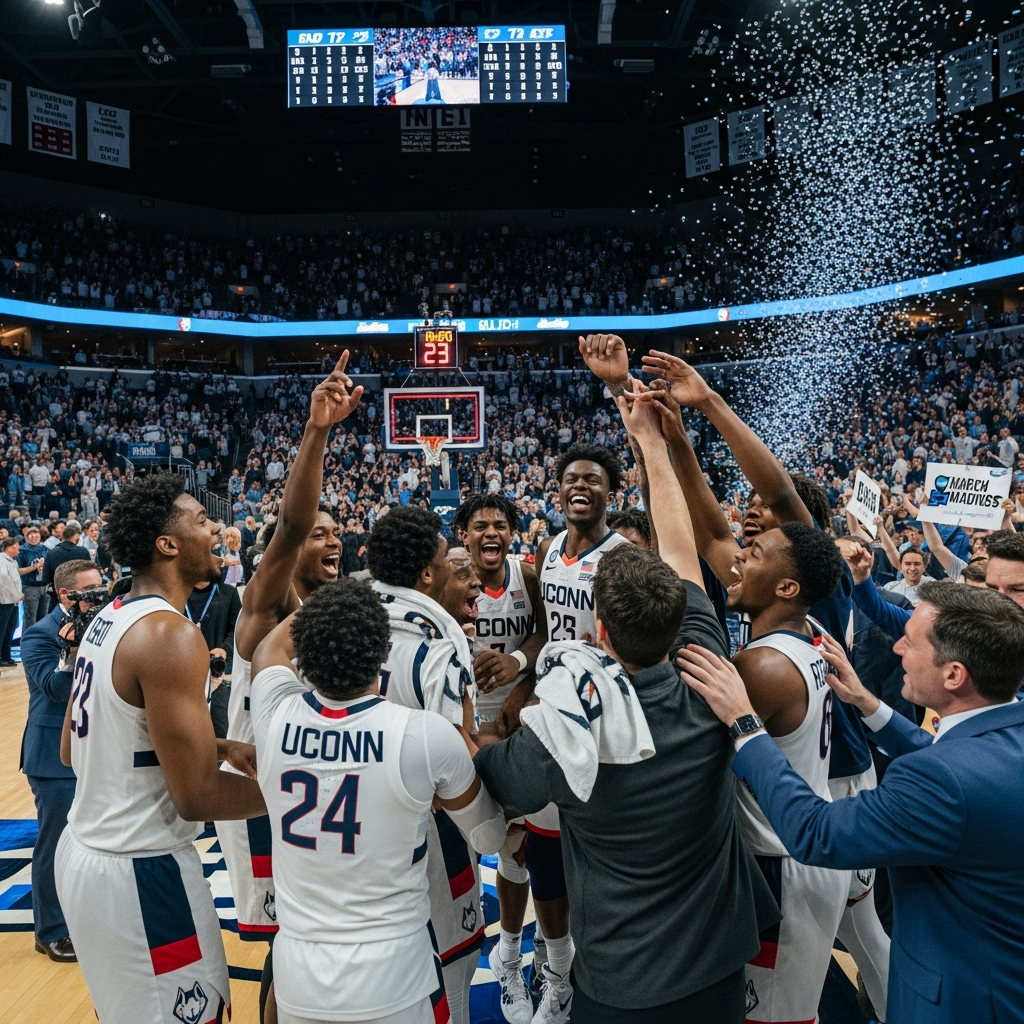
March Madness consistently delivers captivating stories, but the Elite Eight clash on March 29, 2026, delivered a jaw-dropping spectacle for college basketball fans. The UConn Huskies, facing a colossal deficit against the top-seeded Duke Blue Devils, engineered one of the most stunning comebacks in recent memory. This unforgettable contest, ending in a dramatic 73-72 victory, not only propelled UConn into the Final Four alongside Arizona, Michigan, and Illinois but also etched its name into the annals of sporting legends. Prepare to relive every heart-stopping moment of a true March miracle.
Duke’s Dominance: A Game Seemingly Decided Early
For much of the Elite Eight showdown, the atmosphere suggested a straightforward progression for Duke. The Blue Devils, widely considered the tournament’s top overall seed, appeared destined for a comfortable victory over UConn. From the outset, Duke asserted its authority, establishing a commanding 19-point lead at one stage. By halftime, their advantage remained significant, holding a 15-point cushion over the Huskies.
Even as the clock dwindled in the second half, Duke maintained control. With just five minutes left in regulation, the Blue Devils still held a comfortable 9-point lead. The narrative seemed written: Duke would cruise, and UConn’s impressive season would conclude just shy of the Final Four. Few in the arena, or watching from home, anticipated the seismic shift about to unfold.
Dan Hurley’s Call: Swinging for the Fences
UConn’s remarkable resilience isn’t born from underdog status. This is a program with a championship pedigree, boasting back-to-back national titles in 2023 and 2024. That deep well of experience, combined with the strategic brilliance of coach Dan Hurley, proved pivotal when faced with such a daunting deficit. At halftime, with his team down by 15, Hurley delivered a potent message that resonated deeply with his players.
UConn center Tarris Reed Jr. later recalled the essence of Hurley’s locker-room address: “At halftime, coach said, we’ve got to swing for the fences. We’ve got to give it all we’ve got.” This wasn’t a call for wild abandon but a directive to play aggressively, take calculated risks, and unleash every ounce of their talent and determination. The Huskies emerged from the locker room with a renewed sense of purpose, ready to chip away at Duke’s lead, one possession at a time.
The Relentless Pursuit: Chipping Away at the Blue Devils
As the second half progressed, UConn’s offensive rhythm began to click. Their three-pointers, which had been elusive earlier in the game, started to find the bottom of the net, breathing life into their comeback bid. Each basket, each defensive stop, chipped away at Duke’s lead, fueling the Huskies’ belief. The atmosphere in the arena transformed from resignation to fervent hope as the margin steadily decreased.
With only ten seconds remaining on the clock, UConn had managed to claw their way back to within two points. The ball was inbounded to Duke, and the pressure was immense. The Huskies deployed a full-court press, an aggressive defensive gamble designed to force a mistake. What happened next would become the defining moment of the game, a testament to quick thinking and incredible execution under extreme duress.
The Final Seconds: A Buzzer-Beater for the Ages
Under the suffocating full-court pressure, Duke’s freshman guard, Cayden Boozer, attempted a lob pass to an open teammate. In a heart-stopping sequence, a UConn defender, perfectly anticipating the play, deflected the pass, securing a crucial steal. The clock was ticking away, and the Huskies had mere seconds to orchestrate a game-winning shot.
UConn’s Alex Karaban quickly gathered the loose ball and, without hesitation, passed it to freshman Braylon Mullins. Mullins, who had not made a single three-pointer all game, found himself with the ball 35 feet from the basket. With less than a second left, he launched a desperate, arcing shot. The ball swished through the net, defying all odds. UConn had taken the lead with virtually no time remaining, completing an improbable one-point victory. Mullins’ raw elation captured the moment perfectly: “Just happy to see that [expletive] go in. Man, I’m so happy.”
Adding to the storybook quality, Mullins, an Indiana native, hit the shot that sent the Huskies to the Final Four, which coincidentally was being held that year in Indianapolis, his home city.
“March Magic” Personified: Hurley’s Gut Instinct
One of the most remarkable coaching decisions of the game came after UConn’s steal in the final seconds. With about five seconds remaining, coach Dan Hurley had the option to call a timeout, drawing up a precise play for his team. Many coaches would have, opting for control in such a high-stakes situation. Yet, Hurley chose to let his players improvise.
“It’s gut instinct,” Hurley explained later. “It just felt like the window where you’ve just got to let March Madness take over, March Magic.” This decision to trust his players’ instincts echoes the improvisational brilliance seen in other sports, such as the split-second, pre-snap adjustments made by future Hall of Fame quarterbacks like Aaron Rodgers. In a pivotal NFL game, Rodgers famously changed a play’s instruction at the line of scrimmage, guiding Kenneth Gainwell to an improbable “miracle touchdown” against the Lions. Just like Rodgers’ on-field genius, Hurley’s “gut instinct” allowed the spontaneous brilliance of his players to shine, leading to one of the most memorable finishes in tournament history.
Heartbreak for the Blue Devils: A Star’s Bittersweet Exit
For Duke, the loss was a gut-wrenching end to a promising season. Freshman phenom Cameron Boozer, widely regarded as a top NBA Draft prospect, played what was likely his final collegiate game without the national championship title he coveted. This experience, unfortunately, mirrors that of several other high-profile Duke one-and-done players from the past decade, including Jayson Tatum, Zion Williamson, and Paolo Banchero, none of whom captured a national title during their single season in Durham.
Cameron Boozer, the son of NBA great Carlos Boozer, had an exceptional season, averaging approximately 23 points, 10 rebounds, and 4 assists per game. In the Elite Eight game against UConn, he led all scorers with an impressive 27 points. In a cruel twist of fate, it was his twin brother, Cayden Boozer, who committed the critical late turnover that sealed Duke’s defeat. While acknowledging the turnover, Duke coach Jon Scheyer emphasized that the loss was a collective failure to close out the game, stating, “There’s not a person in this room, including me, that doesn’t replay everything that you could do and how you can help. End of the day, we’ve got to finish it off.”
Echoes of Sporting Immortality: Other Unforgettable Comebacks
UConn’s March Madness comeback wasn’t just a great game; it resonated with the spirit of other “miracles” in sports history, proving that belief and resilience can conquer seemingly insurmountable odds. In cricket, the 2001 Test match at Eden Gardens saw India, forced to follow on, stage an epic comeback against Australia. VVS Laxman and Rahul Dravid built a legendary partnership, turning an inevitable defeat into a stunning victory, a testament to “belief, patience and resilience.”
Similarly, the “Miracle on Ice” at the 1980 Winter Olympics, where the underdog U.S. men’s hockey team defeated the seemingly invincible Soviet Union, remains a benchmark for sporting upsets. Decades later, the U.S. men’s hockey team again struck gold at the Milan Cortina 2026 Winter Olympics, with Jack Hughes scoring the overtime winner against Canada, evoking the same spirit of “American hockey” grit.
Perhaps the most poignant parallel to March Madness itself comes from the 2008 SEC Men’s College Basketball Tournament. A last-second, improbable three-pointer by Mykal Riley for Alabama forced overtime against Mississippi State. This “Shot That Saved Lives,” as Sports Illustrated dubbed it, kept nearly 15,000 fans inside the Georgia Dome just as a deadly F2 tornado struck the building, presenting a powerful case for divine intervention in the unpredictable theatre of sports. These stories, from cricket pitches to Olympic rinks to college basketball courts, underscore a universal truth: in sports, and in life, comebacks are always possible, and sometimes, magic truly happens.
The Road Ahead: Final Four Bound
For the UConn Huskies, this incredible Elite Eight victory means their journey continues to the highly anticipated Final Four in Indianapolis. With renewed confidence and the momentum of an unforgettable comeback, they now face the challenge of competing for yet another national championship. Their dramatic win against Duke will undoubtedly serve as a powerful source of inspiration as they prepare for the ultimate test in college basketball.
Frequently Asked Questions
What was the final score of the UConn vs. Duke Elite Eight game?
The UConn Huskies defeated the Duke Blue Devils with a final score of 73-72. This dramatic one-point victory occurred on March 29, 2026, propelling UConn into the Final Four after overcoming a significant deficit against the tournament’s top overall seed. The game is remembered as one of the most incredible comebacks in March Madness history.
Who hit the game-winning shot for UConn against Duke?
The game-winning shot was made by UConn freshman Braylon Mullins. With less than a second remaining on the clock and the Huskies trailing by one point, Mullins launched a 35-foot shot that swished through the net, securing the dramatic 73-72 victory. This shot became instantly iconic in the annals of March Madness lore.
How did Coach Dan Hurley influence UConn’s epic comeback?
Coach Dan Hurley played a crucial role by motivating his team at halftime with a message to “swing for the fences” when they were down by 15 points. In a key decision during the final seconds, after a steal, Hurley chose not to call a timeout, allowing his players to act on “gut instinct” and “March Magic,” which directly led to Braylon Mullins’ game-winning shot. This demonstrated immense trust in his championship-experienced team.