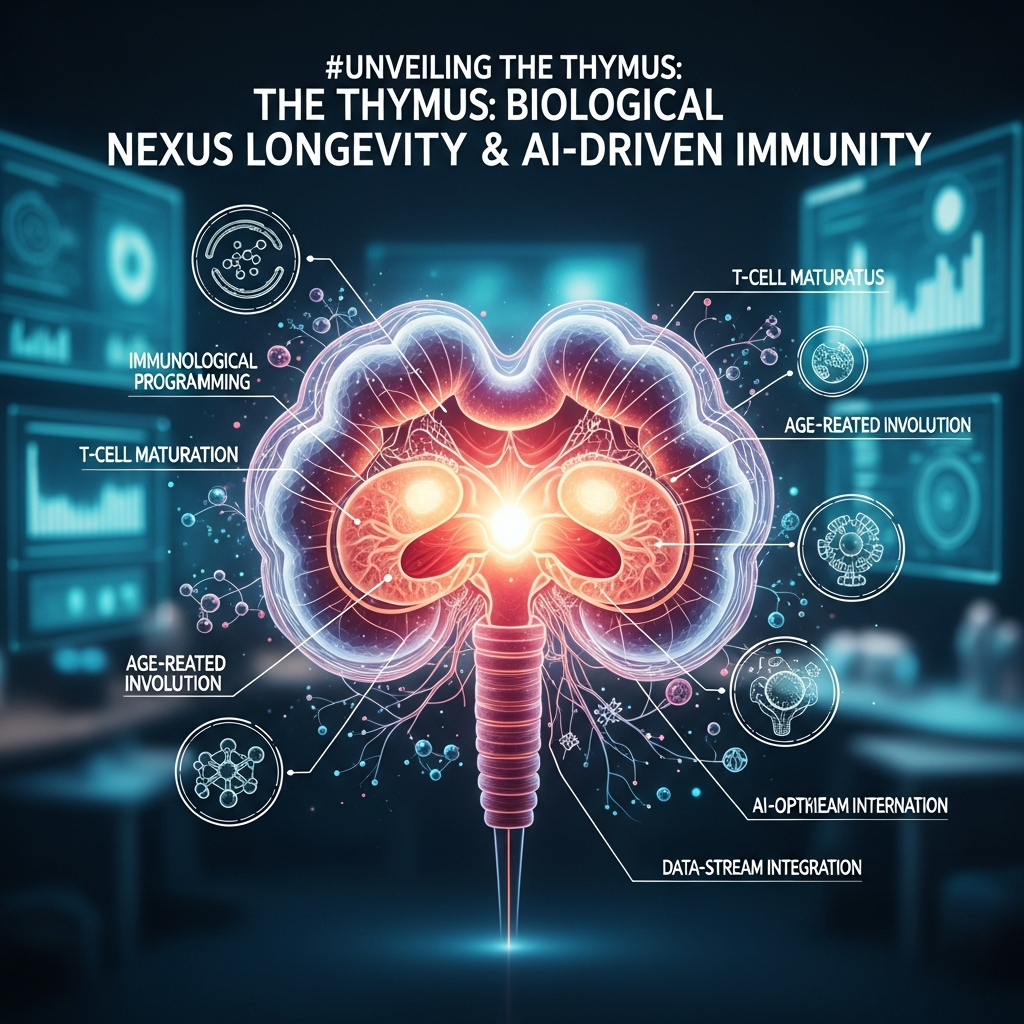
Imagine a hidden master gland in your chest, silently overseeing your immune defenses and, surprisingly, profoundly impacting how long you live a healthy life. For decades, the thymus gland has been largely overlooked, shrinking with age and presumed to lose its significance. However, groundbreaking recent research, powered by cutting-edge Artificial Intelligence, is now revealing the true, critical role of thymus health in determining our overall healthspan and resilience against disease. This isn’t just about living longer; it’s about optimizing your body’s innate ability to fight illness and thrive as you age.
The Thymus: Your Body’s Immune HQ
Nestled behind your sternum, the thymus gland is far more than a forgotten childhood organ. It’s the essential “training ground” for T cells, a crucial type of white blood cell that forms the backbone of your adaptive immune system. These “T” cells earn their name from the thymus, where they mature, differentiate, and learn to distinguish between your body’s own healthy cells (“self”) and dangerous invaders (“non-self”) like viruses, bacteria, and cancer cells. Without a robust thymus, your immune system’s ability to mount a precise, targeted defense is severely compromised.
The Silent Guardian of Your Immunity
As we age, a process called involution causes the thymus to gradually shrink, transforming its spongy, active tissue into fatty deposits. This decline in functionality leads to a decrease in new, “naïve” T cells, leaving us with an older, less diverse pool of “memory” T cells. This age-related weakening, known as immunosenescence, contributes significantly to our vulnerability to infections, chronic diseases, and even cancer. However, the extent and timing of this thymic decline vary dramatically among individuals, making its assessment a complex challenge – until now.
AI Unlocks the Thymus’s Secrets: A New Era of Immune Assessment
Two landmark papers published in Nature have revolutionized our understanding of thymus health. Researchers leveraged advanced Artificial Intelligence to quantify thymus health from medical scans, providing an unprecedented, objective measure. This wasn’t a simple task, given the thymus’s variable anatomy and location.
The Precision of AI in Thymus Quantification
The innovative AI pipeline involved two sophisticated stages. First, a 3D U-Net model, trained by expert radiologists on thousands of CT scans, achieved an astonishing 99.8% accuracy in localizing and segmenting the thymic bed. This crucial step allowed the AI to precisely identify the gland despite its anatomical variations. The second stage developed a “thymic health score,” ranging from 0 to 100, using a self-supervised foundation model. This advanced AI, unlike subjective radiology scores, generated a holistic, high-dimensional representation of the thymus, proving significantly more accurate and comprehensive in its assessment.
Beyond Traditional Methods: Why AI Matters
This AI breakthrough provides a level of detail and objectivity previously unimaginable. Traditional methods for assessing thymic health were often subjective and limited, making it difficult to track changes or correlate them with long-term health outcomes. The AI’s ability to process vast numbers of complex CT scans rapidly—thousands in mere hours—means that, for the first time, we have a reliable, scalable tool to quantify thymus health and explore its links to a wide array of clinical outcomes. This deep learning approach, with its explainability features, confirmed the AI’s focused analysis on the thymic bed, uninfluenced by surrounding tissues, cementing its reliability.
The Profound Link: Thymus Health and Your Longevity
With the ability to accurately measure thymus health, researchers analyzed data from over 27,000 participants in the National Lung Screening Trial (NLST) and the Framingham Heart Study (FHS), with over 12 years of follow-up. The findings were nothing short of remarkable, drawing a clear line between a healthy thymus and a longer, healthier life.
Reducing Mortality and Disease Risk
The studies consistently showed that individuals with higher thymic health scores experienced a significant reduction in all-cause mortality. This benefit extended to specific causes of death, including cardiovascular, digestive, and pulmonary diseases. For instance, the aggregate risk for cardiovascular mortality was reduced by nearly half (hazard ratio 0.53) in those with higher scores. Beyond mortality, better thymus health was linked to favorable metabolic markers like higher HDL cholesterol, lower triglycerides, better blood glucose levels, and healthier blood pressure. Conversely, lower scores correlated with increased age, higher BMI, male sex, smoking, and elevated inflammatory biomarkers such as C-reactive protein.
The Thymus in Cancer Immunity
The impact of thymus health on cancer outcomes was particularly striking. A high thymic health score was associated with a 36% reduced incidence of lung cancer. In patients undergoing cancer immunotherapy, those with healthier thymuses showed improved progression-free survival for various cancers, including non-small cell lung cancer, melanoma, breast, and kidney cancer, demonstrating a 44% lower risk of progression. Intriguingly, the thymus health score proved to be an independent prognostic marker, outperforming traditional metrics like PD-L1 and tumor mutation burden, and directly correlating with adaptive immune function before treatment.
The Stark Reality of Thymus Removal
Further reinforcing the thymus’s vital role, a critical 2023 study examined patients who underwent thymus removal during cardiothoracic surgery. Compared to matched controls, those without a thymus faced a 2.9-fold higher risk of all-cause mortality, double the incidence of cancer, and a 1.5-fold increase in both cancer mortality and autoimmune diseases. This dramatic evidence underscores the profound, lifelong consequences of impaired thymic function on overall health and immune resilience.
Strategies for Thymus Rejuvenation and Supporting Immune Health
The exciting news is that thymus involution isn’t necessarily an irreversible one-way street. Preclinical studies and emerging human trials suggest various pathways and factors that can potentially promote thymus rejuvenation and support its function, even in later years.
Lifestyle Factors: The Foundation of Thymic Wellness
Thymus involution is largely driven by the loss of thymic epithelial cells (TECs) and the infiltration of pro-inflammatory thymic adipocytes. Systemic inflammation, often dubbed “inflammaging,” resulting from factors like smoking, obesity, and chronic stress, actively promotes this decline. This highlights the foundational role of lifestyle. Emerging research from the National Institutes of Health (NIH) indicates that moderate calorie restriction can rejuvenate the thymus in humans, leading to increased T cell production and reduced fat content. This benefit is mediated, in part, by the inhibition of the Pla2g7 gene, a promising target for future therapies mimicking CR’s effects without strict dieting. Lifestyle Plus factors, including mitigating environmental toxins, addressing social isolation, and prioritizing sleep, also contribute significantly to reducing systemic inflammation and fostering immune resilience.
Promising Research Pathways and Clinical Trials
Researchers are actively exploring multiple avenues for thymus rejuvenation:
Hormonal Interventions: Small human studies, such as the TRIIM (Thymus Regeneration, Immunorestoration, and Insulin Mitigation) trial, have investigated a combination of growth hormone, DHEA, and metformin. This cocktail has shown potential to slow epigenetic aging, improve thymus mass and function, and even lead to a reduction in cancer-risk metrics. Growth hormone alone can regenerate thymic tissue, and DHEA helps counteract its diabetogenic effects, with metformin adding further anti-aging benefits.
Targeting Growth Factors: FGF21 (fibroblast growth factor 21), produced by the thymus, appears to control involution. Increased thymic FGF21 in aged mice led to more CD8 T cells, extended healthspan, and improved physical performance. Other factors like Hepatocyte Growth Factor (HGF) from the liver, and midkine, a growth factor identified in the regenerative axolotl salamander, also show promise in restoring TEC function and promoting thymus regrowth.
- Key Molecular Pathways: FOXN1, a master transcription factor, has historically been linked to TEC function and thymus regeneration in mice. More recently, RANK and RANKL (receptor activator of nuclear factor κB and its ligand) have been confirmed as critical regulators of medullary TECs, showing benefits in restoring function and promoting T cell development in aged mice and human cell cultures.
- erictopol.substack.com
- longevity.technology
- erictopol.substack.com
- nextbigideaclub.com
- www.nih.gov
The Liver-Thymus Axis and Growth Factors
The interplay between organs, particularly the liver and thymus, is also a key focus. An experimental mRNA vaccine delivered to the liver, encoding a combination of DLL1, IL-7, and FLT3-L, has been shown to transiently enhance immune function in aged mice by supporting thymopoiesis (the process of T cell development). These insights underscore the complex, systemic nature of immune aging and the potential for multi-target interventions.
The Future of Immune Assessment: Your Personalized Immunome
The convergence of AI, advanced diagnostics, and regenerative biology heralds a new era for understanding and managing our immune health. We’ve long lacked a comprehensive clinical test to assess a patient’s immune status – what some call an “immunome.” The ability to derive a thymic health score from routine CT scans represents a significant step towards this goal.
From Chest Scans to Health Insights
With millions of chest CT scans performed annually, opportunistically integrating AI-derived thymic health scores could become a routine part of medical interpretation. This simple addition could provide invaluable insights into an individual’s adaptive immune system and overall healthspan. Such a score could guide personalized cancer immunotherapies, identifying patients who might benefit from more intensive treatments, or pinpoint individuals at increased risk for age-related conditions like cancer, cardiovascular disease, and neurodegenerative disorders, years before symptoms appear. This data, combined with other “biological clocks” (epigenetic, proteomic organ clocks) and genetic information, allows for unprecedented, precise risk forecasting and truly personalized preventive strategies.
Balancing Promise with Practicality and Risk
While the promise of thymus rejuvenation is immense, it’s crucial to proceed with caution. Interventions that promote cell proliferation, such as some growth factors, carry potential risks, including inducing autoimmunity or increasing the risk of cancer. Careful clinical trials are essential to define the benefit-to-risk tradeoffs for any rejuvenation strategy. The goal is to safely maintain or restore a high thymic health score, providing a robust reservoir of naïve T cells and supporting a vibrant immune system throughout life.
Frequently Asked Questions
What is the thymus gland, and why is its health so important for my longevity?
The thymus gland is a vital immune organ located in your chest that produces and matures T cells, which are critical components of your adaptive immune system. These T cells learn to recognize and fight off infections, cancer cells, and other threats. As you age, the thymus typically shrinks (involution), reducing the production of new T cells and weakening your immune system. Recent AI-driven research has now definitively linked higher thymic health scores to significantly reduced risks of all-cause mortality, cardiovascular disease, cancer, and autoimmune conditions, underscoring its profound importance for a longer, healthier life.
How is thymus health measured by AI, and can I get my thymic health score?
Thymus health is now precisely measured using a two-stage AI pipeline applied to standard chest CT scans. The AI first accurately locates and segments the thymus, then calculates a “thymic health score” (0-100) based on its composition and density. This advanced method is far more objective and accurate than previous subjective assessments. While this technology is currently a research tool, there’s a strong push for its integration into routine clinical practice, potentially allowing millions of people to receive an opportunistic thymic health score from existing CT scans in the future.
What are some practical ways to promote or support a healthy thymus gland as I age?
While direct thymus rejuvenation is still largely experimental, several strategies can support its health. Lifestyle factors are foundational: reducing systemic inflammation through a balanced diet, regular exercise, stress management, and avoiding smoking. Moderate calorie restriction has shown promise in human trials for improving thymus size and function. Additionally, research is exploring specific growth factors and molecular pathways, and small human trials like TRIIM suggest that a combination of growth hormone, DHEA, and metformin could be beneficial. Consult your healthcare provider for personalized advice on lifestyle changes and to discuss any emerging clinical interventions.
Conclusion: A New Horizon for Healthspan
The evidence is clear: the thymus gland is not merely a relic of youth but a critical, lifelong regulator of our healthspan. The revolutionary ability to quantify thymus health with AI, combined with exciting advancements in regenerative biology, marks a new frontier in personalized medicine and longevity. This newfound understanding paves the way for a future where we can proactively monitor our immune status, predict disease risks decades in advance, and potentially even rejuvenate our immune systems. By embracing a holistic approach to health and supporting ongoing scientific research, we can move closer to unlocking the full potential of our immune systems and extending not just our lifespan, but our healthspan – the years lived free from chronic disease and disability.